

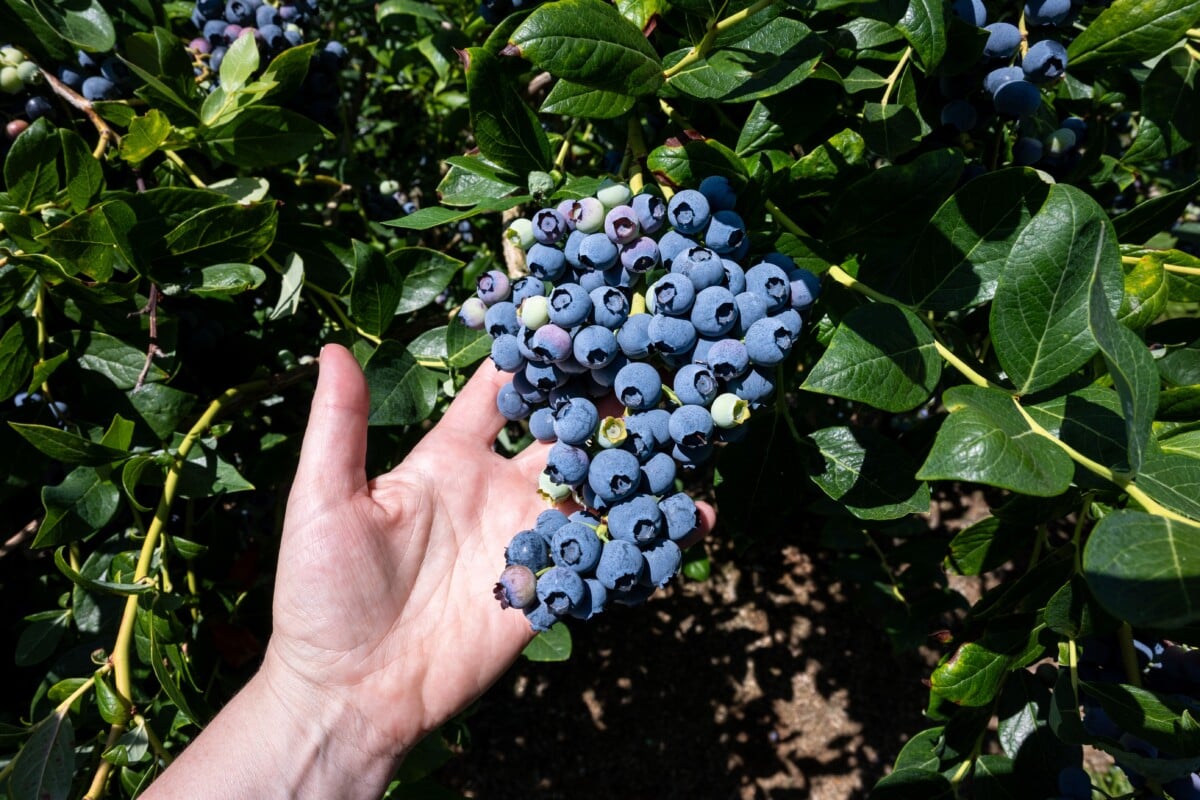
We live in a day and age where one can procure blueberries at the supermarket any time of the year. That doesn’t mean they will taste great or be picked at the peak of perfection. It just means that you can have berries any time you want. Then there are those who know that these sweet summer treats are worth waiting for because nothing beats picking sun-warmed blueberries by the bowlful in our backyards.
Whether you’re already a member of this club or hoping to join when you plant blueberry bushes this year, there is key knowledge about these plants that often gets overlooked, even when we know better.
In the end, this leads to stunted growth and a lackluster harvest, or worse, dead blueberry bushes.
I won’t go into detail about how to plant blueberry bushes, as I’ve written a thorough step-by-step guide here. However, I still recommend you start with this article, as these factors are at the very core of ensuring a summertime filled with sweet, juicy blueberries.
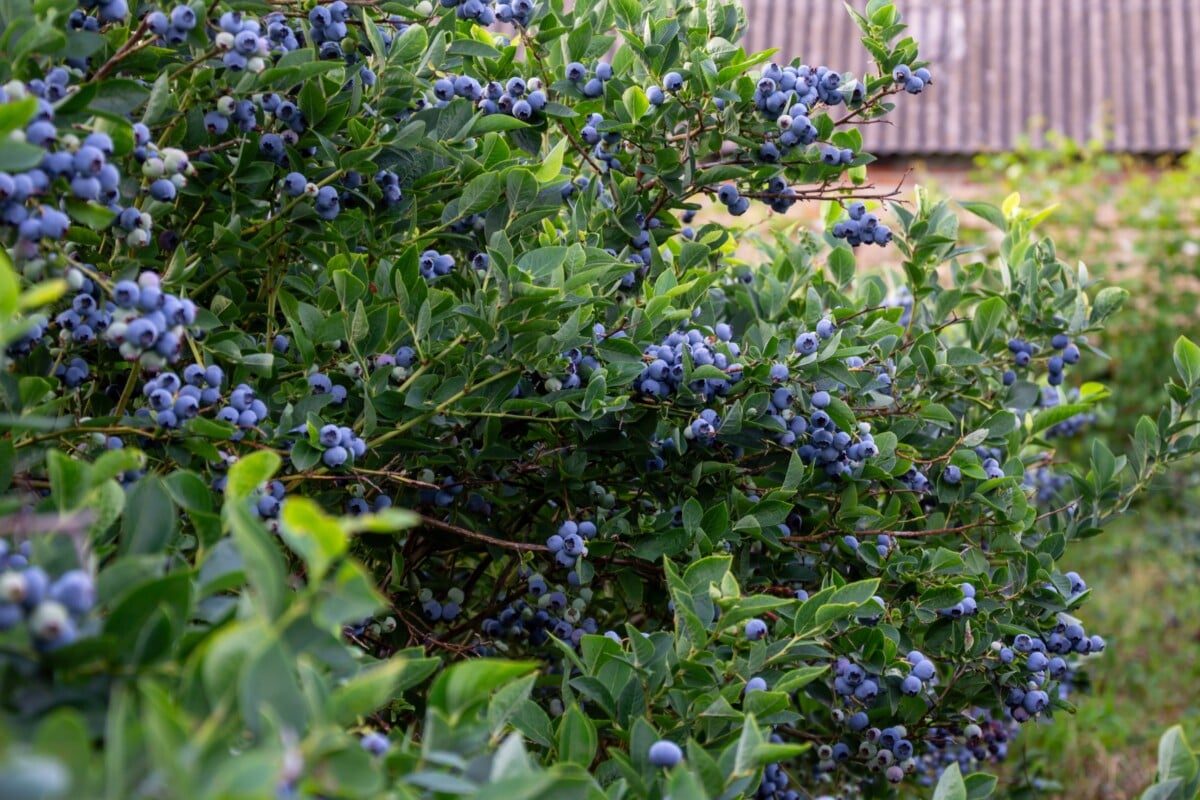
More importantly, though, you’re giving yourself an edge as you get your blueberry bushes started correctly, which means you aren’t left troubleshooting later down the road when they aren’t producing.
Likewise, if you already have established blueberry bushes and find yourself here because they are lacking in, well, actual berries, you’ll probably find the root cause in this article.
For the most part, you can correct these issues and, with a little patience, be back on your way to bountiful harvests each year. Keep in mind, your bushes didn’t get to this state overnight, and getting them to produce again won’t happen that way either.
I think it’s important to acknowledge that although blueberries are not difficult to grow, they are certainly not what I would call a set-it-and-forget-it plant.
If you want a bumper crop of blueberries every summer, then you have to invest time in caring for your plants each year.
1. Get Your Soil Tested

This might be the single most important thing you can do to ensure you get blueberries every year, so we’re going to spend a little extra time with this first one.
Get your soil tested.
Almost everyone knows that blueberries need acidic soil, but even knowing that, I’m surprised at how few people actually get their soil tested before poking a blueberry bush in the ground.
Don’t be that person.
If you were that person, please sit in the back of the class and spend some time reflecting on your actions.
Get your soil tested.
Blueberries need acidic soil. It’s a must. Blueberries have adapted to grow in acidic soil. This acidity plays a huge role in which nutrients the plant can take up through its roots, such as iron. If you plant blueberries in soil that isn’t the correct acidity, they struggle to take up the right nutrients through the roots (you’ll understand why in a bit). The plant develops deficiencies (which are evident in the color of the leaves), and it will fail to thrive and produce berries.
The sweet spot for blueberries is a pH of 4 to 5.5.
Anything above or below that will cause nutrient deficiencies and severely limit plant growth, sometimes even resulting in the death of the plant.
So, get your soil tested.
Something to keep in mind when looking at your soil pH is the difference between each number on that scale. Yes, it really does matter if your soil is off by .5 pH in either direction.
We measure pH on a numeric scale, from 0 to 14. Pure water, which is neutral, lands in the middle at 7. Anything less than 7 is acidic, anything higher is alkaline.

The important thing to keep in mind is how big the change is in pH from one number to the next.
The pH scale is logarithmic rather than linear, which means that each step up the scale isn’t just adding another single value.
Each number represents a multiple of ten. So, when reading a pH measurement, going from 6 to 5, 5 isn’t one more part acidic than six; 5 is 10x more acidic than six. Hopefully, this spells a clearer picture when talking about how important soil pH is for your blueberries and the need to get your soil tested.
It’s easy to do and inexpensive. If you live in the United States, you can reach out to your local extension office for soil testing.
Now, here’s the news that no one likes to hear. To effectively alter the pH of your soil, you need to amend it and then wait a full four to six months before testing again, especially if the goal is to lower the soil pH. If you are planning on planting blueberry bushes, trust me, this step is worth getting right before your plants go in the ground.
Elemental sulfur is the best and fastest way to acidify soil.
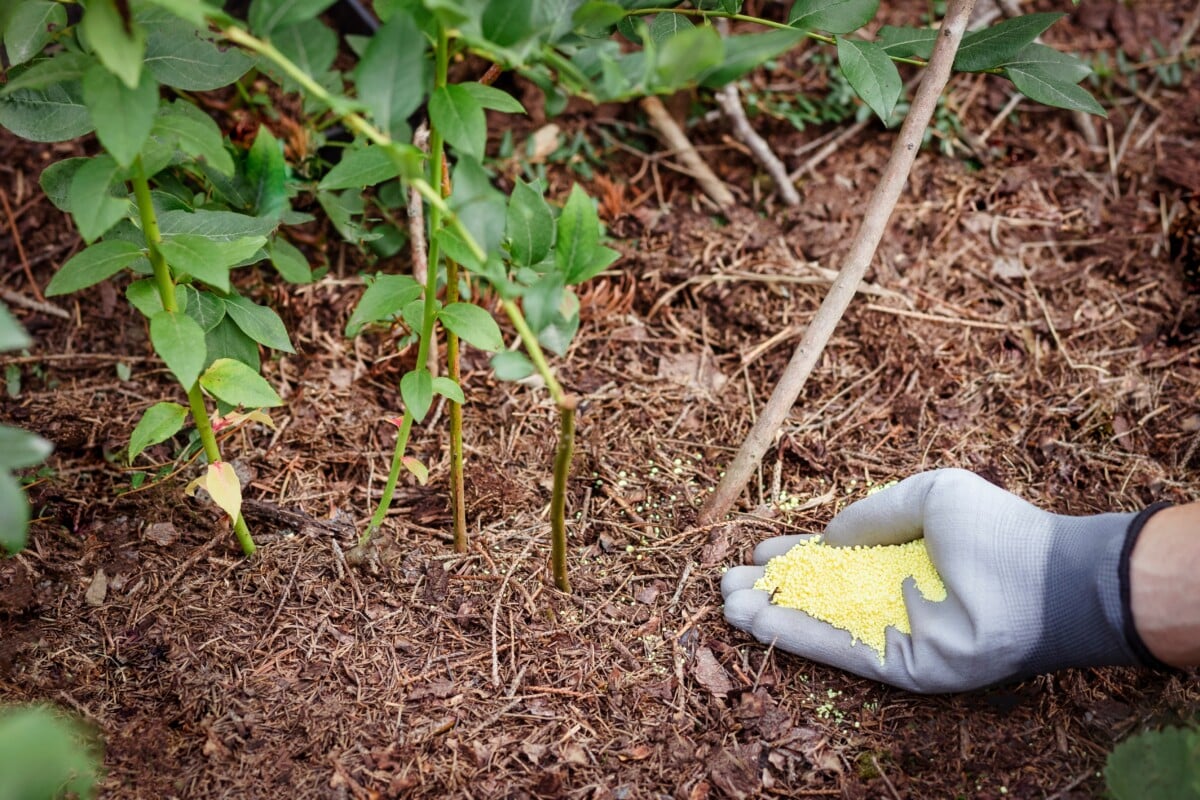
I’m going to say this once – do not use coffee grounds. Look, I know it’s one of those gardening ‘hacks’ that pops up all over the place, but there isn’t enough acid in coffee grounds to have a significant impact on the soil. Stick with actual sulfur.
Once you get your soil tested, you will know the exact pH, which means you can follow the directions on the package of whatever sulfur you choose to buy. Those instructions will tell you how much you need to apply, how deeply, etc. I highly recommend True Organic prilled sulfur, as they have excellent instructions on how much sulfur is needed to lower your soil pH. Once you have added the sulfur, retest your soil in six months.
For soil that is too acidic, you will need to add garden lime.
You need those handy-dandy soil test results to determine your starting point and to add enough lime to reach your desired pH accurately. Again, I really like True Organic Garden Lime mainly for its great, easy-to-figure-out instructions. Just as with the sulfur, you’ll need to work the lime into your soil and then retest.
Neither of these soil amendments will be a quick fix. However, your patience will be rewarded with thriving blueberry bushes that crank out buckets full of berries each summer.
If you had to amend your soil, you would need to get your soil tested every couple of years thereafter. It should be easier to maintain the correct pH by amending each year, but that still means regular soil testing every couple of years. It’s like a preventative checkup at the doctor’s, but for your soil health.
2. Know How Blueberries Grow Below
We’ve established how important soil pH is for successfully growing blueberries. But before we move on, we’re going to hang out here below the ground for a bit. Like most things garden-related, what’s happening in the soil has the most impact on what’s going on above it.
Blueberries only grow well through a buddy system.
Okay? What exactly does that mean, Tracey?
Blueberries were never meant to be grown in our backyard. Unless you are a swamp witch, living in a boggy marsh, the blueberry isn’t really cut out for your garden.
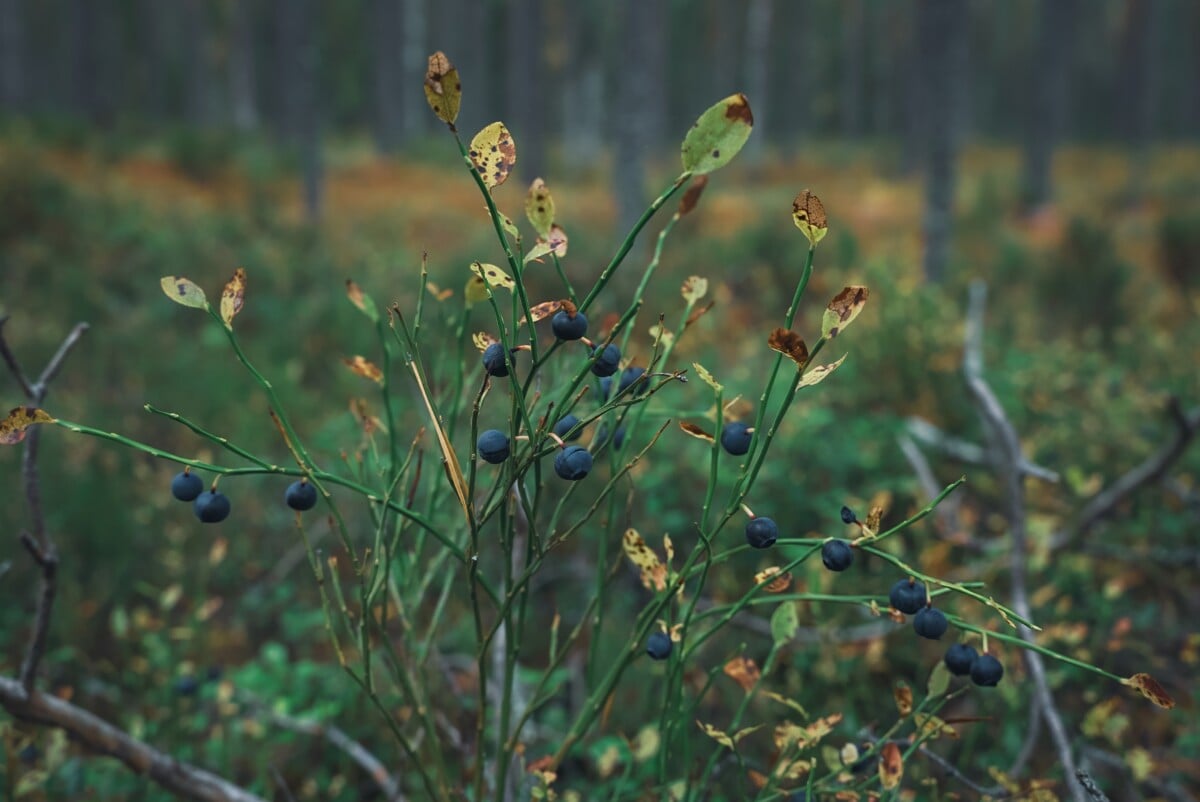
Blueberries evolved to grow in this highly specific environment, and then we humans discovered agriculture and decided we wanted to grow them everywhere. Except that blueberry bushes aren’t cut out to grow everywhere. They lack a key component to grow well in our unmarsh-like backyards.
Blueberry bushes never evolved root hairs.
Root hairs allow plants, like tomatoes, to create vast and deep underground networks, anchoring them in place and allowing the plants to take up nutrients and water buried deeply in the soil.
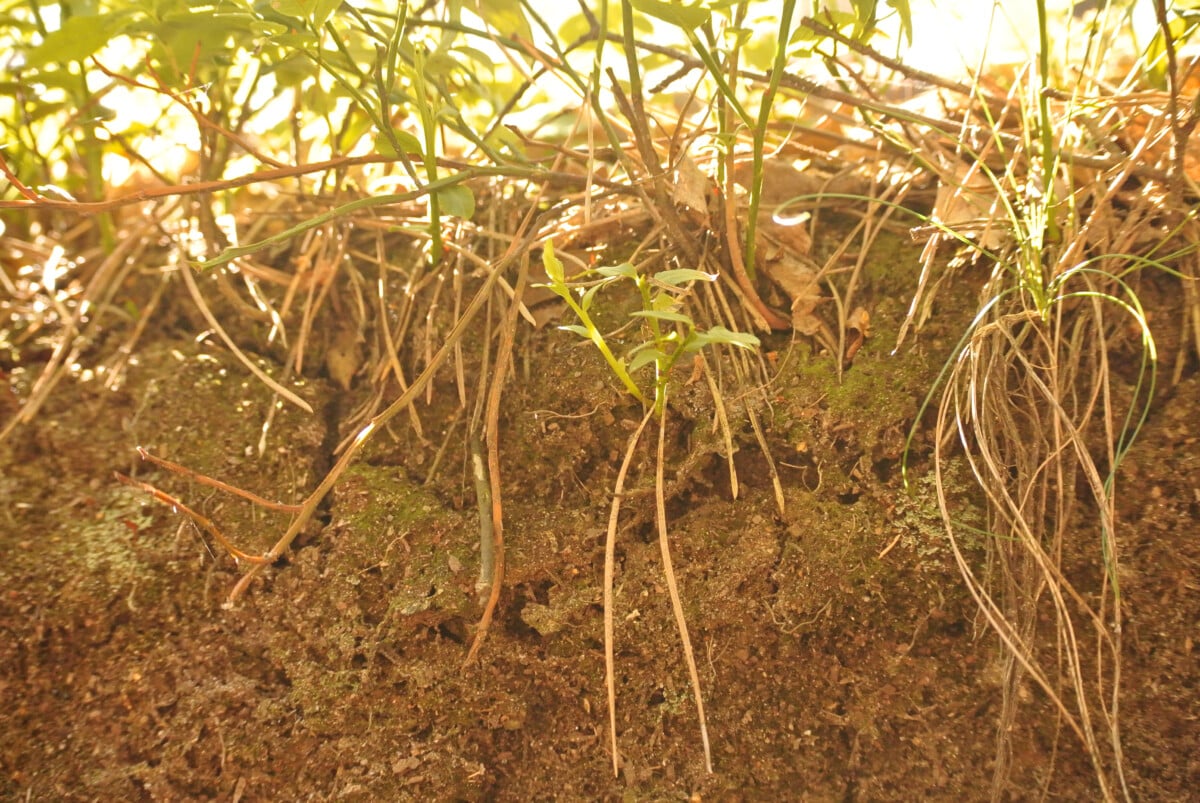
Blueberries don’t have those. They have fibrous root systems that grow close to the soil surface, creating a wide and dense but shallow network, usually no bigger than 3’ around the base of the plant.
That means blueberries are more susceptible to drought and heat stress because their roots lie much closer to the surface.
When we plant blueberry bushes, we’re actually growing two things in the soil: the blueberry bush and its hidden assistant, which grows from within the plant’s roots – mycorrhizal fungi.
Unlike the mycorrhiza you can buy online and in stores for your plants, this is a mycorrhizal fungi specific to blueberry plants. These mycorrhizae work in tandem with the plant, absorbing water and nutrients, acting like a second, more efficient root system, and the plant passes on sugars (from photosynthesis) to the fungi. Everyone is happy.
We need to cater to these microscopic fungi because they are the ones doing the heavy lifting on behalf of the plant.
Guess who loves highly acidic soil? Yup, our little fungi friends. Guess who likes it slightly swampy and moist? Again, our little fungi friends. But they also don’t like sitting in stagnant still water.
This is why the best soil composition for growing blueberries is both loamy and sandy and consistently moist. (Think slow drip irrigation.) The sand allows for good drainage. It’s even better if you grow your plants on top of a mound.
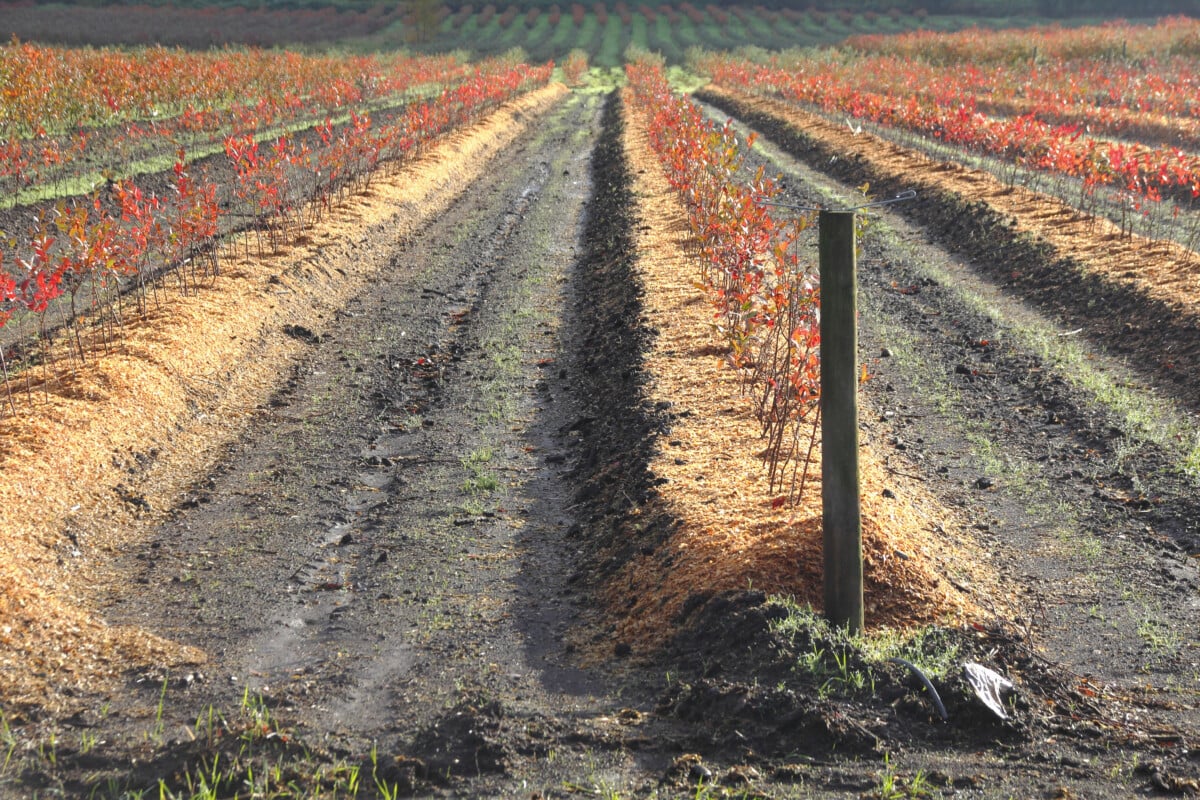
The shallow root systems are also why it’s difficult to grow blueberry bushes in pots and keep them alive for long. Without constant watering, there isn’t enough soil to keep the roots moist and happy. Potted blueberries are much more susceptible to drying out and heat stress.
Mulching beneath your blueberries slows evaporation and traps more water in the soil, keeping the fungi happy. It also protects the shallow roots from extreme temperatures, both hot and cold, during the summer and winter months.
Because blueberries like consistent, moist soil, if you can, I highly recommend a drip irrigation setup. Ideally, you should choose something that provides very slow, but constant moisture. I use Rain Bird for all of my irrigation needs in my garden, and I highly recommend them. With their hose timers, you can even set your irrigation system up so everything is automatic.
As far as nutrients go, blueberries need to be fertilized correctly twice at the beginning of the year. You can learn when and what to feed blueberries here.
3. Blueberries Need Full-sun
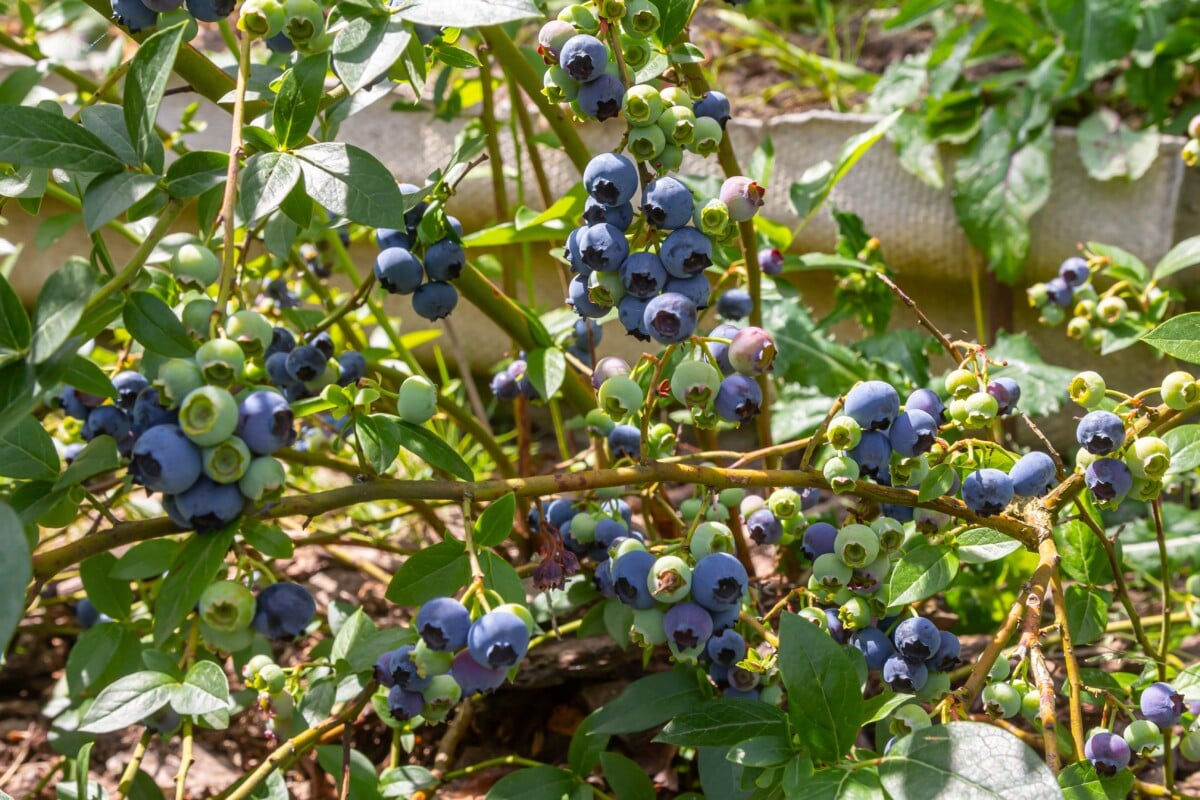
I’m going to keep this section short and sweet because your plants either have it or they don’t.
Blueberries are a full-sun plant. Especially if you actually want them to grow blueberries.
Your plant needs between 6-8 hours of full sun every day.
Keep in mind, if you’ve had your blueberries for a long time, nearby shrubs and trees may have grown to a height where they are now shading them out. You may want to move your plants. If they are older plants that can be difficult, and it may be easiest to start with new plants in a sunnier location.
Look, I get it. I, too, sometimes get a little carried away on the hope-ium. I read a plant care label and, knowing full well that spot doesn’t meet the plant’s needs, I put it in the ground anyway, foolishly hoping that just for me, this plant will ignore millennia of evolution and grow with less light. It never works.
4. Prune to Get More Fruit
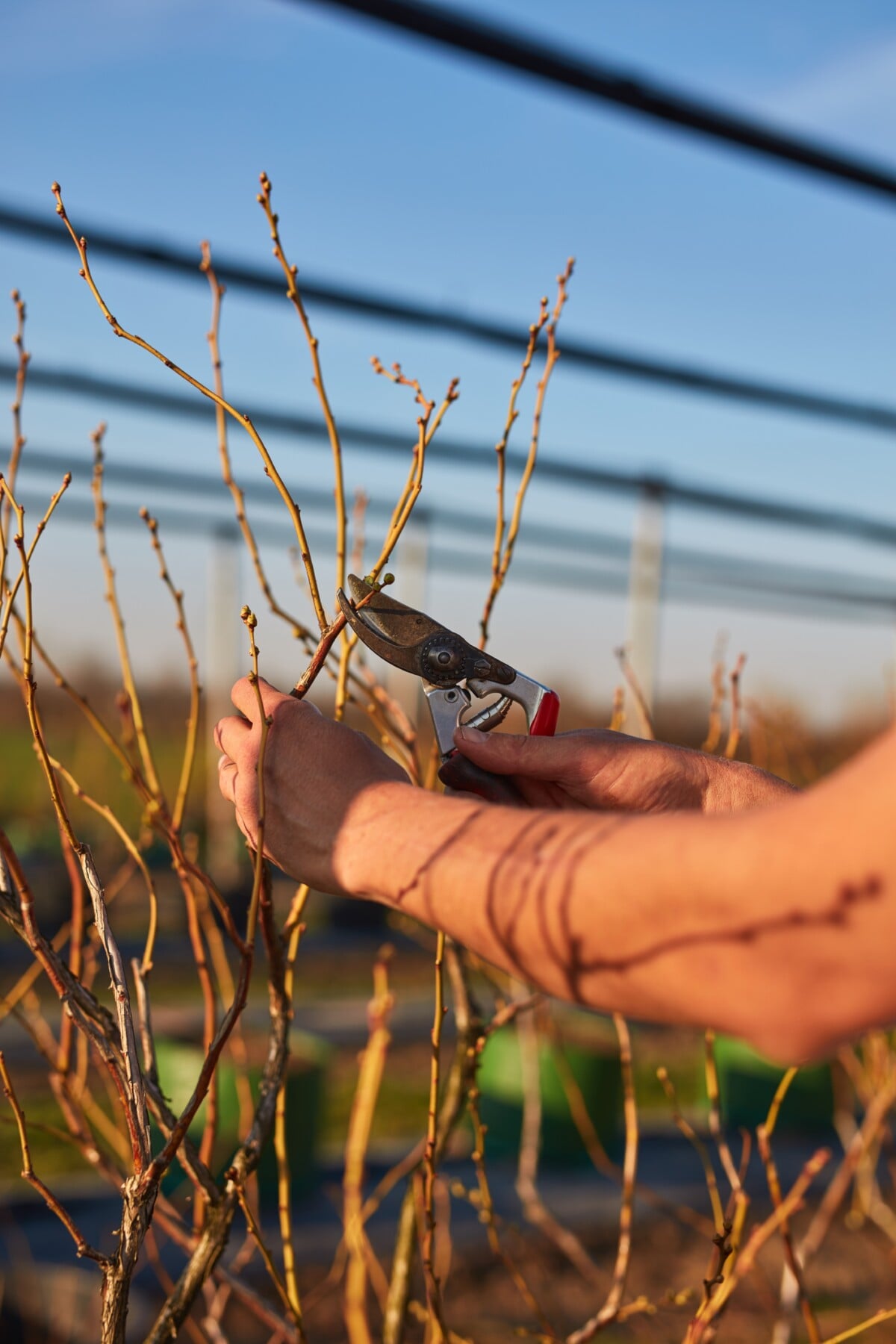
Pruning is a bit like the acidic soil. Most gardeners know they need to prune their blueberries; they just don’t know when or how. So, they don’t. In the end, the plants become overgrown and produce fewer berries each year.
Pruning isn’t hard. I promise.
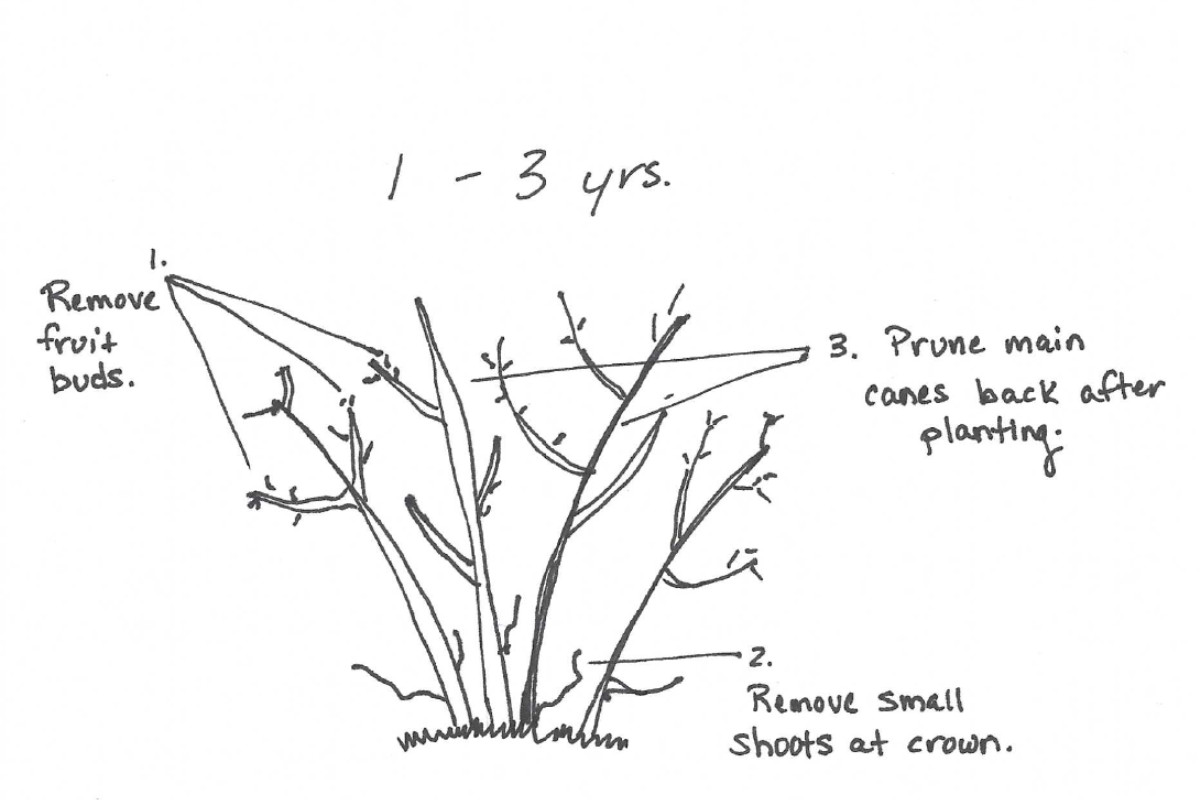
You’ll need a decent pair of sharp and clean hand pruners. (Like the Felco F2s. If you know, you know.) Blueberries are pruned annually. If your bushes are newer, you’ll have to prune a little differently for the first few years. Always prune blueberries while they are dormant, so in late winter or early spring, before the plant begins growing.
I’ve written detailed pruning instructions here, complete with hand-drawn diagrams and everything!
5. Protect Your Investment
There’s nothing more infuriating than taking well over a year to get your soil right, ensuring your plants get the right amount of water, fertilizer, and sun, and pruning them for optimum berry production, only to have a bunch of birds come along and eat them.

To add insult to injury, those same birds will then repeatedly fly over your parked car, leaving little purple splotches all over it as evidence of their crime.
Let me tell you, my friend, this is an indignity you only suffer once.
Along with birds, if you live in a rural area, there are other critters out there who will help themselves to your bounty—deer, rabbits, raccoons, chipmunks, squirrels, and bears.
There isn’t a whole lot out there that will protect your berries from bears. If you live in an area where bears are prevalent, there are things you can do that will deter them from hanging out at your place.
For the rest of the critters, especially birds, there are some inexpensive ways you can shield your berries from hungry animals. You can check out all the different methods here. (A couple may even bring back summertime memories as a kid.)

In my own experience, I dislike using the wide-mesh bird netting.
I’ve had to rescue too many entangled birds and once even a garter snake. Not fun. Especially for the snake who had no interest in my berries, but was merely sunning himself in the mulch.
I much prefer the lightweight nylon bags that cover the entire bush. It means having to time when I put them on. I don’t want to prevent pollination, and I have to carefully remove the bag each time I want to pick berries. In the end, I’ve found it’s the solution that works the best with the fewest number of headaches.
We haven’t covered every aspect of blueberry growth and care, but you have a better understanding of what’s important. You’ve got enough information to grow plenty of tasty summertime blueberries. In which case, you’ll probably need to know how to freeze them so they don’t stick together, and give my incredible blueberry basil mead recipe a try.
Read Next:
Get Garden Notes From Tracey, Right to Your Inbox
Pull up a chair on the front porch. Join 54,000+ gardeners who get Tracey\'s friendly notes, seasonal to-dos, and hands-on tutorials three times a week.