

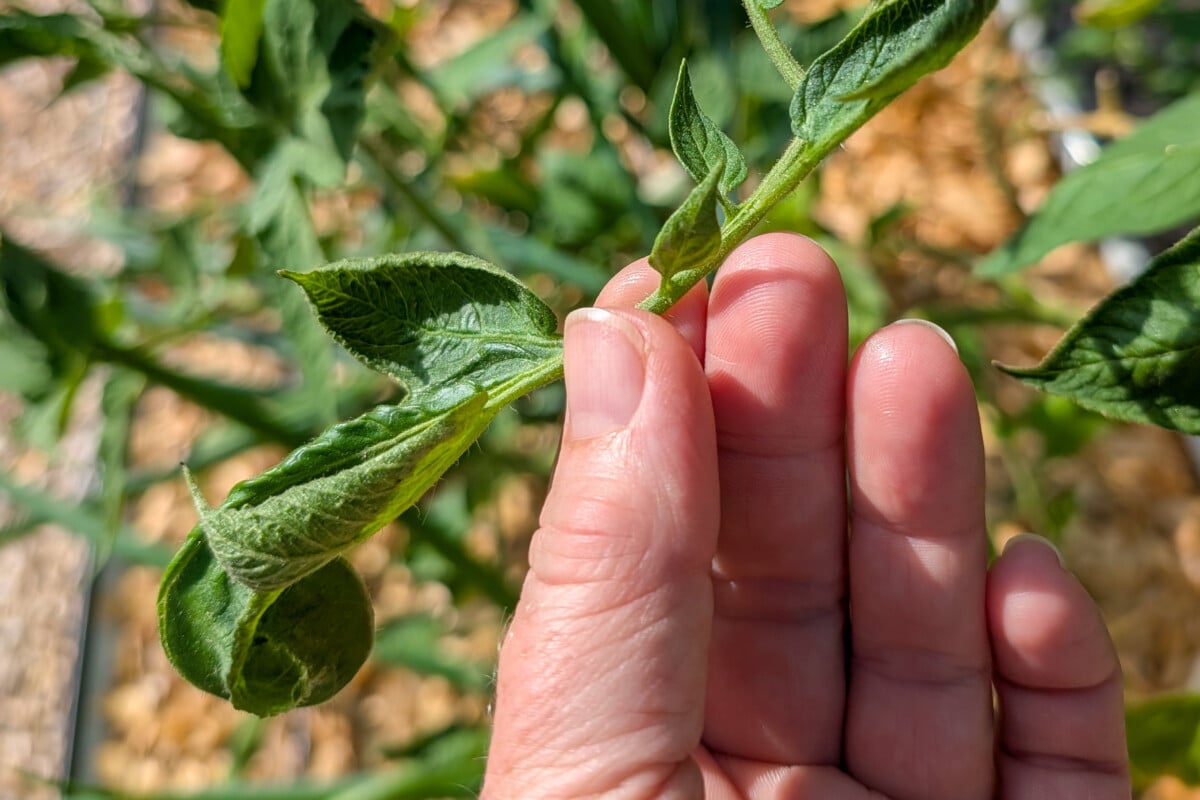
Excuse me! Yeah, you, standing next to the tomatoes. Please, put down the hose and step away from the plant. (At least for now, anyway. You might do more harm than good.) Grabbing the hose or the watering can seems to be the most common response when met with a plant with curling leaves.
But if we’re talking about tomatoes, there are numerous reasons why their leaves curl, and very few are serious.
Knowing why your tomato plant’s leaves are curling up will also be the key to knowing what to do to fix it. Let’s take a look at everyone’s favorite fussy garden diva, the tomato, and see what’s got its leaves all in a flutter.
Why Are My Tomato Plants’ Leaves Curling?
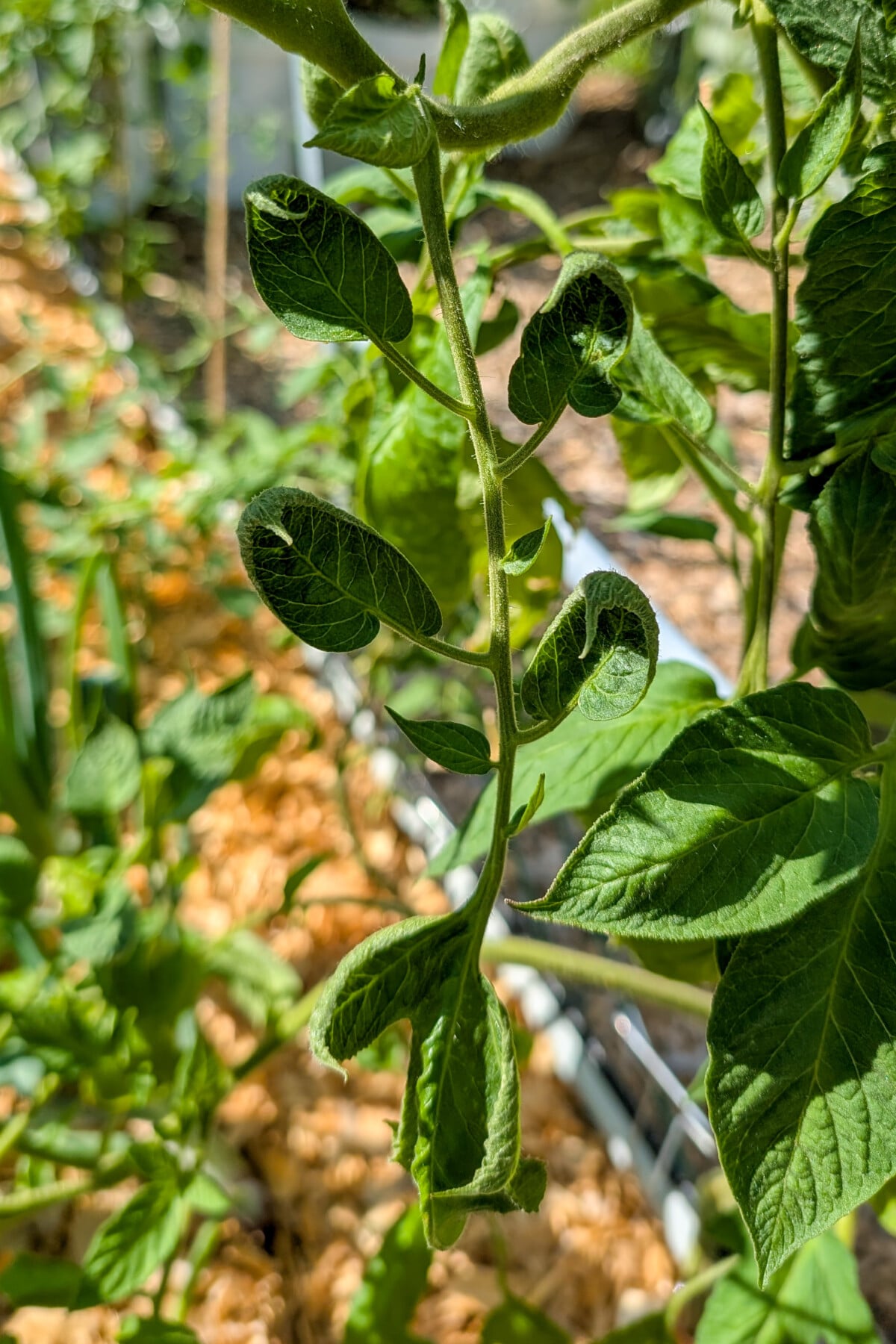
Well, it is a tomato. The most reasonable answer is that there simply isn’t enough drama in the garden at the moment, and it’s Tuesday, so your tomatoes decided they needed to throw a fit.
For as much as we all love to grow them, tomatoes tend to be the neediest thing we’ve got growing out in our patch of dirt. I know that’s always my experience. If something is being eaten by a pest or damaged by a disease, or needs to be fertilized again or is pouting over some perceived slight in regards to care, it’s my tomatoes.
Naturally, when you see curled leaves, the first thought is that something has gone terribly wrong and needs to be fixed right away.
It’s important to keep a few things in mind when diagnosing tomato leaf curl.
- Look at the leaves closely. In which direction are the leaves curling, up or down?
- Are the leaves discolored?
- If the leaves are green, are they a different shade of green, darker or lighter?
- Are the leaves also distorted or oddly shaped?
- How does the rest of the plant look? Is the curling limited to one area? Only where there is new growth? The whole plant?
For nearly all of these, it’s also important to keep in mind what you’ve been doing to or near your tomato plant recently. Doing so will offer further clues.
All of these will help you figure out what is causing the leaves to curl and whether or not you need to do anything. Because tomatoes are such sensitive plants, there are a number of things that can cause them to have curled leaves that aren’t necessarily alarming. Most of these issues need no action on your part beyond a bit of patience and a watchful eye. Let’s start with those first.
Physiological Leaf Curl
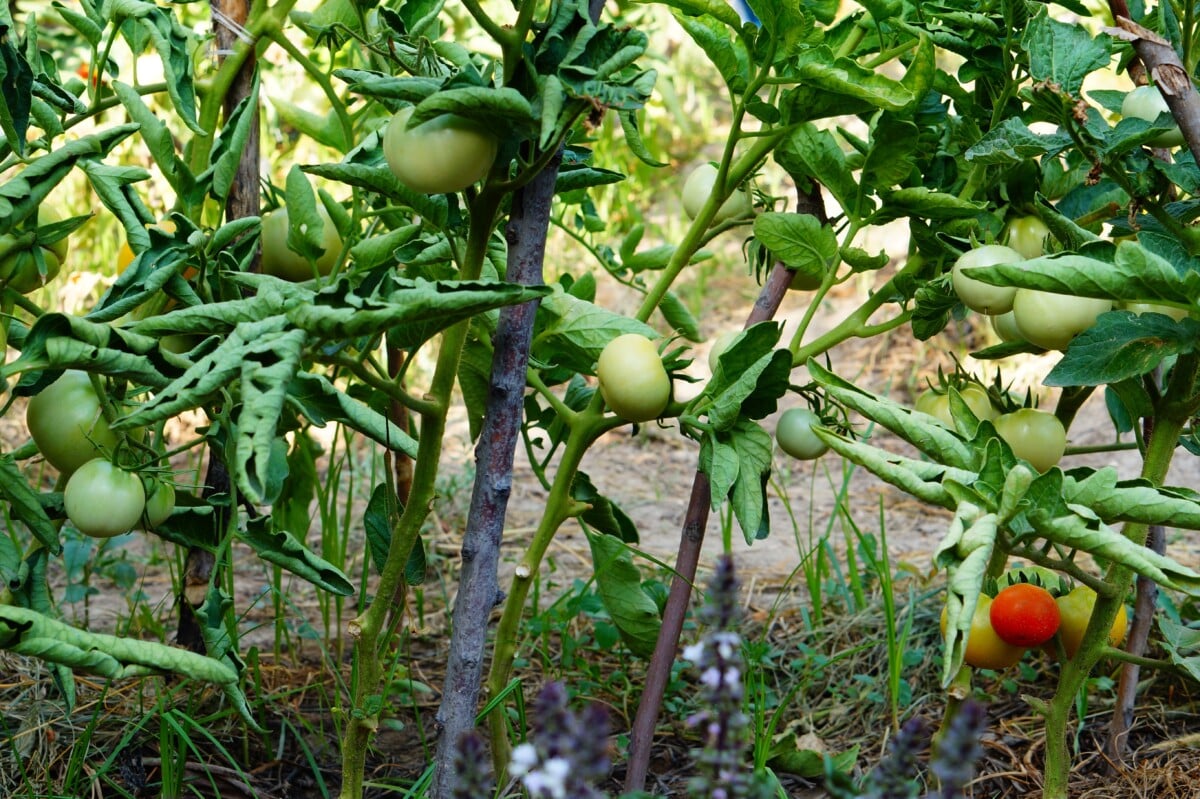
Physiological leaf curl is the most common reason for your tomato to roll up its leaves. It is caused by a surprising number of factors, all of which stem from your tomato plant giving Beyonce a run for her money in the diva department.
Physiological leaf curl is a defense mechanism that tomato plants use to prevent moisture loss through the leaves. It’s a way for the plant to conserve energy. It’s often the first line of defense when your tomato feels a “disturbance in the force.”
Because of this, most of the time it will show up on the lower, older leaves at the bottom of the plant first. The leaves will roll upwards, cupping themselves. They rarely change color.
Unless there is a serious issue, most causes of physiological leaf curl do no lasting damage. The plant continues to grow normally and produce fruit, and usually, you only need to adjust one or two minor things to fix the issue.
If you grow more than one variety of tomato, you may even notice that some varieties tend to be more sensitive to leaf curl than others. I’m looking at you, German Pinks. (I still love growing them, though.)
Transplant shock
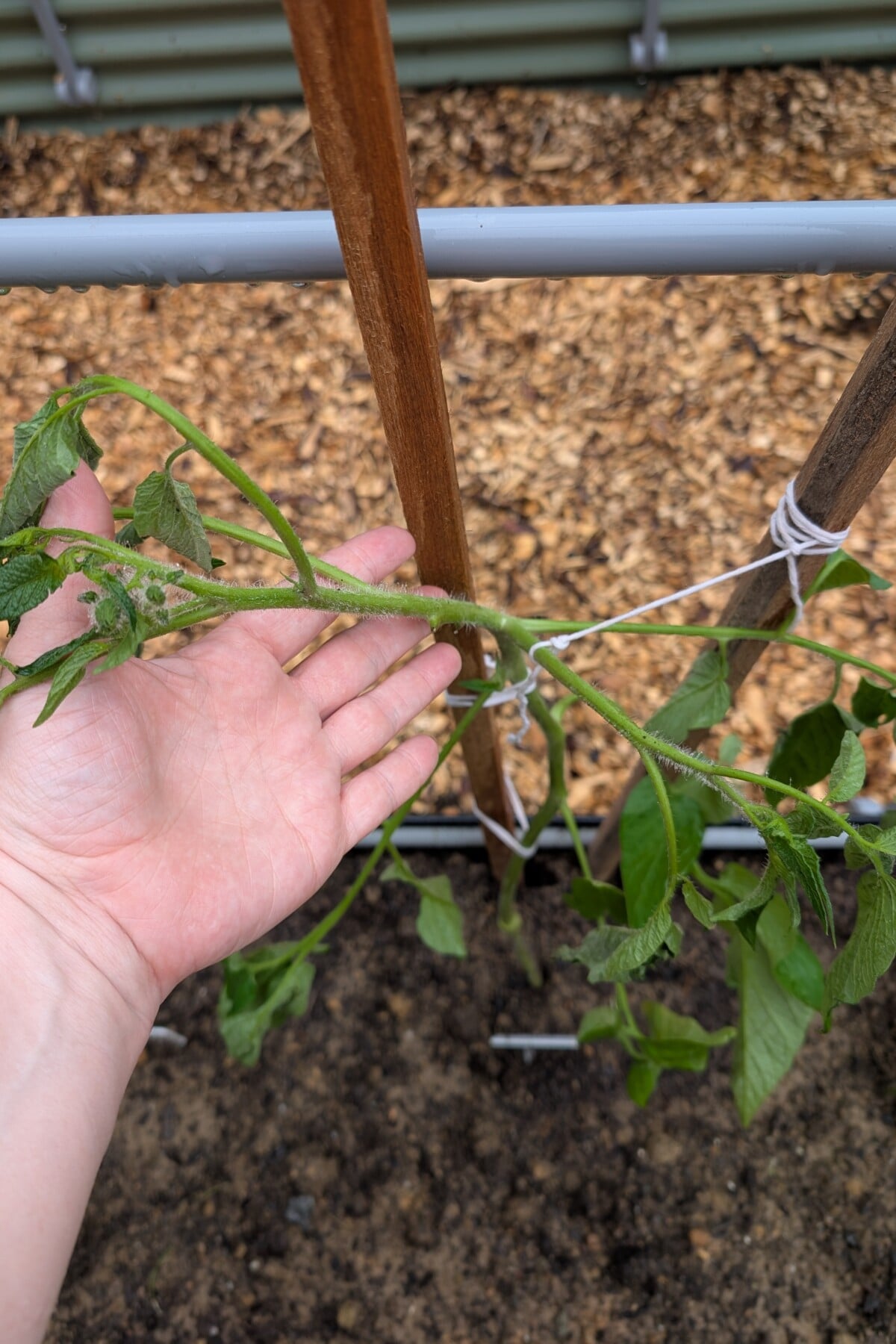
This is probably the easiest to diagnose, as it happens when you plant your tomato seedlings out in the garden in the spring. For the first few days, the leaves may curl up, and your tomato may look a little worse for wear. Ensure that the soil remains moist while the plant acclimates to being in the ground. Once it begins to put down roots, it will bounce back.
Disturbing the Roots
We all know we need to encourage our tomato plants to push deep roots down into the soil, but there is also an extensive network of roots at the surface level of the soil as well. These surface roots also take up nutrients and water, but also help anchor the plant in place.
If you are weeding a little aggressively at the base of your tomatoes, you can damage some of the surface roots. Even something as simple as planting lettuce at the base of your tomatoes, a common trick to extend the lettuce-growing season, can upset your tomatoes when it’s time to pull up the lettuce plants.
Much like transplant shock, nothing needs to be done, and your tomato plant will recover in a matter of days.
Pruning too hard
Just like the roots below the soil, if you prune your tomato stems back too hard, it will go into shock and curl up its leaves while it heals. It’s good practice to get into the habit of pruning a little bit here and there each time you check your tomatoes over or pick. Pruning this way keeps your plant neat and tidy throughout the season and won’t cause the plant distress. In other words, give your tomatoes a loving pinch every time you see them.
Heat Stress & Drought
Since the point of curled tomato leaves is to slow down transpiration, it makes sense that a tomato plant going through a heat wave or a seasonal drought will curl up its leaves. This makes it easier for the plant to hold onto the water it’s able to take in from the soil.
Depending on where your tomatoes are planted and how much direct afternoon sun they get, you may even notice curled leaves during the hottest part of the day. I often see this in my own garden during the dog days of summer. The leaves always unfurl again once the sun goes down.
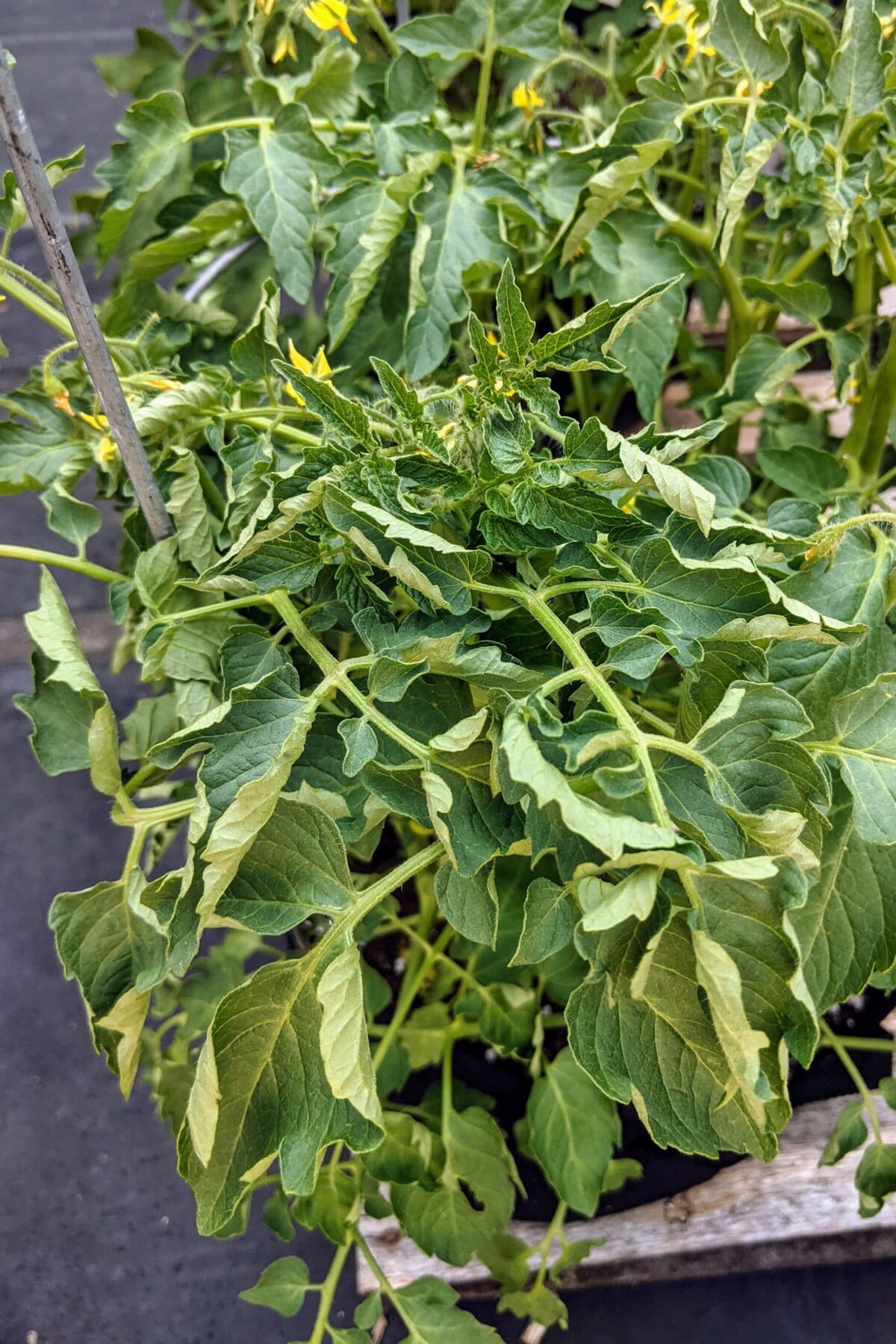
Mulching is such an important measure for growing tomatoes, and keeps the soil cool and moist. Mulch can be the difference between happy, healthy tomatoes during a heat wave and dropped blossoms and wilting plants. It’s great for keeping those summer water bills in check. Don’t garden without it!
Inconsistent watering and rapid weather changes
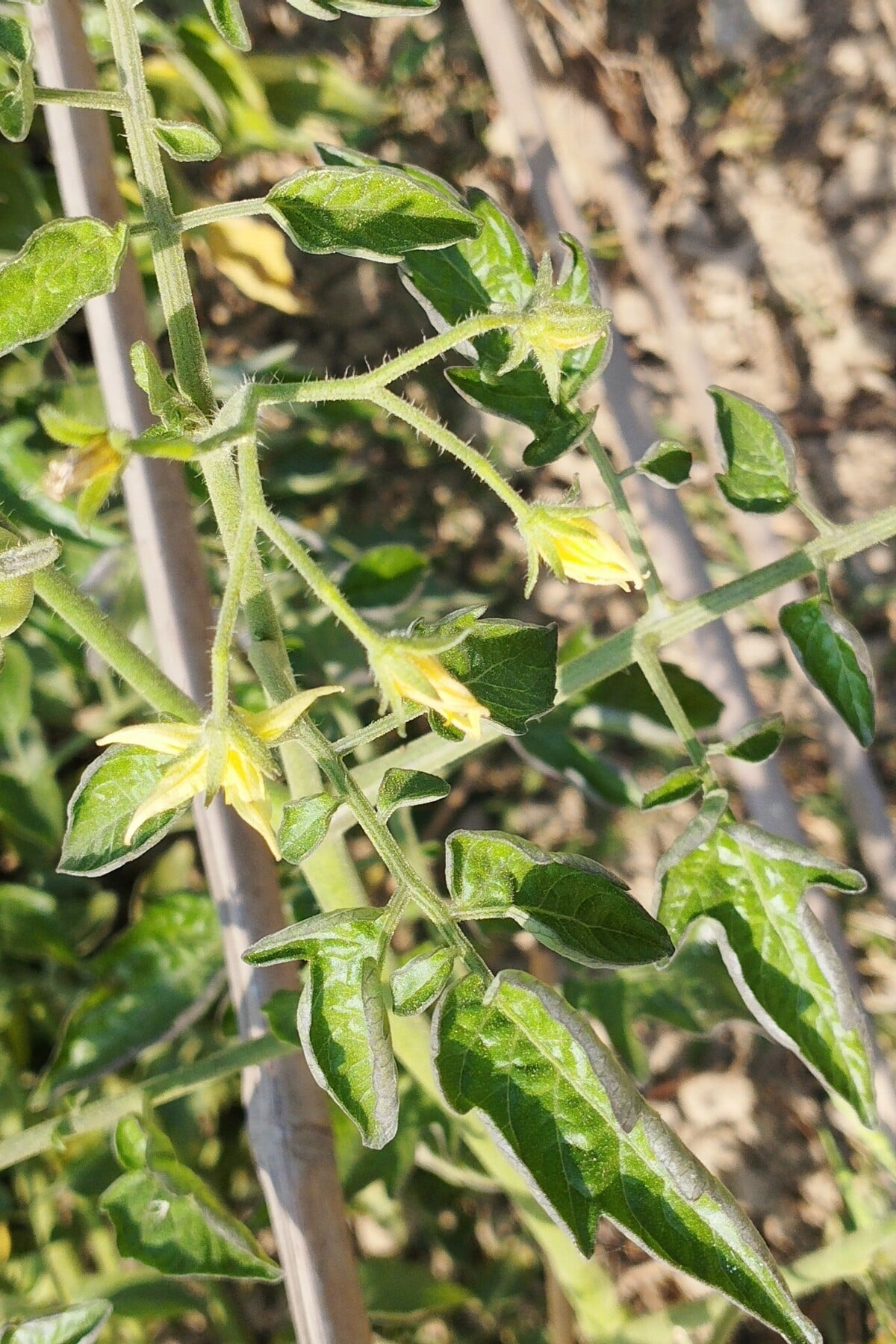
Both of these can cause curled tomato leaves, and both are easy to prevent. First and foremost, have you mulched your tomatoes yet? Mulch is the easiest tool at your disposal to prevent either of these issues from affecting your tomato plants. (Can you tell I’m a big fan of mulching your garden?)
We all know the advice about watering tomatoes deeply to encourage them to push their roots deep underground. But you also want to keep the soil they are growing in, whether it’s at the surface or below, consistently moist, and mulch does that. I’ve written a very helpful piece about watering tomatoes that takes into account how you are growing them: in the ground, in raised beds, in containers. If you want to remove the mystery from tomato watering, give it a read here.
Curled leaves can also be caused by quick weather changes, more often than not, a dry period followed by heavy rain. Again, though, if you are mulching and watering consistently, this one won’t happen often.
Next, we’ll move on to other causes of curled tomato leaves.
Too Much Nitrogen
At the beginning of the season, when our plants are small, we want to encourage lush foliage growth. But if you go too heavy on the nitrogen, the plants will put out a quick flush of weaker growth. The roots don’t have the right nutrients to grow at the same pace as the stems and leaves, so you end up with foliage that isn’t getting enough water and nutrients right away.
Along with curling up, excess nitrogen causes leaves to look dark green and have a thick, leathery appearance.
When it comes to fertilizing, slow and steady is the way to go. You want the entire plant to grow together. If you’re curious what I use to feed my tomatoes from seed to salad bowl, check this out.
Herbicide Overspray
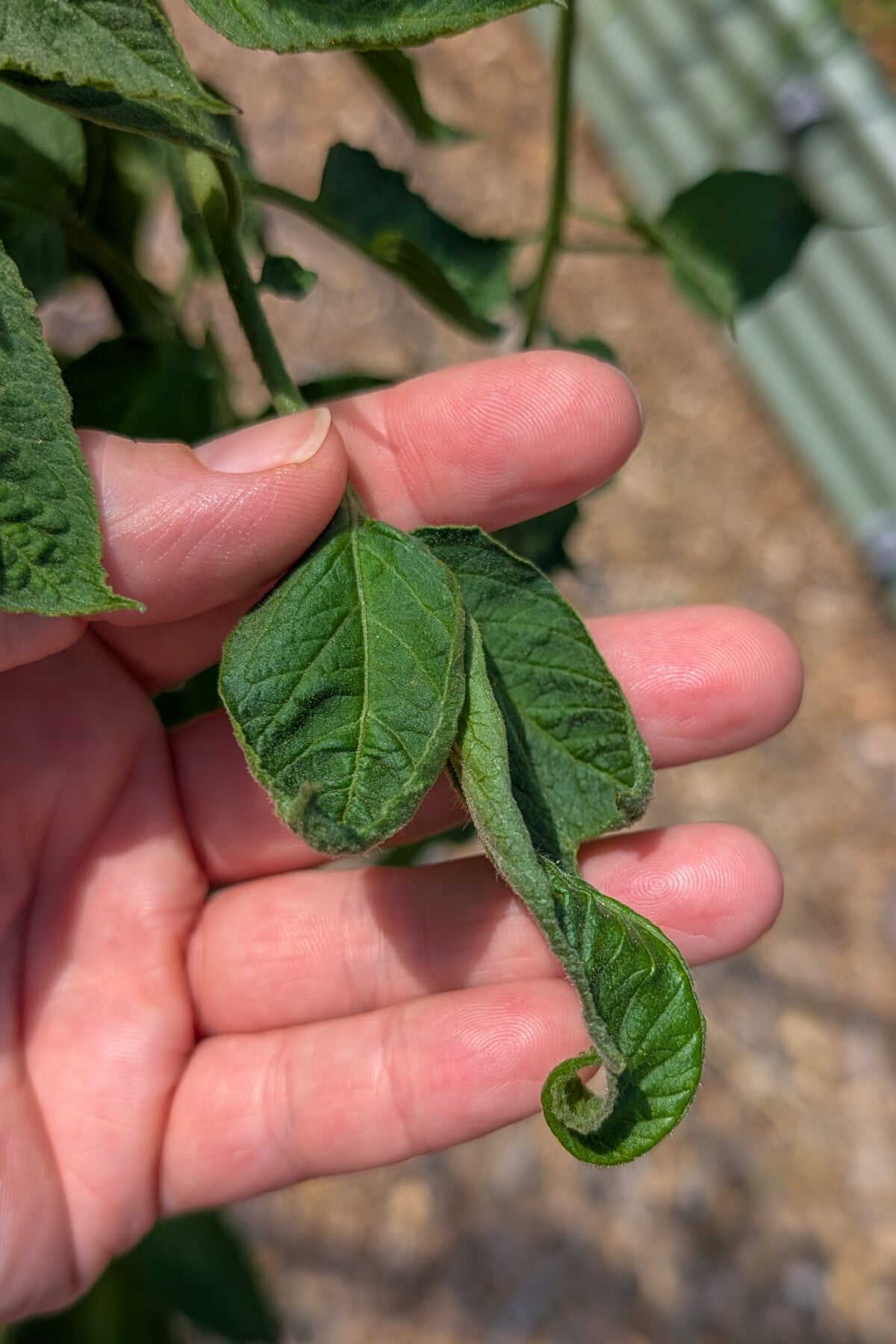
Quite often, this one can leave gardeners scratching their heads because it looks a bit like physiological leaf roll. But on closer inspection, you’ll see that there’s more than just curled leaves going on. New growth is often oddly shaped, stems end up twisted, and you can end up with dropped blossoms. The curled leaves are misshapen.
Obviously, this one is easy to diagnose, as you’ve either sprayed with an herbicide near your tomatoes or you haven’t. Tomatoes are very sensitive to herbicide drift, so if your garden is near a neighbor’s fence, their spraying can affect your tomatoes.
All is not lost if it is herbicide damage; trim away the wonky growth and keep an eye on the plant. If it’s not too severe, the tomato should bounce back. However, if the plant continues to decline, you’ll need to pull it up and dispose of it and consider it a lesson learned about spraying anything near your garden.
Tomato Yellow Leaf Curl Virus
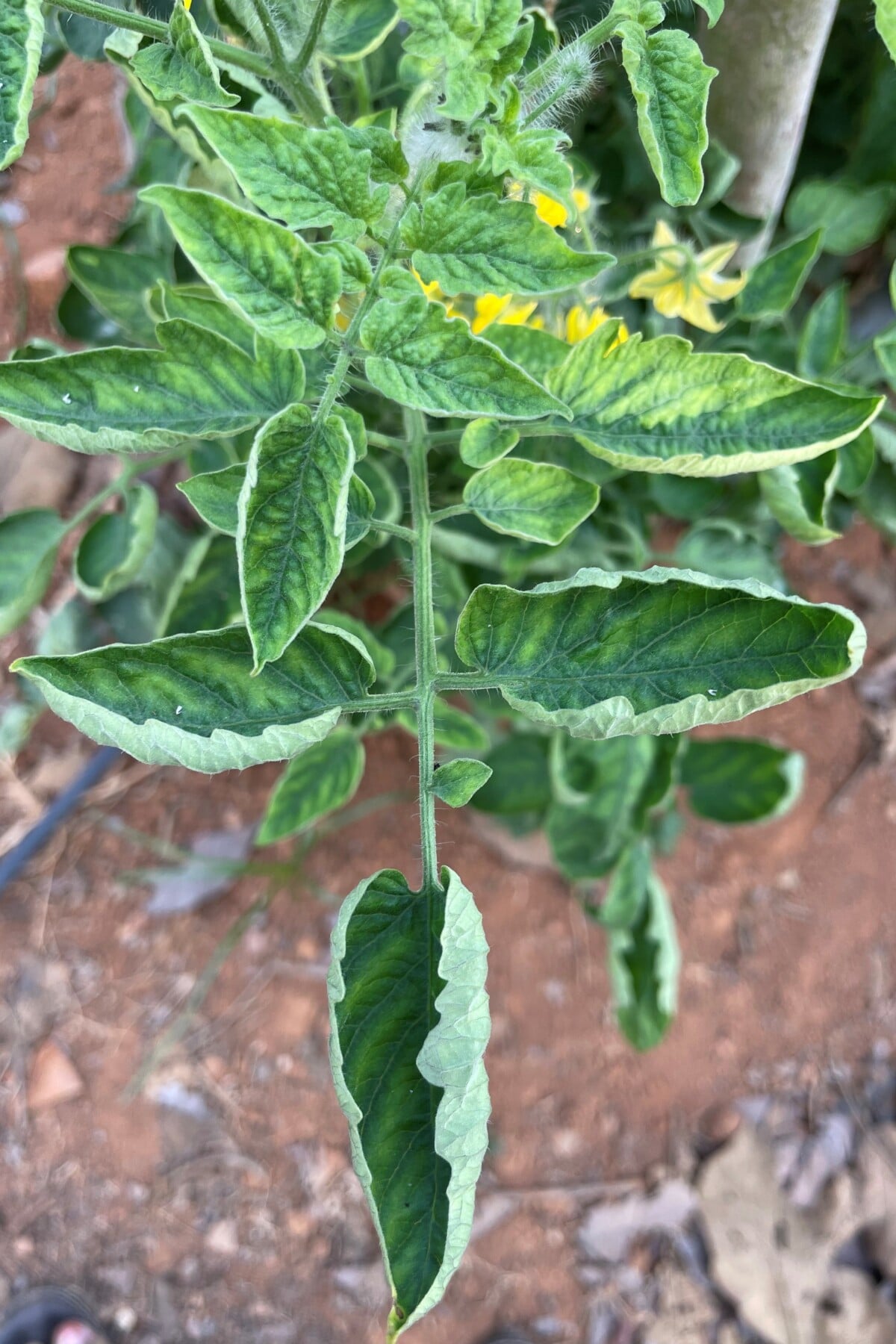
Finally, we’re going to look at tomato yellow leaf curl virus (TYLCV). This is the one that strikes fear into every gardener’s heart when they see a curled tomato leaf. It’s also one of the most misdiagnosed reasons for curly tomato leaves.
So, before we panic and start yanking up plants with abandon, let’s take a look at this virus.
Thankfully, TYLCV isn’t a prevalent virus here in the United States, but as it is so hard to get rid of and can be devastating to local farms, it’s important to keep an eye out for it.
Tomato yellow leaf curl virus is a virus carried by adult white flies, which makes it especially troublesome for commercial greenhouse growers, as white flies are always a problem in that environment.
TYLCV is a predominantly tropical and subtropical viral disease. But it’s important to note that it can exist in temperate climates like ours.
Key differences to look for in determining if your tomato plant is affected by TYLCV are the overall size and health of the plant. Tomato plants infected by the disease are usually short and bushy because their growth has been stunted. You’ll also notice a drop off in fruit and blossoms falling off. Or, if the plant is infected early enough, it may not produce fruit at all.
While many physiological causes of leaf curl show up at the base among older leaves or in specific spots, leaf curl caused by TYLCV occurs over the entire plant. The outer edges of the leaves are also yellowish and splotched.
If you suspect that your tomato plant has been infected by the tomato yellow leaf curl virus, remove the plant from your garden right away. Don’t compost it. It’s also a good idea to reach out to your nearest county extension office, as they may have guidance on how to dispose of it or may ask for samples of the plant to correctly ID the virus. (This may be especially helpful if you live in an area where commercial farming takes place.)
Like with so many garden issues, prevention is the best cure.
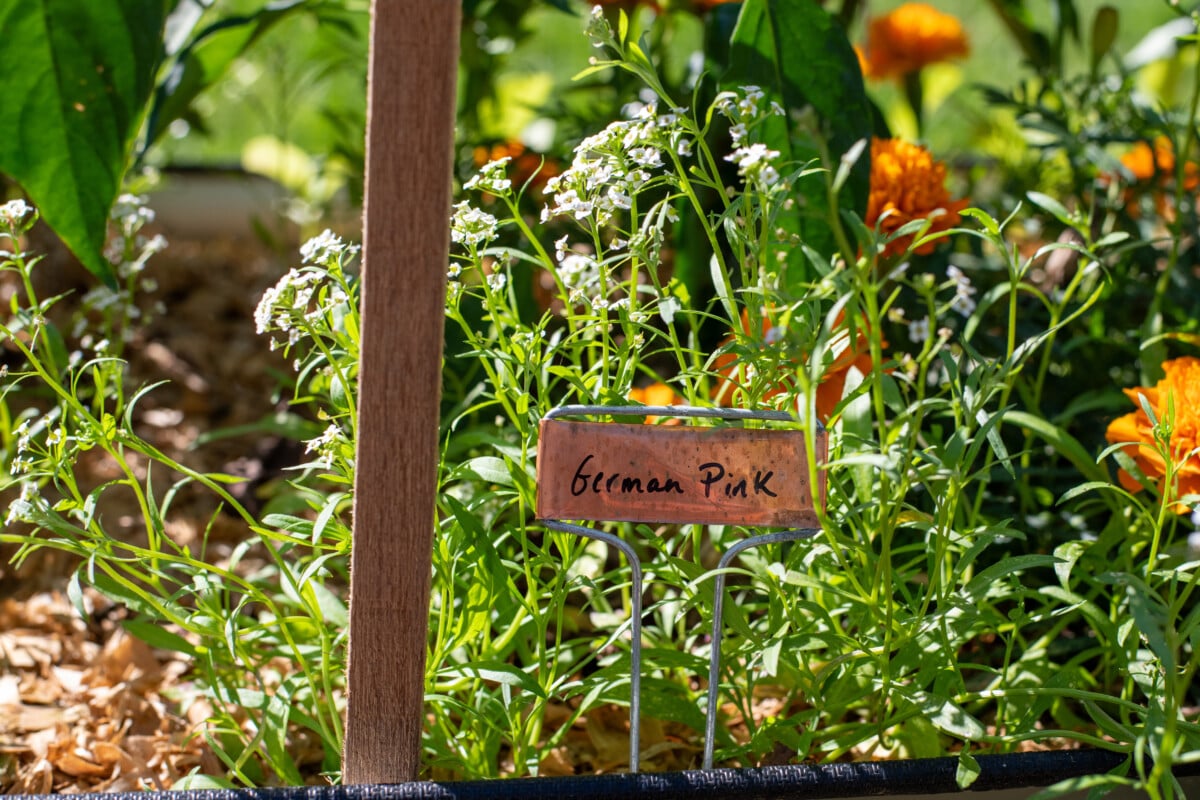
One of the smartest things you can do to protect your tomatoes is to plant sweet alyssum throughout your garden. This humble little ground cover produces tons of tiny nectar-filled flowers that attract hoverflies like it’s their job. Hoverfly larvae feed voraciously on whitefly, as well as aphids and thrips. This is one tiny insect army you want in your garden. You can read more about the benefits of planting sweet alyssum with your tomatoes here.
And there you have it. Curled tomato leaves can feel like a big deal if they catch you by surprise, but rarely are they more than a temporary condition. With a little vigilance and preventative tomato care, your tomatoes will find other ways to remind you what garden divas they are, rather than curling up their leaves.
Get the famous Rural Sprout newsletter delivered to your inbox.
Join the 50,000+ gardeners who get timely gardening tutorials, tips and tasks delivered direct to their inbox.