

One of the things I’m becoming more aware of about gardening is how much it is a continuum. Like a talent show in which contestants follow one another – and sometimes overlap – to the thrill and entertainment of the audience.
Take August, for example.
Some plants are in their prime (hello, black-eyed Susans) while others are just preparing their performance backstage (Japanese anemones ready to burst into bloom). Others are exiting the stage with a bow.

It’s these latter plants, going to seed in August, that I’ve chosen as the stars to talk about now. Before they take a much-needed retirement, I want to encourage our readers to collect some seeds.
There’s no better feeling than growing a garden from cuttings we took (you can see what cuttings to take in August here) and seeds we saved ourselves.
And if you think you have enough seeds, may I remind you of the joys of swapping with others for new varieties, colors and cultivars. Just look for your nearest seed library and start saving seeds and money.
Here are the ornamental plant seeds that we can save in August:
1. Foxgloves (Digitalis)
Back in the spring, I helped an acquaintance brainstorm ideas for plants she could have in her backyard that wouldn’t trigger her allergies. (Let me know if you’re interested in this topic too.)

She loves gardening, but what she loves even more is not being a congested mess for weeks at a time. So, some perennials were out of the question due to how much pollen they release.
In the end, we settled on a combination of plants that produce bell-shaped flowers facing downwards. While they still have pollen for our pollinator friends, it is more contained and not so easily spread in the wind. And foxgloves were at the top of the list.

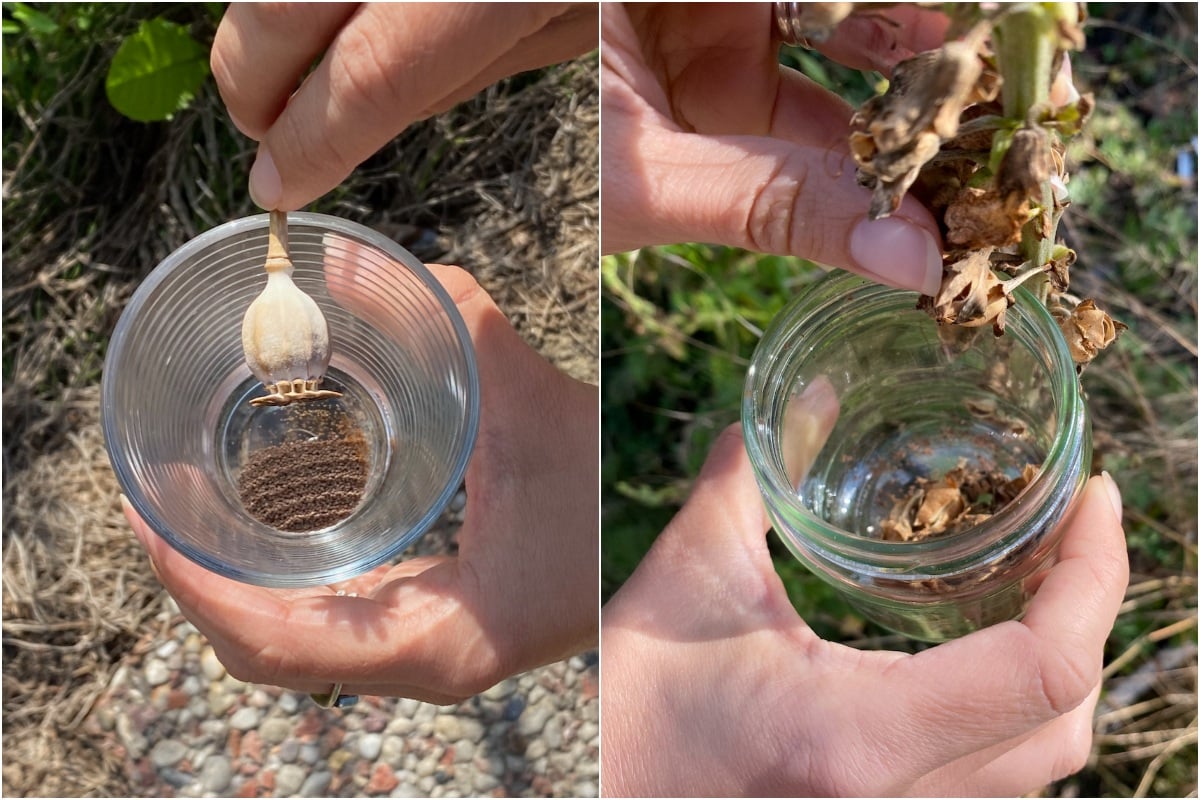
Luckily, I had already saved some seeds last year, and we were able to get her foxgloves started right away. The seeds are super small and finicky, so I just hold them over a jar and either shake them or collect the entire pod.
2. Hollyhocks (Alcea rosea)
I’ve written before about my love of hollyhocks and how they’ll always be associated with beach summer holidays in my memory.

If we holiday in July, we get treated with vibrant, pink poufs of cottage garden bliss lining the streets of our favorite beachside town. But when we holiday in August, there’s a muted tone to the leaves, and the flowers have turned to pods. Each pod can contain 20 to 30 seeds, so you can let some self-seed while you gather others.
Hollyhocks are biennials (here’s what that means), spending their first year developing roots and foliage and their second year showcasing their blooms.

The best way to avoid taking gap years is to save some seeds. Plus, they come in so many different shades and colors, it’s always fun to have seeds for a hollyhock exchange.
For a few more ideas about what to do with hollyhocks after they’re done flowering, have a look at this article I wrote.
3. Sweet William (Dianthus barbatus)
I have been smitten with Dianthus (also known as Sweet William or pinks) ever since I managed to turn it from a biennial to a perennial in my garden. True, it was probably the mild winters that have contributed to this transformation, but I’d like to take some credit too.

Dianthus starts blooming in May, and will be fully open by July. The nice thing about them is that they respond very well to deadheading. So I keep trimming off the spent flowers to encourage it to start growing secondary flower heads.

It’s a productive game, but I can only play it as late as August. At that point, the plant has spent most of its blooming energy for the season. But there’s always next season, and that’s what seed collection is for. I simply scratch the dead flowers a bit, and the seeds come right out.
One thing to pay attention to is that dianthus is home to some juicy caterpillar larvae that burrow in the seed pods. When cleaning out the seeds for storage, ensure you remove all the crawlies.
4. Echinacea
Echinacea (also called coneflower) is one of the plants that I always encourage our readers to overwinter in place in the garden. It’s on my list of plants that we should only prune back in spring, not in the fall.

Its sculptural silhouette and sturdy stem hold up really well even in the coldest months of the year under a layer of snow. But they usually grow in groups, and we can save a few seed heads at the end of August without much disturbance to the rest of the remaining ones.

You can scratch the seed heads a bit while holding a jar underneath, or simply cut the seed heads, dry them completely and store them in a paper envelope.
5. Snapdragons (Antirrhinum)
If you ask me, you can never have too many snapdragons in the garden. Whether you’re growing the garden variety or the cut-and-come-again florist’s variety, there’s a snapdragon for every backyard design imaginable.

They each produce so many tiny seeds, probably in the hundreds, that you’d think we never have to save any. But I think that starting a few new plants every year is a surefire way to make sure we always have these tender perennials in the garden. And it helps us place them where we want, rather than wherever they decide to pop up.

Just like with all the small seeds, I don’t like to fiddle with dry pods in the garden. The drier they get, the more spring-loaded they are and the more they’ll scatter. So I remove the entire seed head over a jar, put the lid on, and shake it a bit to release the seeds from the pods.
6. Sage (Salvia)
I started this sage from seed. Let me tell ya, it was a lesson in patience to jumpstart it and get it in the right location. After miraculously surviving two relocations (mostly to get more sun and better drainage), it absolutely shot up.

I knew I had finally finetuned its location when, in year three, it started blooming again after the first flush of flowers was completely gone. Now that I know it’s so easy to start from seed, I gift a few seed packets every year to other curious gardeners who want to try this out.
For sage, I trim the dry pod spire, then strip the seedheads off the pod (they come off easily when it’s very dry). Not every seed pod has a seed. Some have two, some one and some none.
I’d say in about equal parts.

The seeds are medium-sized, making them easier to separate and collect. I put it all in a colander and swoosh it around (technical term, I know). The seeds fall in the bowl underneath, and the chaff stays in the colander.
7. Pansies (Viola)
I don’t know about where you live, but at garden stores around me, there are pansies for sale almost year-round. I know they’re readily affordable and easy to buy.
But I noticed that the ones I buy (usually for container arrangements), do not fare as well as the ones I grow from seed. They bloom less, they flop more and they live shorter lives.
I prefer to save seeds of my favorite color combinations and scatter them over the garden come spring. Once the petals fall, the bulbous seedpod that’s left behind opens up into a three-point star.

Blink and the seeds disperse and become impossible to find. So I make sure to collect them when they’re almost dry, which I know they are because they’re dark and glossy.
I snip off the entire seed pod and store it in a jar to let everything cure. Then, as an agent of gardening chaos, I mix the seeds of pansies of different colors and sizes just to give future me something to be inquisitive about when they start sprouting the following spring.
8. Poppies (Papaver)
Oriental poppies don’t necessarily need our help to reseed, but we do need to collect seeds if we want them in a particular spot in the garden. There’s little chance of controlling where they end up unless we plant them there ourselves.
The seeds are so small and light that they get blown away by the wind. Sometimes they end up quite far away from where we’d like them to thicken up.
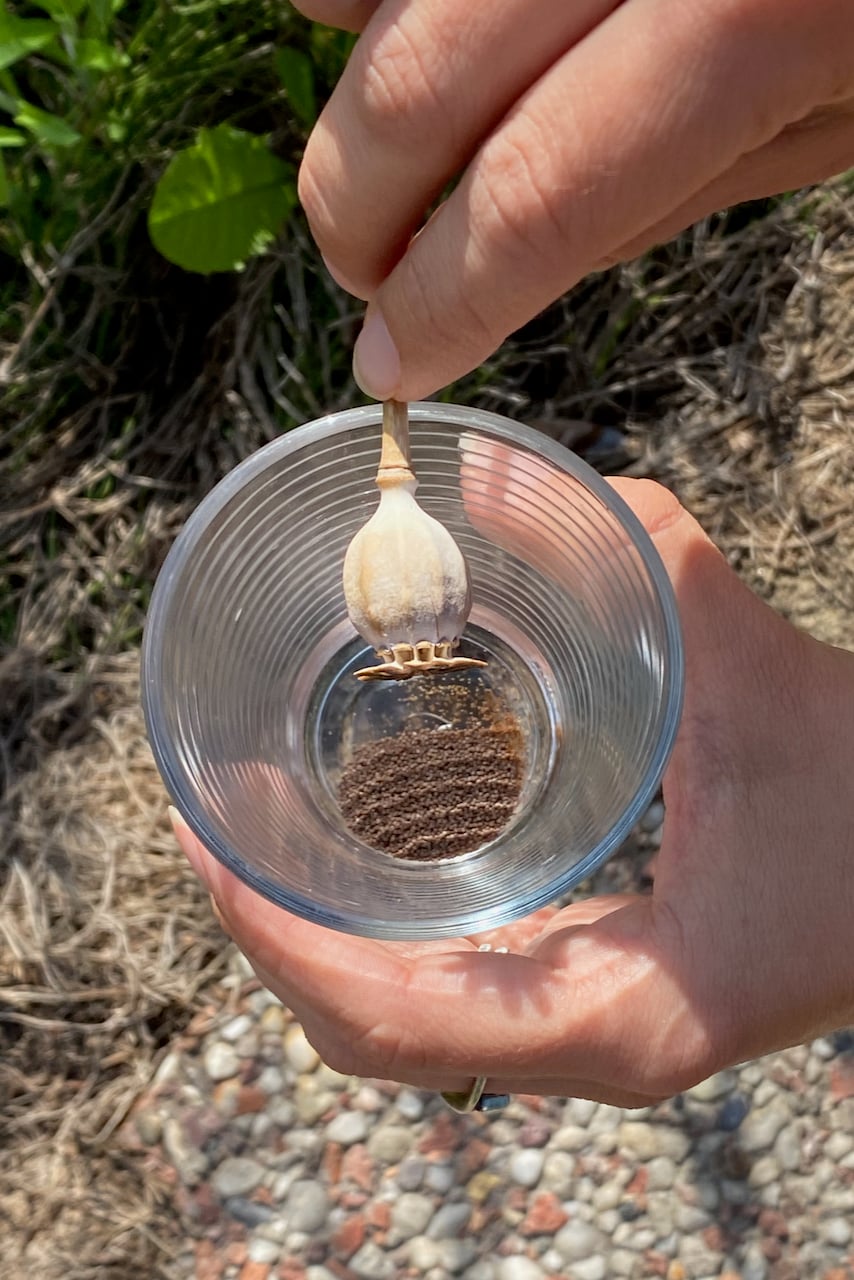
Poppy seed pods are a work of nature’s art, with each pod having a 360-degree opening at the top for seeds to disperse. I simply tilt the pods over a glass, enough for the seeds to reach the opening, and tap gently on the pod.
Then I leave the pod itself still standing on the plant over the cold months. Be prepared to be amazed by how many seeds you’re getting from a single pod.
9. Honesty (Lunaria annua)
You may know this ornamental as honesty, or silver dollar, moon flower or simply lunaria. I’ve included it on my list of plants with three seasons of interest because it undergoes quite a transformation from flower to seed pod.

The purple flowers turn into purple pods that look like a modernist stained glass chandelier. After a bit of rain, the lunaria pods remind me of a kaleidoscope, casting diffuse light and colors in that corner of the garden. Then the pods turn silver and eventually open up to disperse the seed in late fall.

The problem with lunaria is that it’s a biennial, so if we want to have it bloom every year, we’d better start it from seed every year. I leave about two-thirds of the pods to overwinter in the garden, but I collect the rest in August. It’s early enough for the pods not to have peeled in half and scattered the seeds around.

10. Rose campion (Silene coronaria)
I’ve recently become obsessed with rose campion, so consider this my warning that I’ll mention it every chance I get. I’m really smitten by the combination of two cold colors (fuchsia and silver) into something so aesthetically pleasing. Just like with snapdragons and sage, the more I deadhead it, the longer it keeps blooming.

But it’s just about sapped of energy by August, no doubt about it. When the time comes to collect seeds, I cut off the entire seed head and let it dry in a jar. I then either store it as is or shake out the seeds.

Learn from my mistake and always check that the seed pods are clean of anything that might be munching or burrowing in them. I had this little squiggly stored in a paper envelope for a couple of weeks. I was checking the seeds to share with a friend when I spotted him.
Storing Your Seeds

You can sow your collected seeds right away in the spot you want them to grow. They’ll likely lay dormant until next spring when they’ll burst into life.
Alternatively store your seeds in labeled paper packets and then inside a sealed container someplace cool and dark. Add a desiccant, such as a silica gel packet, to be extra safe that moisture won’t damage your seeds.
Remember, in nature these seeds would normally undergo a process known as cold stratification, so you may need to refrigerate your seeds before sowing if you plan to wait ’til next spring.
Read this article on how to cold stratify your seeds and which seeds require it.
Get the famous Rural Sprout newsletter delivered to your inbox.
Join the 50,000+ gardeners who get timely gardening tutorials, tips and tasks delivered direct to their inbox.