

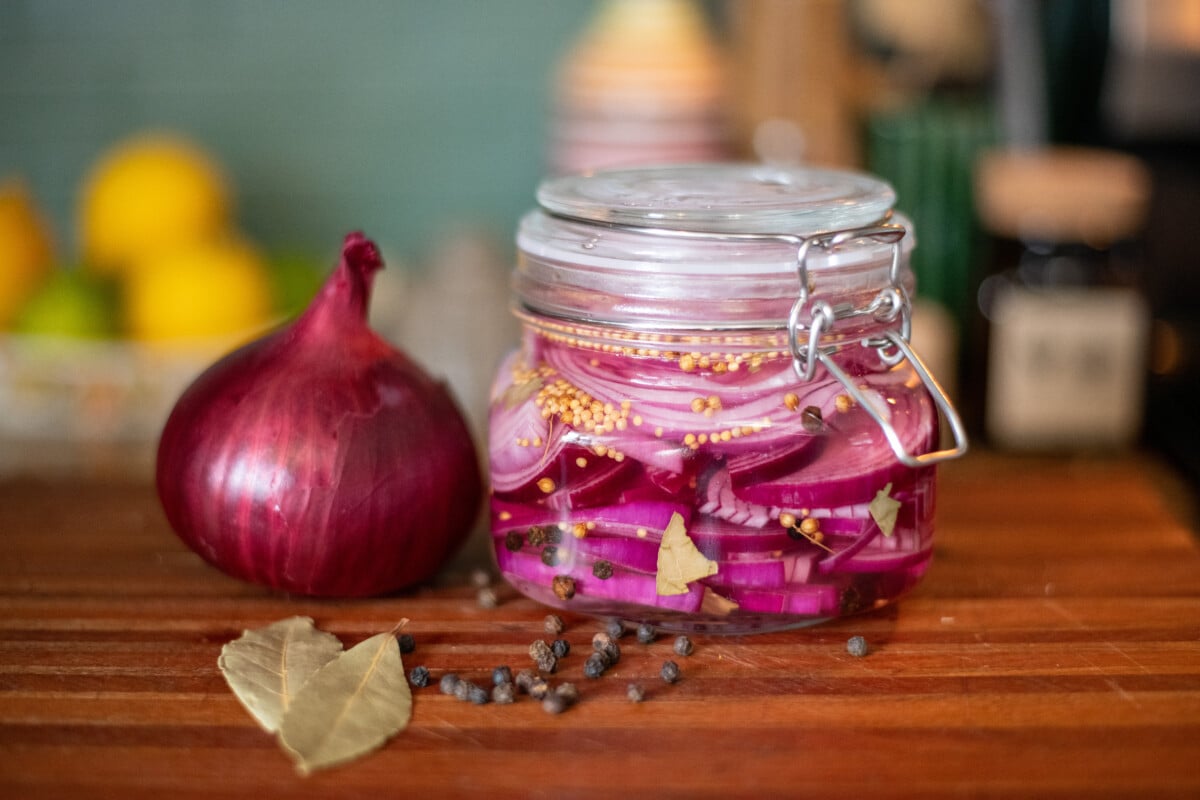
When it comes to pickles, cucumbers are usually the first to come to mind. But if you’re a gardener or a gourmand, pickled red onion needs to be in your repertoire. These tangy pickles are easy and fast. But the magic of them is how they seem to go with everything, adding a pop of bright flavor to every dish. You’ll be making jar after jar.
The Pickle You Never Knew You Needed
Can we take a moment to appreciate quick pickles, also known as refrigerator pickles? Back in the day, it was canned pickles or nothing.
Frankly, I’ve eaten a lot of soggy canned pickles in my lifetime. Oh, there were many good ones, too, but I’m a little over cracking open a jar of soggy pickles. The art of crunchy pickled veggies seems to have leaped forward the minute we decided to start making them with a shorter shelf-life in our refrigerators.
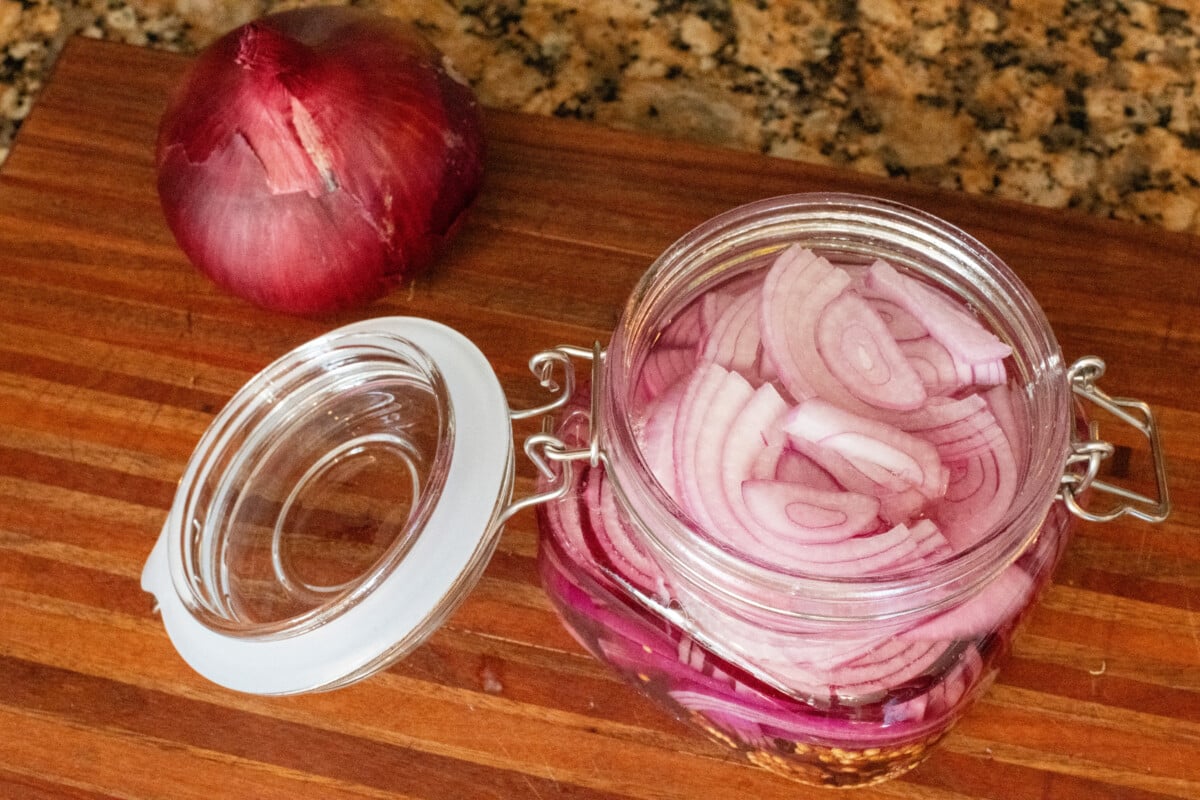
Like many a home gardener, there is still space in my pantry (and heart) for canned pickles, but my love of tossing fresh veggies into a brine, with a handful of spices, and putting them in the fridge knows no bounds.
Seriously.
During the pandemic, we played a game during a Zoom lab meeting where everyone had to post a photo of the contents of their fridge. Mine was about a third full of mason jars with all kinds of pickles and preserves. Everyone in the lab correctly guessed that the photo was of my fridge.
So, I don’t know why it took me so long to try pickled red onions.
Look, let me be straight with you: even if you’re not a huge onion fan, I would encourage you to make a batch. These things are magical and habit-forming.
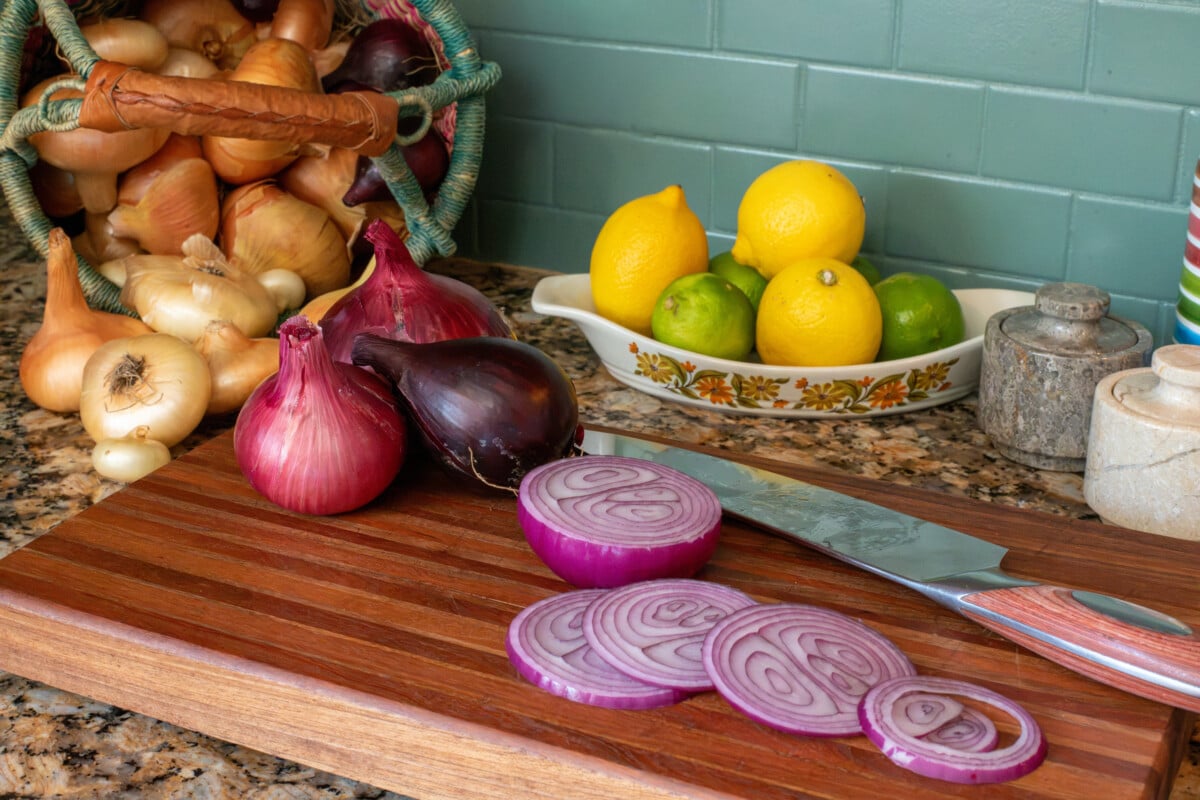
For years, I would pick off the red onions from my salad or burger. I didn’t want to spend the day with onion breath or burp onion every few minutes. But the first time I experienced a fancy sandwich piled high with crunchy pickled red onions, I was a changed woman.
The humble onion, when combined with vinegar and pickling spices, develops a sharp tang and complex flavor, while at the same time mellowing its oniony pungency. Pickled red onions are like that friend that moves to Europe and comes back to visit, oh so cool. Only you can eat them.
It only takes about five minutes to whip up a batch of quick-pickled red onions.
If you like to tinker in the kitchen, use this recipe as a jumping-off point, then go wild using different spice and vinegar combinations. (Just, you know, write down what you do so that when you get that incredible jar of pickles you can replicate it. There is nothing worse than creating the perfect pickle after winging it, knowing you’ll never be able to remember what you did to get it. Why, yes, I do know this from personal experience.)
As for the pickling spices, you can stick to the basics or experiment and come up with your own specialty blend.
Let’s take a look at your pickling spice options.
The Classics – there’s a reason this trifecta shows up in nearly every pickle recipe.
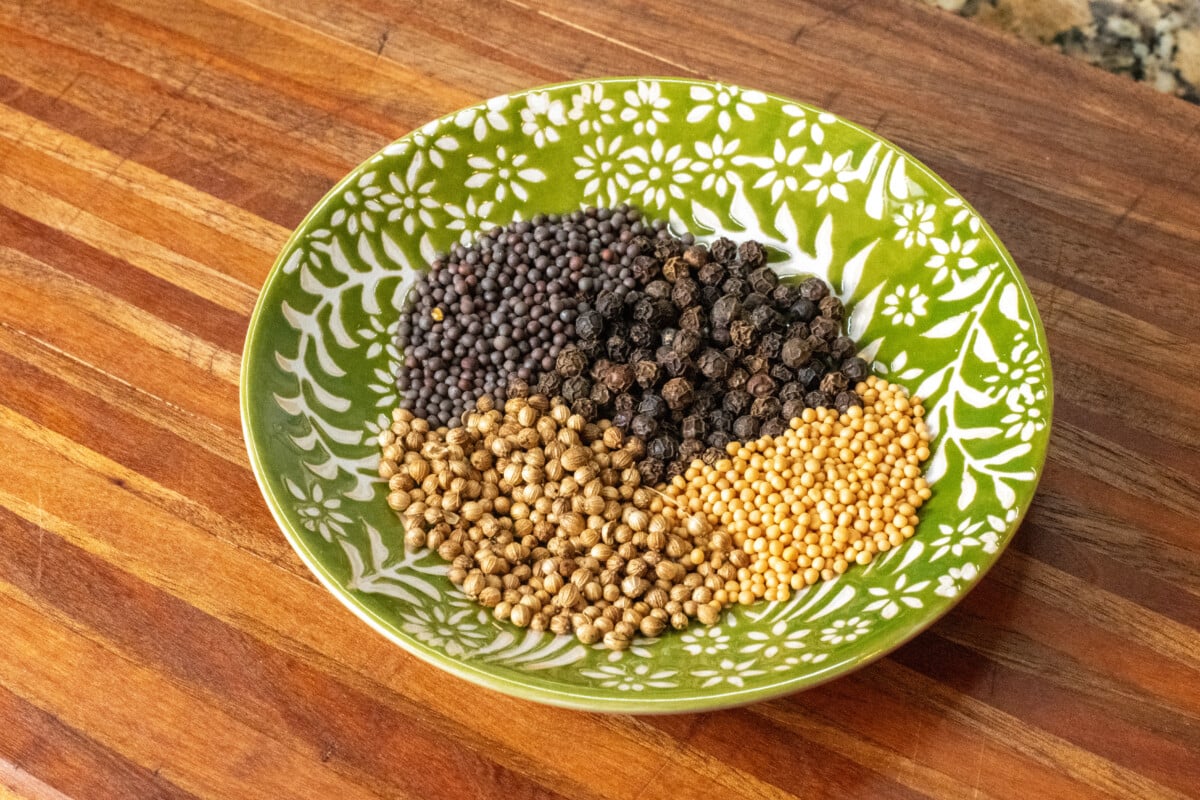
- Whole black peppercorns, with their sharp bite.
- Yellow or brown mustard seeds add to the bite, but bring with it a little tang.
- Coriander seeds give depth and a citrusy note.
Warming, Sweet Spices – think holiday baking and warm scents from the kitchen.
- Fennel seeds impart subtle sweetness with a light licorice note.
- Allspice berries come in with a rich, complex warmth.
- Whole cloves make a big impact on pickles with their strong, warming spiciness.
- Cinnamon sticks lend a comforting, cozy depth and light sweetness.
- Star anise, along with adding visual interest, provides warming sweetness.
The Aromatics – these bring big flavor and are often the star of the show.
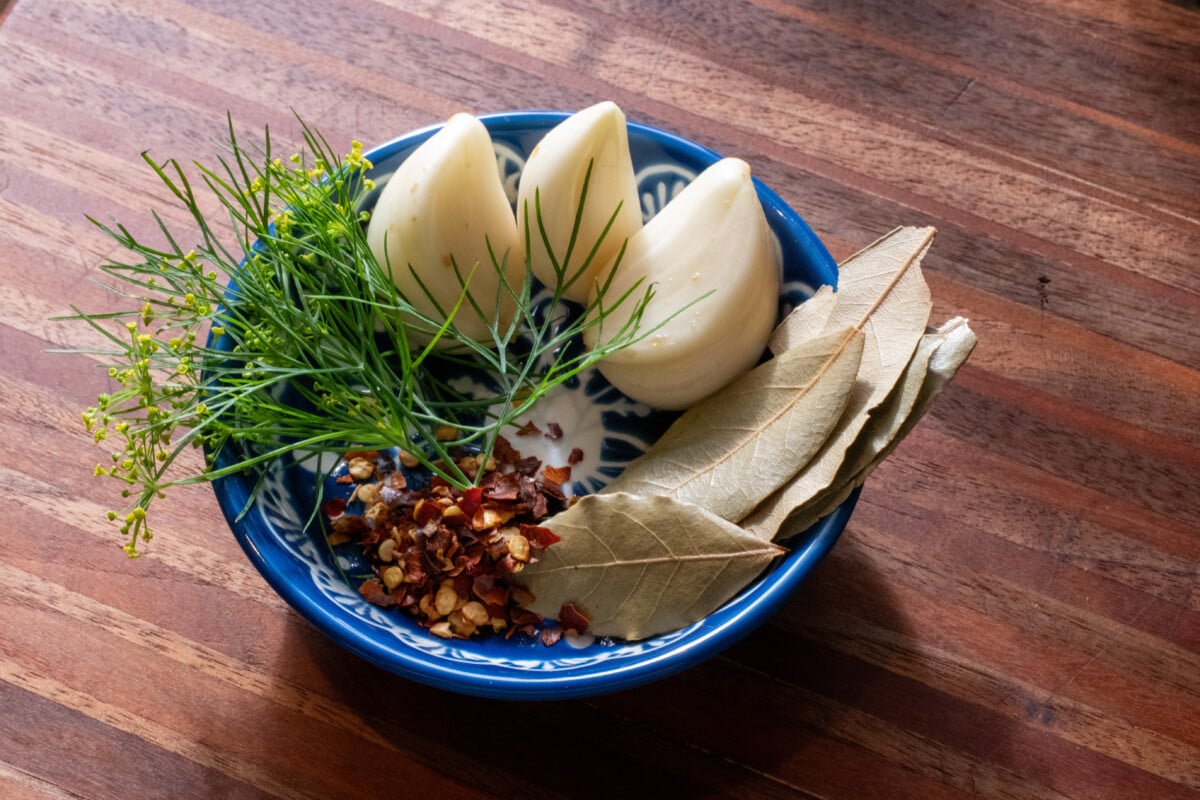
- Garlic because who doesn’t love a garlic-laced pickle?
- Dill, with its pungent fronds, has its very own beloved pickled category.
- Bay leaves impart an earthy, citrus note.
- Hot peppers are great for giving your pickles a little kick of heat, whether you opt for red pepper flakes, fiery Thai chilies or freshly sliced jalapeños.
This recipe is pretty basic as far as pickle spices go. I wanted to keep the classic pickled red onion flavor profile and not get wild with too many exotic spice combinations. That’s your job when you make the next batch.
The Brine
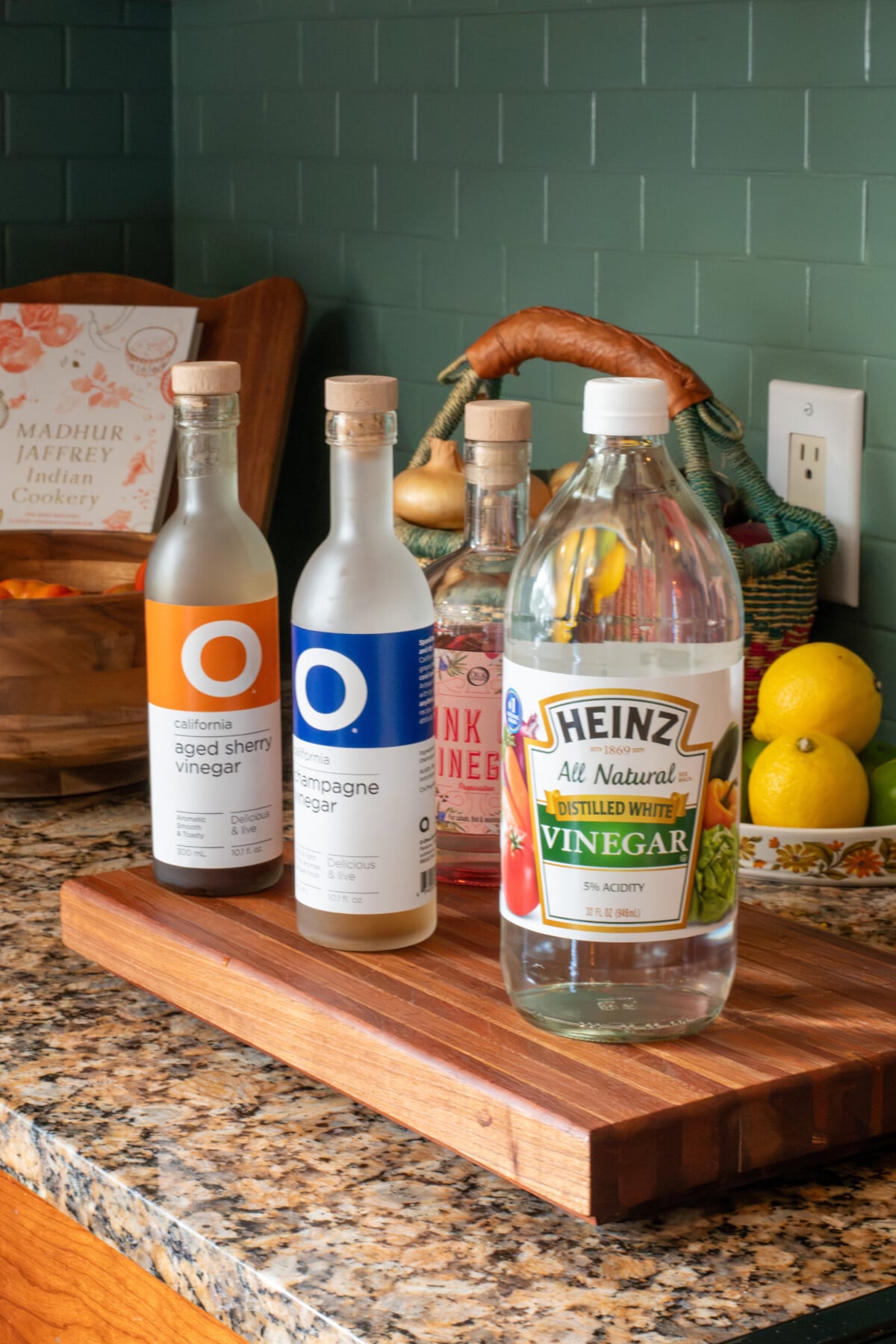
Normally, we use white vinegar in pickle recipes because the acid is around 5%, which is needed to prevent the growth of organisms in our canned pickles. But because we are being slackers and not canning our pickles, the vinegar becomes more about flavor. And oh, my friends, there are some incredible vinegars out there.
I love flavored vinegars because they offer some serious bang for your buck and a little goes a long way.
They’re a great way to introduce new flavors in your kitchen without spending tons of money on more spendy ingredients.
In no particular order, here are five that have graced my kitchen cupboards recently and will definitely be making a repeat appearance:
- Pink Gin Vinegar – not only does this stuff do amazing things to pickles, but you can make some pretty fun mocktails with it, too.
- O Fig Balsamic Vinegar – this has become my favorite thing to spritz on salads, and I can only imagine onions pickled in this stuff would be amazing on said salads. I won’t be picking those onions off anytime soon.
- Colavita White Balsamic Vinegar – this is one I always keep on hand because the lighter color makes for prettier pickles and because it’s a real winner when paired with berries for a vinegar shrub.
- O Aged Sherry Vinegar – if you want to make pickles that feel a little fancy and grown up, give this one a try. P.S. This stuff is also amazing sprinkled on a tin of chilled cockles. The sherry plays so nicely with the sea salt brine.
- O Champagne Vinegar – Yes, another one. These guys make some great vinegars, and there is a reason champagne vinegar is popping up all over the place. Bright and puckery, this stuff is lovely and just made for fridge pickles.
Another nice thing about making fridge pickles is that because we keep them in the fridge and we’re not processing them, you don’t need to worry about sterilizing the jars. Just use a clean jar from your cupboard and skip all the extra work.
Okay, But They’re Just Onions. What Do I Put Them On?
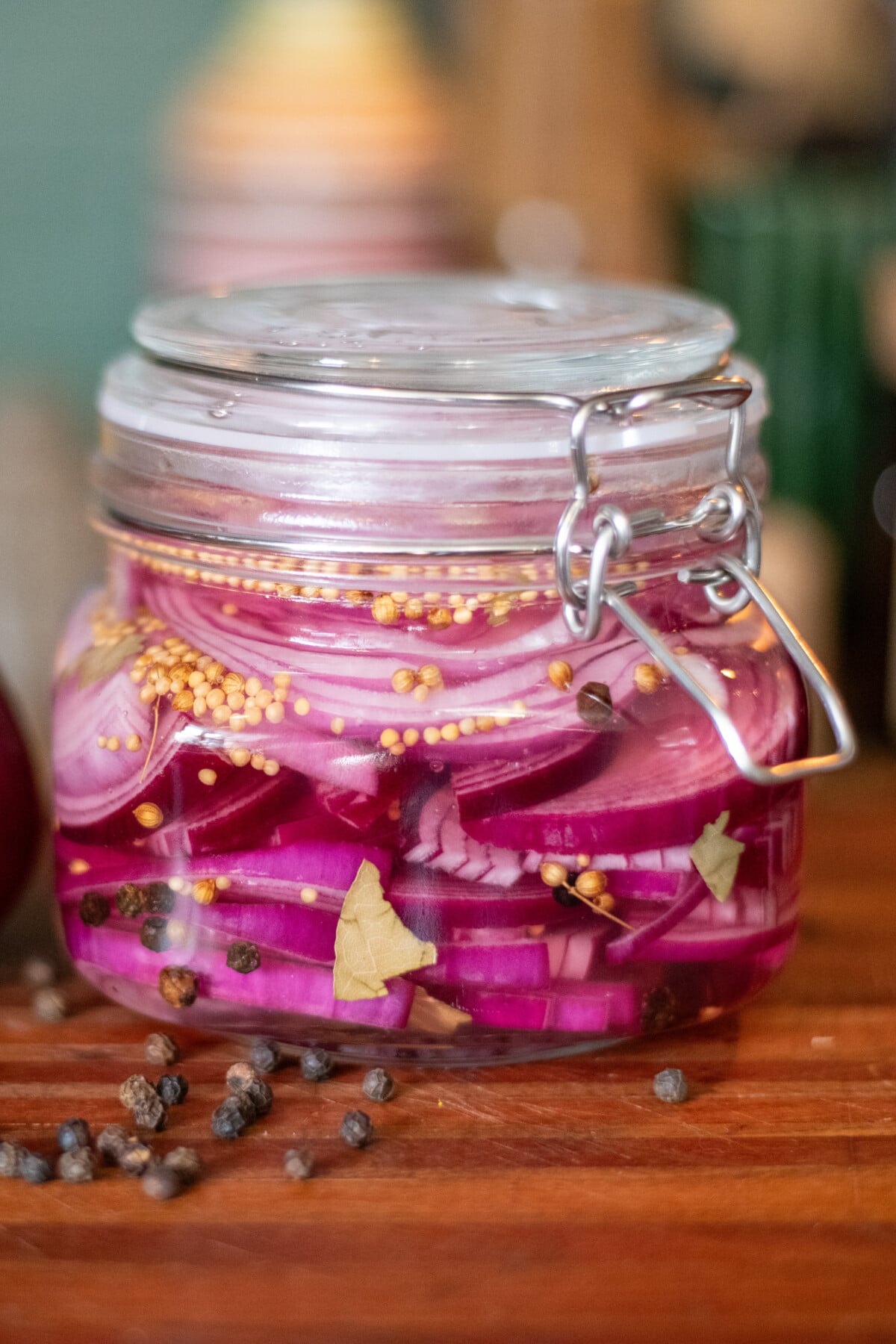
I think this is why pickled red onions aren’t as popular as cucumber pickles; they need better PR. The question isn’t really what do you put them on; rather, it’s what can’t I put them on?
Quick Pickled Red Onions Go Great With:
- Broth-based soups, both as a topper when serving or when making the soup
- Burgers
- Sandwiches
- Fresh, green salads
- Bean salads
- Cottage Cheese (women of a certain age, I see you, I am you)
- Hummus, both on top or blended in
- Oatmeal (gotcha, just kidding)
- Tacos
- Pasta salads
- Served on a charcuterie board (Are we still doing charcuterie boards?)
- Fish
- Garnish a martini
The list goes on and on until your jar of homemade pickles is empty.
Now that I’ve got your head spinning with all sorts of pickle ideas, let’s make a jar of quick pickled red onions. After spending a few days in the fridge, they will be ready to nosh. By the time your first jar is gone, you’ll already have ideas for another six jars.
What You Will Need
Tools
- A pint jar with lid
- A knife
- A cutting board
- Small saucepan
- Optional: a canning funnel if you’re messy like me and can’t pour brine into a jar without spilling it all over the countertop.
Ingredients
- One or two red onions
- ½ tsp black peppercorns
- ½ tsp mustard seeds
- 1/4 tsp coriander seeds
- 1 bay leaf, lightly crumbled
- ½ tsp sugar
- 1 tbsp coarse kosher salt *see note about salt substitutions
- ½ cup of white vinegar (or vinegar of your choice)
- ½ cup of water
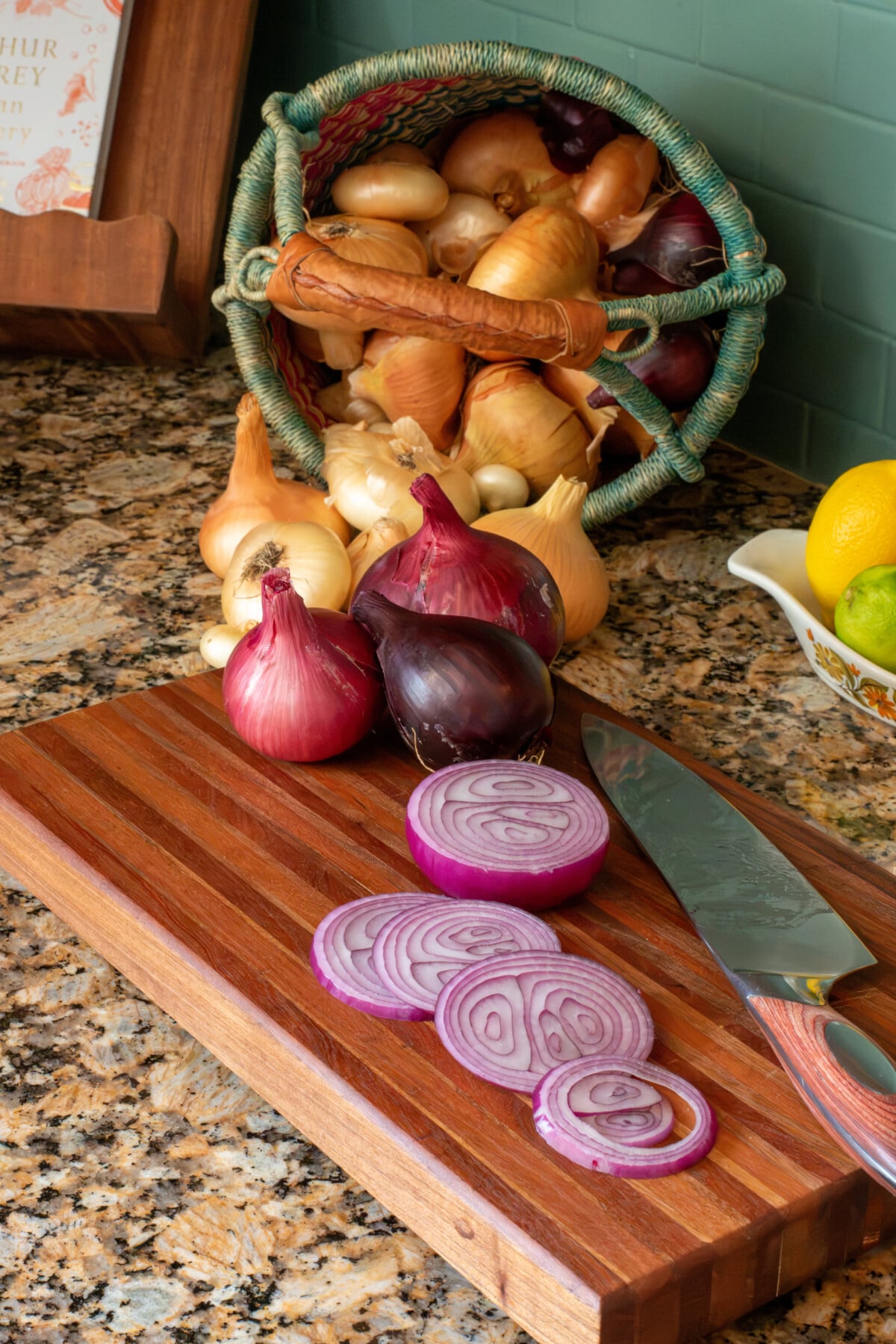
Instructions:
In the bottom of a clean pint jar, place the peppercorns, mustard seeds, coriander seeds, and the bay leaf.
Thinly slice your gorgeous, homegrown red onions. (Or the nice ones you bought at the store.) Pack them firmly into the jar, leaving half an inch of headspace.
In a small saucepan, heat the vinegar, water, sugar and salt together just until the salt and sugar are fully dissolved, and the liquid begins to steam. Remove from heat.
Deftly pour the brine into the jar without spilling a drop, you graceful swan you. Or, like the rest of us, use your canning funnel and pour the brine into the jar. You want to fill the jar, leaving a ½ to ¼ inch of headspace.
Place the lid on the jar and screw it on tightly. Gently turn the jar upside down and right side up a couple of times to allow air bubbles to come to the top and for the ingredients to settle.
Label and date your pickle jar, and place it in the fridge.
Wait at least three days before enjoying, to allow the brine and the spices to work their magic on those pungent little onion slices. Quick pickled onions are one of those pickles where the flavor and texture keep getting better the longer they hang out in your fridge.
Always use a clean utensil, such as a fork or small tongs, to take pickles out of the jar, so you don’t introduce bacteria and hasten spoiling. (Yes, son, I’m talking to you. Stop digging pickles out of the jar with your grubby bare hands!)
The pickles will keep for up to a month in your fridge, but you’ll probably eat them all up before that.
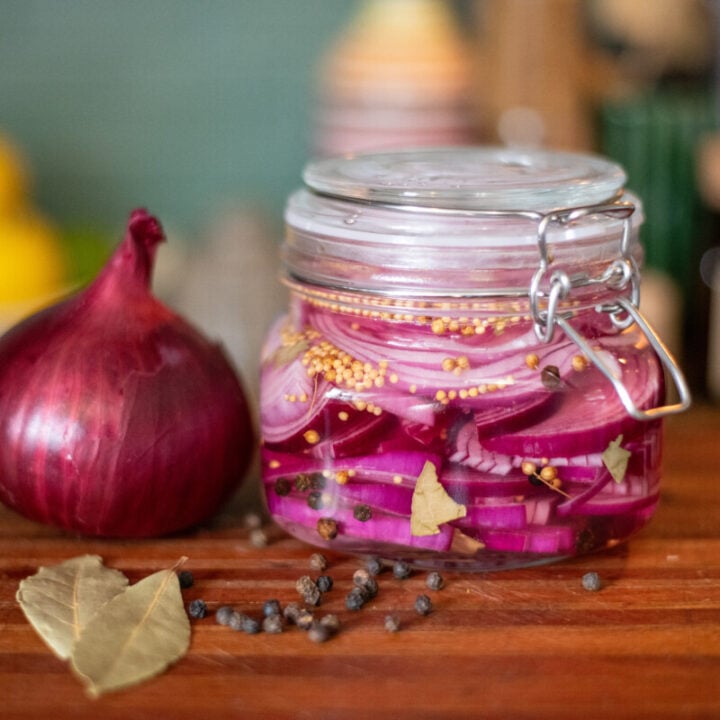
Delicious Quick Pickled Red Onions
Fast and easy, these pickled red onions are the pickle that goes with just about everything, giving even the simplest dishes a tangy, crunchy zip.
Ingredients
- Two or three red onions
- ½ tsp black peppercorns
- ½ tsp mustard seed
- 1/4 tsp coriander seeds
- 1 bay leaf, lightly crumbled
- ½ tsp sugar
- 1 tbsp coarse kosher salt *see note about salt substitutions
- ½ cup of white vinegar (or vinegar of your choice)
- ½ cup of water
Instructions
- In the bottom of a clean pint jar, place the peppercorns, mustard seeds, coriander seeds, and the bay leaf.
- Thinly slice the red onions. Pack them firmly into the jar, leaving half an inch of headspace.
- In a small saucepan, heat the vinegar, water, sugar and salt together just until the salt and sugar are fully dissolved, and the liquid begins to steam. Remove from heat.
- Carefully pour the brine into the jar, leaving a ½ to ¼ inch of headspace.
- Place the lid on the jar and screw it on tightly. Gently turn the jar upside down and right side up a couple of times to allow air bubbles to come to the top and for the ingredients to settle.
- Label and date your pickle jar, and place it in the fridge. Wait two to three days for the flavors to meld before enjoying.
Get Garden Notes From Tracey, Right to Your Inbox
Pull up a chair on the front porch. Join 54,000+ gardeners who get Tracey\'s friendly notes, seasonal to-dos, and hands-on tutorials three times a week.