

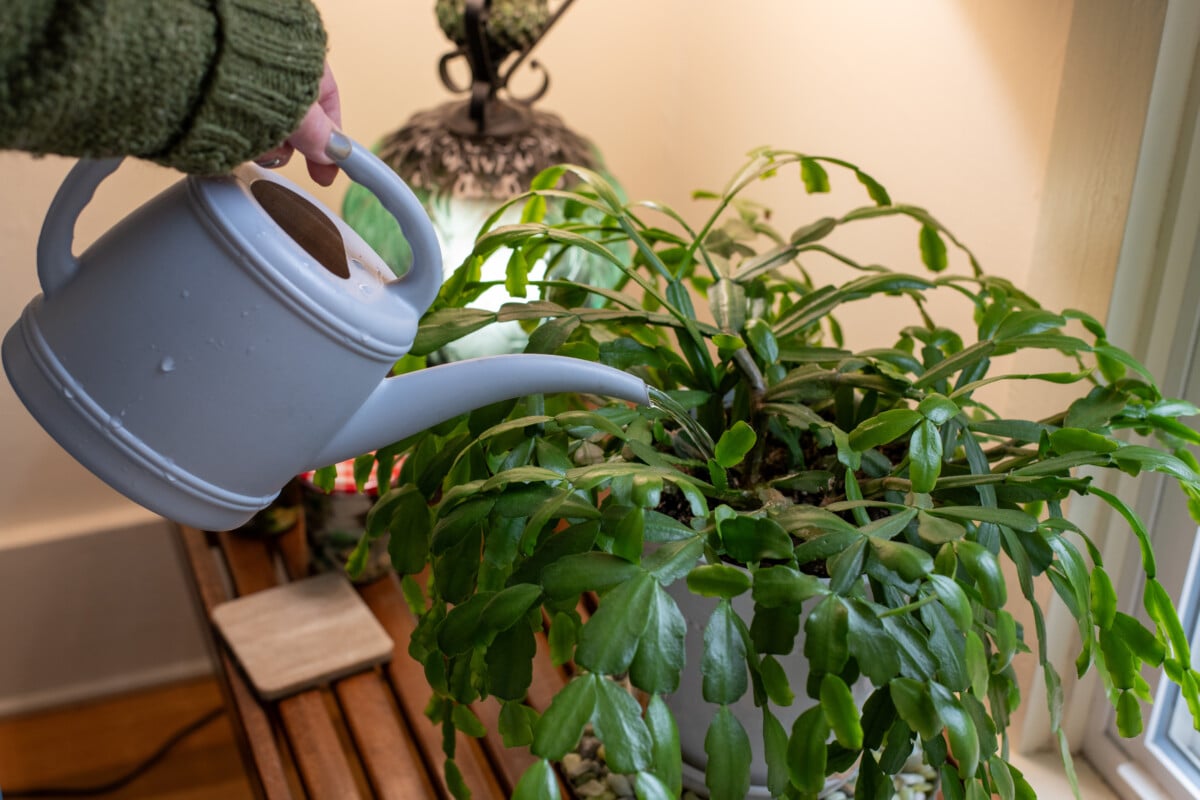
Compared to most houseplants, Christmas cacti are a little different when it comes to feeding them. Because of how they grow and when they bloom, they need different types of fertilizer at different times of the year. There’s even a period where you shouldn’t fertilize them at all. Getting the fertilizer right can often be the difference between no blooms and abundant blooms.
So, let’s take the mystery out of feeding everyone’s favorite holiday houseplant. (And hopefully out of fertilizer in general.)
If they didn’t bloom, Christmas cactuses would be far less frustrating for the average houseplant owner. Let’s face it, unless you’re trying to get them to blossom each year, they’re pretty hands-off when it comes to caring for them. These hardy plants practically thrive on neglect.
But the second you try to get them to bloom, that’s when things get complicated.
It doesn’t have to be this way. As is the case with so many other things, it’s the not knowing that makes it harder. So, I want to make feeding your Christmas cactus less confusing. Because these plants are beautiful when they bloom around the holidays, and it’s immensely gratifying to walk by your Christmas cactus, covered in flowers and know you’ve finally cracked the code.
A Christmas Cactus Primer
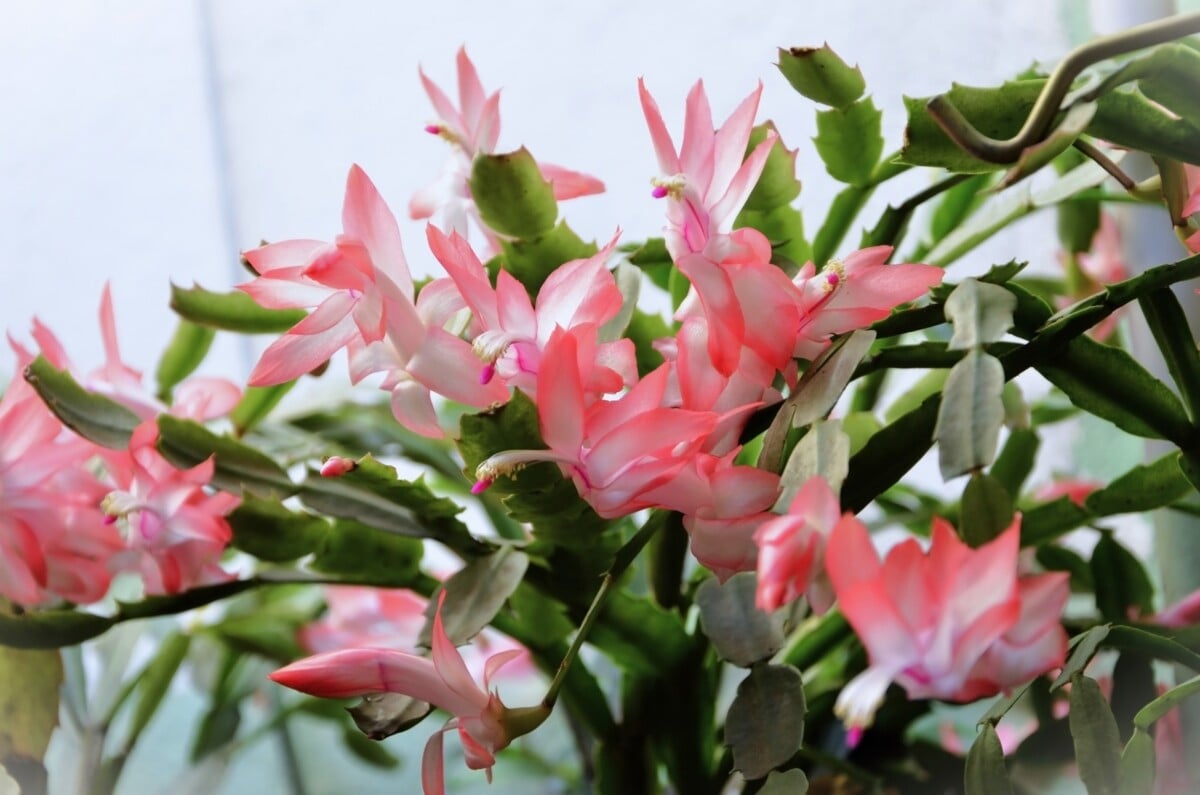
I don’t want to spend a lot of time going over how to care for these plants, but it helps to have a basic idea of what they need. After all, proper care is the difference between a surviving plant and a thriving plant.
Christmas cactuses are true cactuses in the Cactaceae family.
There are somewhere between 6 and 9 of these cacti in the genus Schlumbergera, two of which are popular houseplants: Schlumbergera truncata, also known as the Thanksgiving cactus, and Schlumbergera x buckleyi, also known as the Christmas cactus or sometimes the True Christmas Cactus. There’s a third holiday cactus, the Easter cactus, which is not in the Schlumbergera genus.
You can refer to the photo below to learn how to tell them apart, or click here for more in-depth information about Schlumbergera. They are often collectively referred to as holiday cacti to keep things simple.

The plants respond to day length to trigger bud set each year. The shortened days and longer, cooler nights of fall trigger the plant to enter a semi-dormant state and begin producing buds. This results in blooms that occur around the holidays, hence their names.

If you have trouble getting your Christmas cactus to bloom, one factor may be that these environmental conditions are not being met. For more information on recreating the environment for blooming, click here.
Christmas cactuses prefer to be slightly root-bound and are susceptible to root rot. To that end, always plant them in a pot with a drainage hole using potting soil that’s meant for epiphytic plants, which you can get here. Or, if you’re a DIYer like me, my recipe for African violet soil is perfect for Christmas cactuses, too. Likewise, they need repotting far less frequently than your average houseplant.
Okay, that concludes our crash course in Christmas cactus care. (Say that three times fast!)
Not All Fertilizer is Created Equal
It helps to know a little bit about plant fertilizers and how plants use each of the three most important nutrients. Somewhere on the package of every plant fertilizer, you will find a ratio of three numbers. This is what’s known as the NPK ratio. The letters stand for nitrogen, phosphorus and potassium, respectively. The NPK ratio tells you the percentage of each nutrient in the fertilizer’s recommended dose.
These three nutrients are the most important ones your plants need to thrive.
- Nitrogen – Nitrogen is essential for vegetative plant growth because it’s a key component of chlorophyll and amino acids, driving strong leaf, stem, and overall green tissue development.
- Phosphorus – Phosphorus is vital for plant growth because it supports energy transfer, root development, and the formation of flowers and fruit, promoting healthy blooms and abundant yields.
- Potassium – Potassium is crucial for plant growth because it regulates water balance, strengthens cell walls, and enhances flower and fruit quality by improving color, flavor, and overall plant resilience.
In some situations, the best fertilizer is a balanced one, where the NPK numbers are nearly equal. But for most plants, they need more or less of each of these nutrients depending on what time of year it is or whether or not it’s a blooming or fruiting plant.
For instance, in your garden, you might feed tomatoes a high-nitrogen fertilizer in the spring to encourage your plants to grow large and bushy. Then you would switch to a fertilizer that’s much lower in nitrogen but higher in phosphorus and potassium to give your plant the nutrients it needs to grow lots of tomatoes.
Or say you grow pothos as a houseplant. This isn’t a blooming plant, and what makes it beautiful is its lush vegetation, so you would feed it exclusively a fertilizer high in nitrogen and much lower in phosphorus and potassium.
See? Easy-peasy.
Ignore the Labels
Each year, I get countless emails from readers asking, “Can I use my rose fertilizer on my tomato plants?” or “I need to fertilize my hydrangeas, but I only have this fertilizer that says it’s for vegetables. Can I use that?”
My response is always the same: ignore the label and look at the NPK ratio.
I’m going to let you in on a little secret: most ‘specialty’ fertilizers are meant to sell you one more bottle of fertilizer, not necessarily because your plant needs that exact formulation. I use a rose fertilizer on my tomatoes in the spring because the NPK ratio is perfect. (It’s also great for Christmas cactus in the active growing cycle, but we’ll get to that shortly.)
As long as the NPK ratio is in the ballpark of what your plant needs or what you’re trying to get it to do, i/e, get bigger and bushier (nitrogen), set buds and produce fruit (phosphorus and potassium), it doesn’t matter what it’s called.
I hope this helps clear up some of the confusion surrounding fertilizer and how to choose the right one for your plants.
Of course, if you have questions, don’t hesitate to email me (click Contact at the very bottom of the page). Or better yet, sign up for my email newsletter. Rural Sprout readers always get first access to the newest articles, tips, tricks and the famous Sunday Letter. You can sign up here.
Now, it’s time to apply this to our fickle Christmas cactuses!
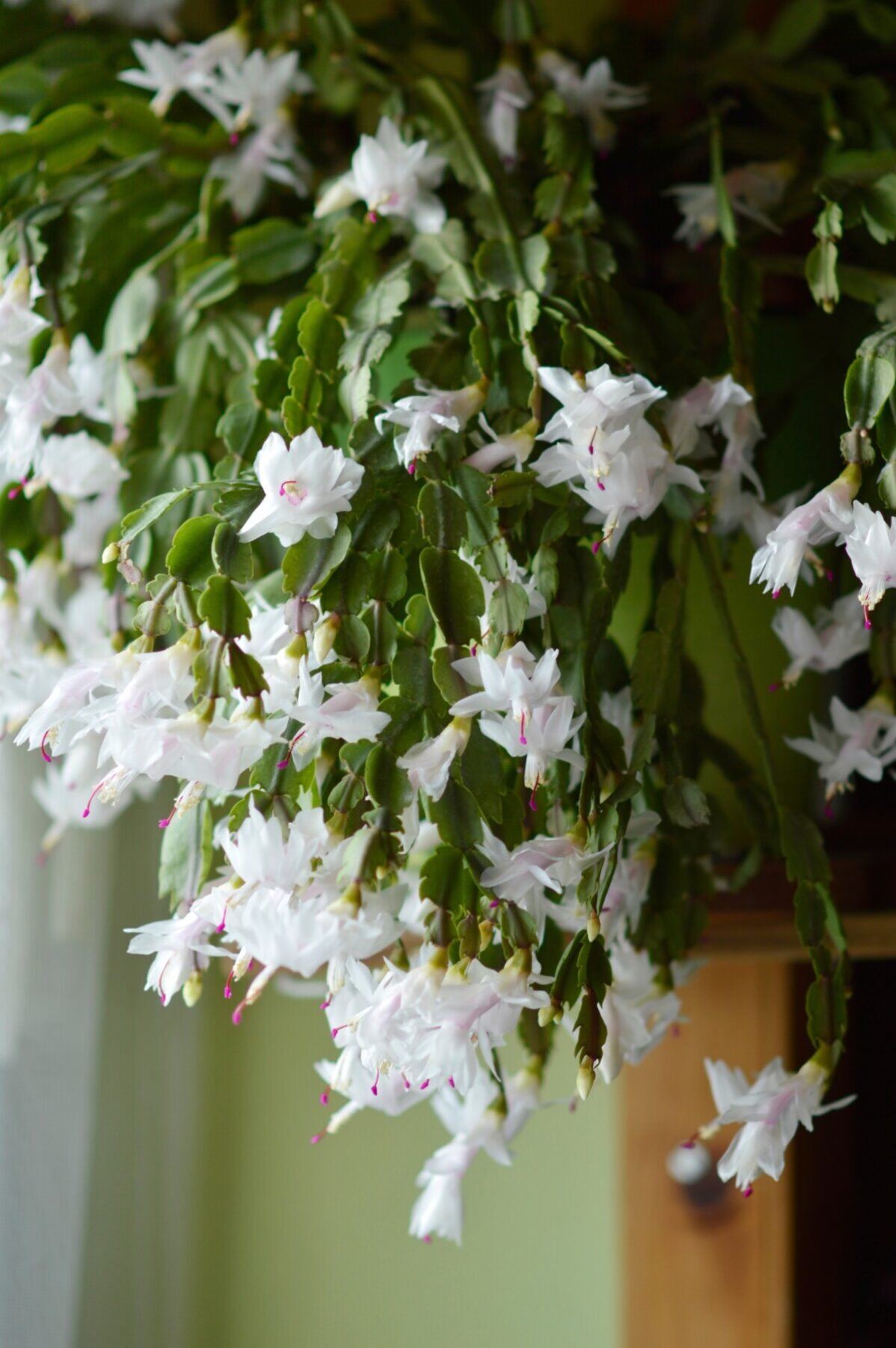
Three-Phase Fertilizing
When it comes to Christmas cactuses, I feed mine differently during three distinct phases of the year that coincide with their annual growth cycle. Let’s take a look.
Active Growth Phase
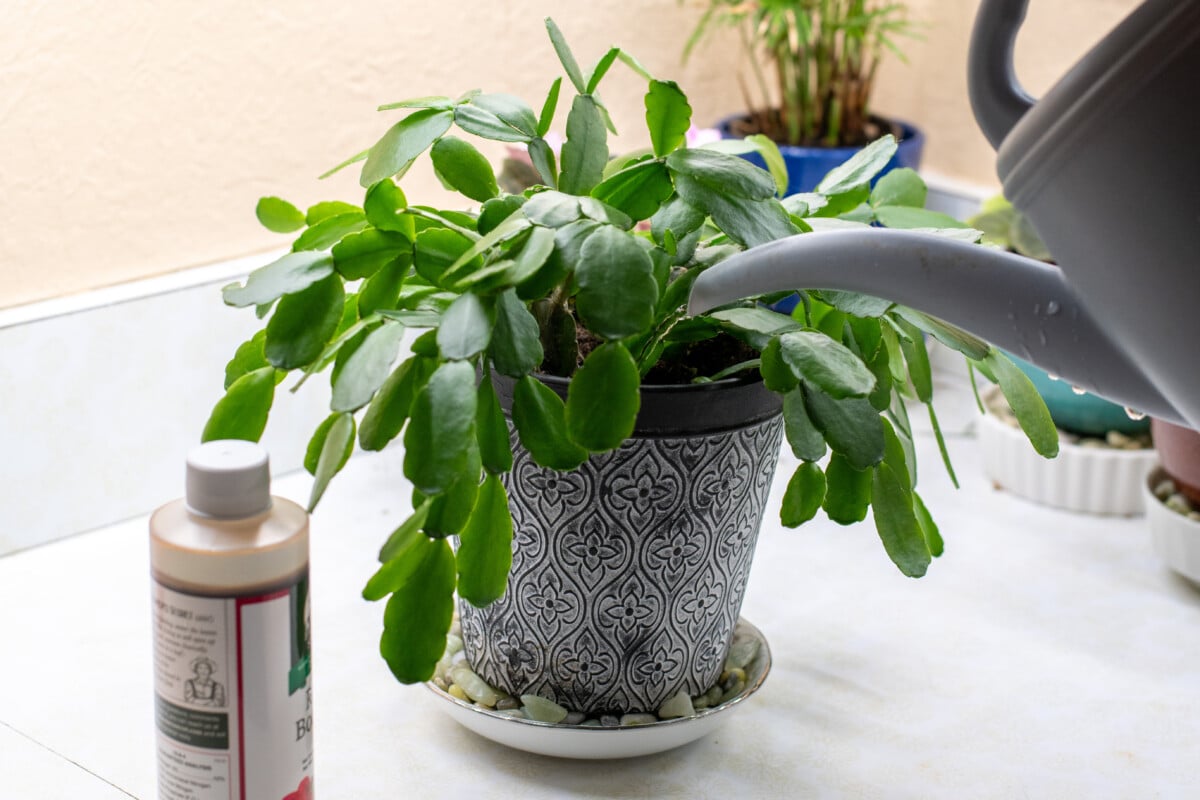
As I mentioned in the care primer, these plants grow and bloom in response to the length of the day. In late winter and early spring, as the days begin to grow longer, your sleepy Christmas cactus will start stirring from its winter dormancy period.
Keep an eye out for two tell-tale signs that your plant has broken dormancy: new cladodes and changes in watering frequency.
We water most houseplants less often in winter because they are dormant and don’t need as much. If you’ve been watering your plant sparingly throughout the winter, there comes a point in early spring where you may notice your plant looks a little dried out, and the individual segments or cladodes might look a little wrinkly. You may also notice that the soil is drying out faster.
When this happens, it’s a cue that your plant is asking for more water because it’s time to grow!

Take a close look at the tips of your plant. When you start to see tiny cladodes growing, you know we have officially entered the active growth phase.
At this point, your plant will need to be watered more often, and you can start fertilizing it.
Once the Christmas cactus breaks dormancy, usually in late winter or spring, its main focus is getting bigger and bushier, which means it needs plenty of nitrogen to support the production of all those new segments. For this stage of the year, you’ll want to reach for a high-nitrogen fertilizer.
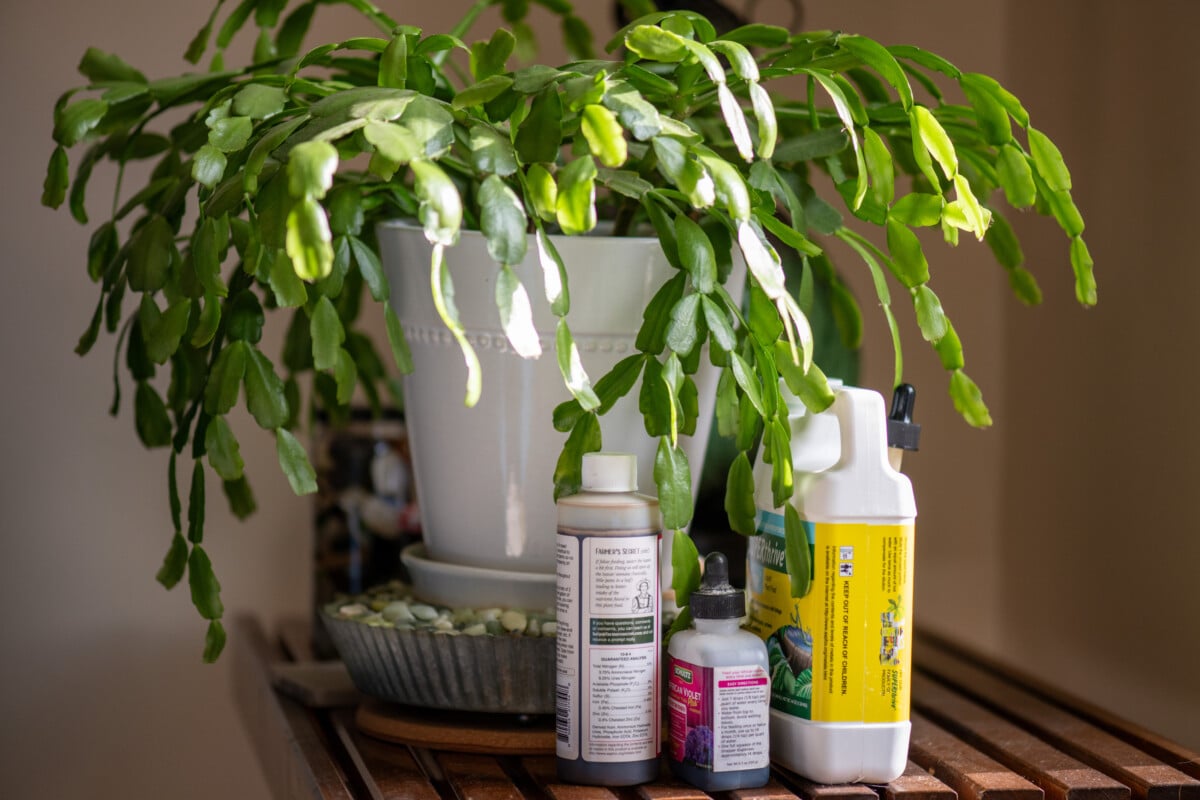
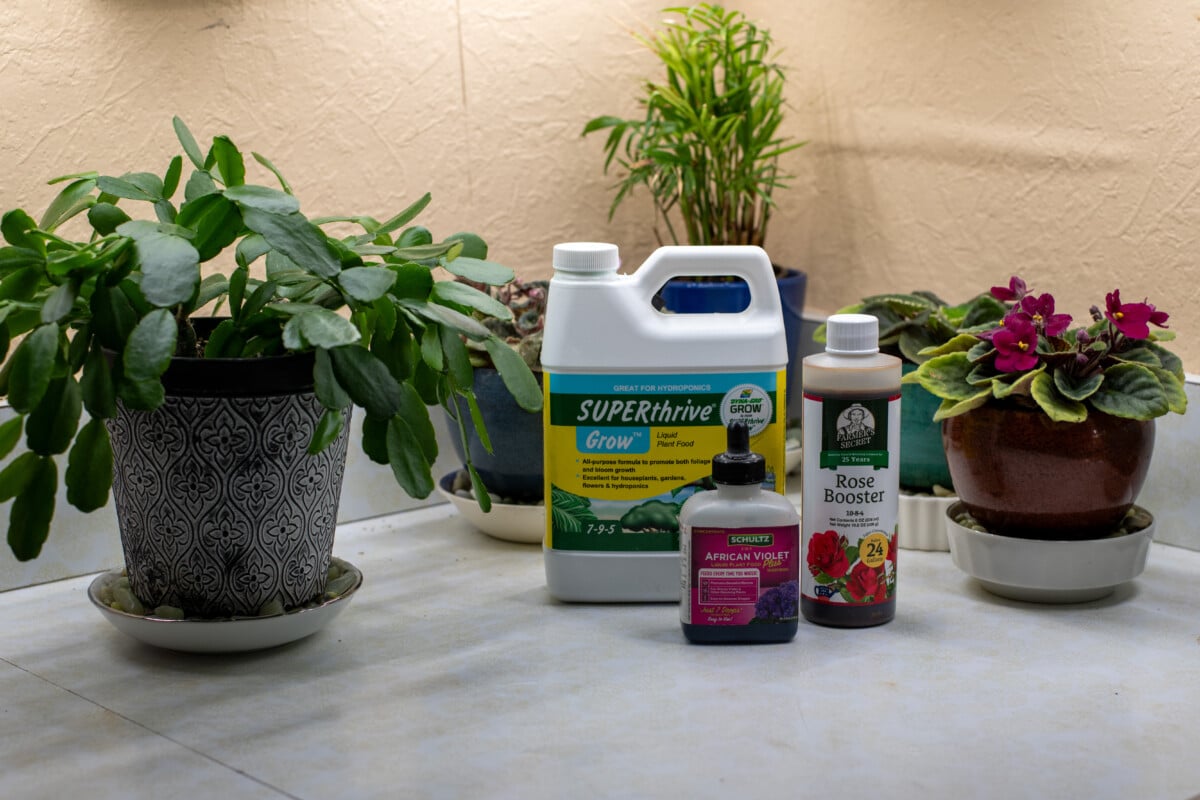
Remember that rose fertilizer I mentioned? Here it is, Farmer’s Secret Rose Booster. (You can buy it here.) If you take a look at the NPK ratio, it’s 10-8-4. It’s high in nitrogen, so it’s going to help your plant put out lots of beautiful new growth all spring and summer long.
It’s also high in phosphorus and has a decent amount of potassium. This allows your plant to start storing those important flower-making nutrients that it will need in the fall.
I also used this formulation exclusively on the plants I propagated when I pruned and repotted my Christmas cactuses last February. It gave them everything they needed to get off to a healthy start. Just look at them!

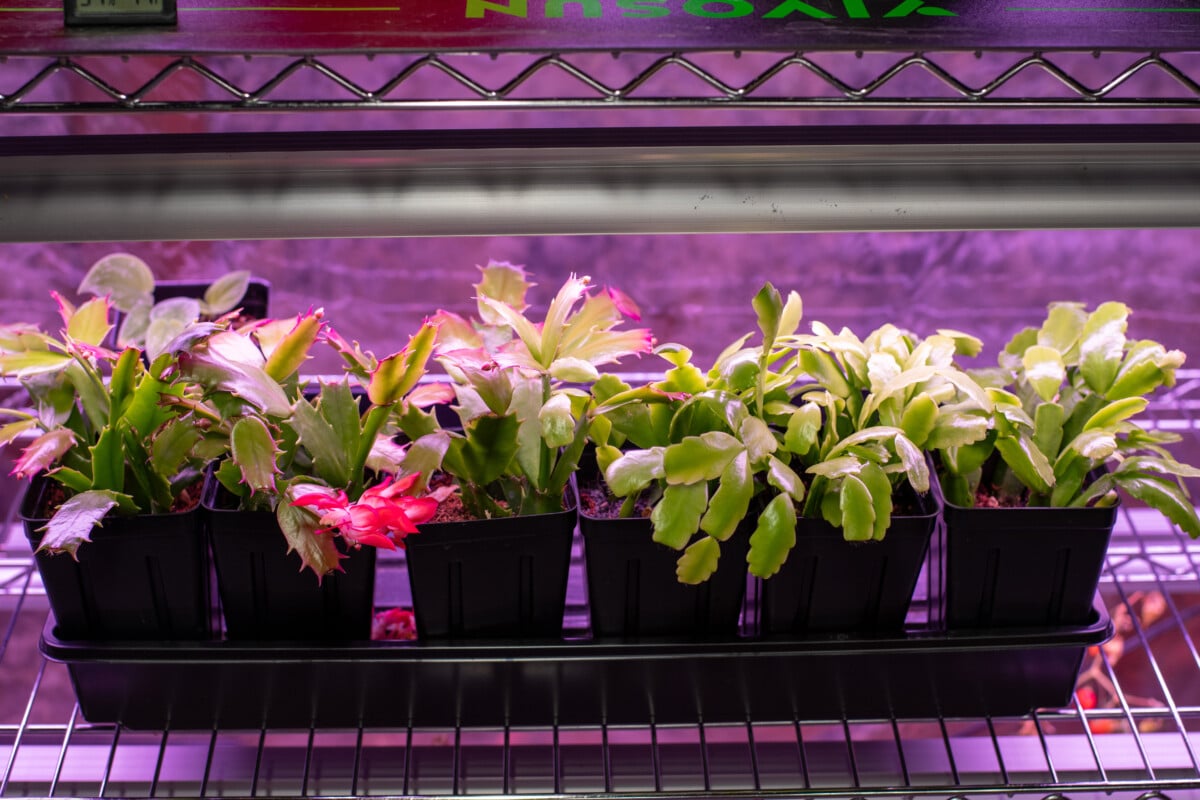
Pro-tip! I’ve been feeding my two holiday cactuses to make them big and lush during their active growing season, so I chose the rose booster because of its high nitrogen content.
However, if your plant is already huge and the thought of a lot of new growth isn’t appealing, then opt for a balanced fertilizer or something a bit lighter on nitrogen.
In the past, I’ve had excellent results using Schultz African Violet food (NPK 8-14-9) from spring until late summer.
I know it’s meant for African violets, but remember what we said about labels. The two plants have similar nutrient needs, so this formulation works really well. Funnily enough, I no longer use Schultz African violet food on my African violets. At the recommendation of The Violet Barn, I switched to Dyna Gro Superthrive, which has an NPK ratio of 7-9-5. Unsurprisingly, it works really well on Christmas cactuses, too.
No matter what fertilizer I’m using, I feed at full strength every time I water my plants during the active growing season.
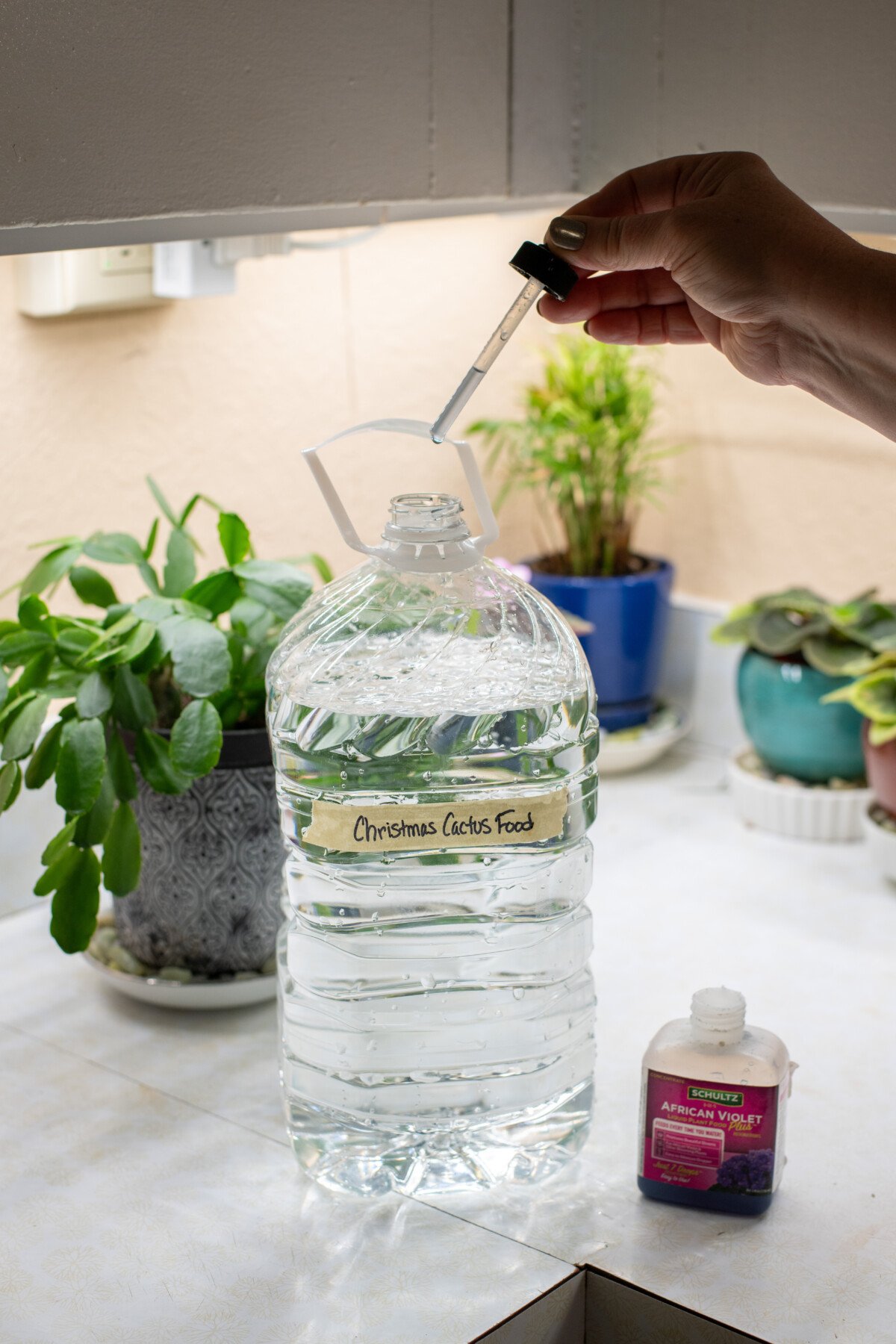
Most fertilizers give directions that make up much more fertilizer than I need at once, so I use a gallon jug to mix a batch. Then it’s ready to go whenever I need to water my Christmas cactus.
Don’t forget, the salts in most fertilizers will collect in the soil of potted plants over time, so it’s important to flush the soil regularly with pure water. Once a month, I skip the fertilizer and use water alone. If I’ve moved my Christmas cactuses outdoors for the summer (which you should do, here’s why) and it’s especially warm out, I’ll do this twice a month.
Pre-Budding Phase
Around late summer, you can do one of two things. You can stop fertilizing, or you can switch to a formula that’s very low in nitrogen, but still has plenty of phosphorus and potassium, such as Fox Farm’s Tiger Bloom.
At this point, you want your Christmas cactus to use more of its energy on storing up nutrients for blooming and less on putting out new growth.
Entering the Short-Day Budding Period Through Dormancy
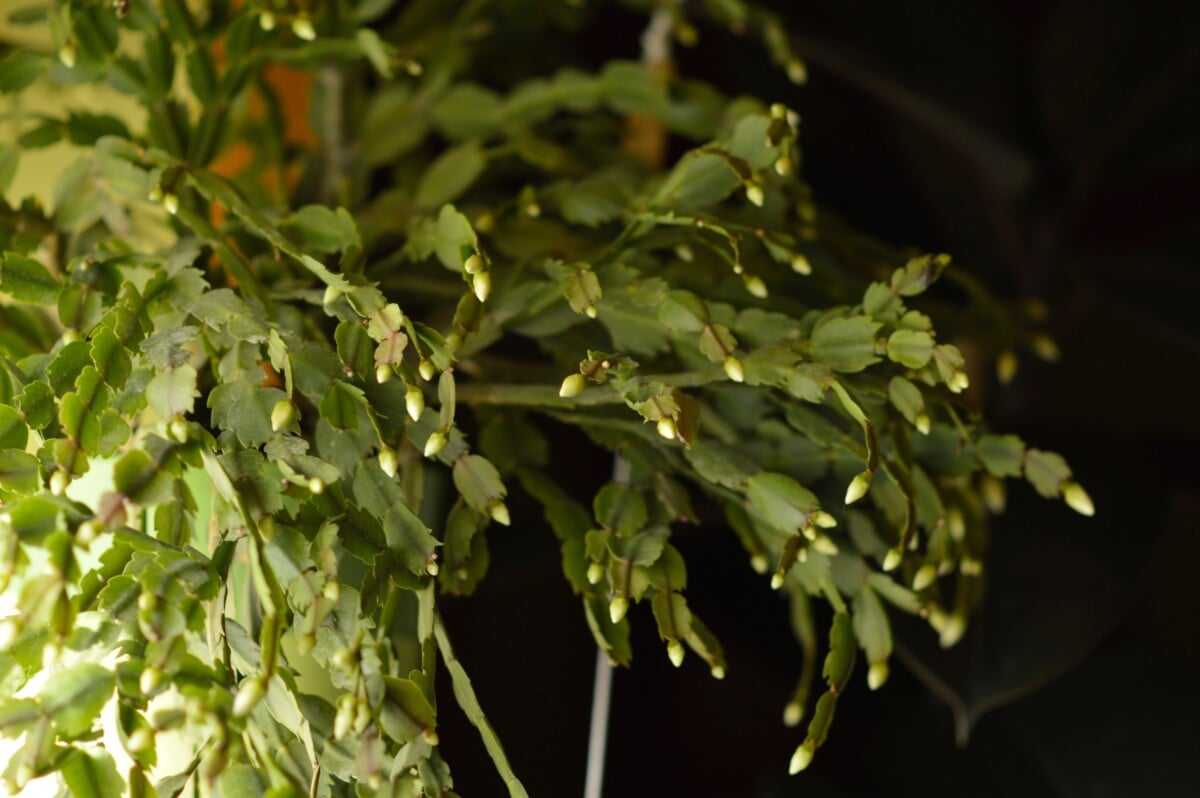
Finally, at the end of the summer, you should stop fertilizing your Christmas cactus altogether. At this point, your plant is slowing down for the season. If you’ve been fertilizing regularly, it will have all the nutrients it needs to produce lots of beautiful buds.
You also won’t need to water as much anymore. It’s important to keep watering it, though, just not as often or as much.
Check the top inch of soil with your finger; if it’s dry, then water lightly.
Continue watering as needed throughout the holidays and winter. After your Christmas cactus has finished blooming, it will enter a period of dormant rest for the remainder of the winter. You should not be fertilizing at all during this time. Then, next year in early spring, it will all begin again.
Summing Things Up
I know I’ve thrown a lot of information at you. I always encourage folks trying to figure out houseplant care to read articles like this twice. It’s likely you’ll never have to read them again if you do, as you’ll have a firm grasp on the information.
I gave you several fertilizer options, all of which I have used with great results on my own plants. In the end, you really only need one of them, at most two, if you plan to switch to a low-nitrogen fertilizer in the late summer.
I’m constantly trying new formulations so that I can report my findings back to you. That certainly doesn’t mean you need to purchase every option I throw out there. Pick one and stick with it for a year to see how you like it.
Following this feeding schedule will ensure that your holiday cactus, whether a Thanksgiving or Christmas cactus, has all the essential nutrients it needs to put on a showy display over the holidays.

Get Garden Notes From Tracey, Right to Your Inbox
Pull up a chair on the front porch. Join 54,000+ gardeners who get Tracey\'s friendly notes, seasonal to-dos, and hands-on tutorials three times a week.