

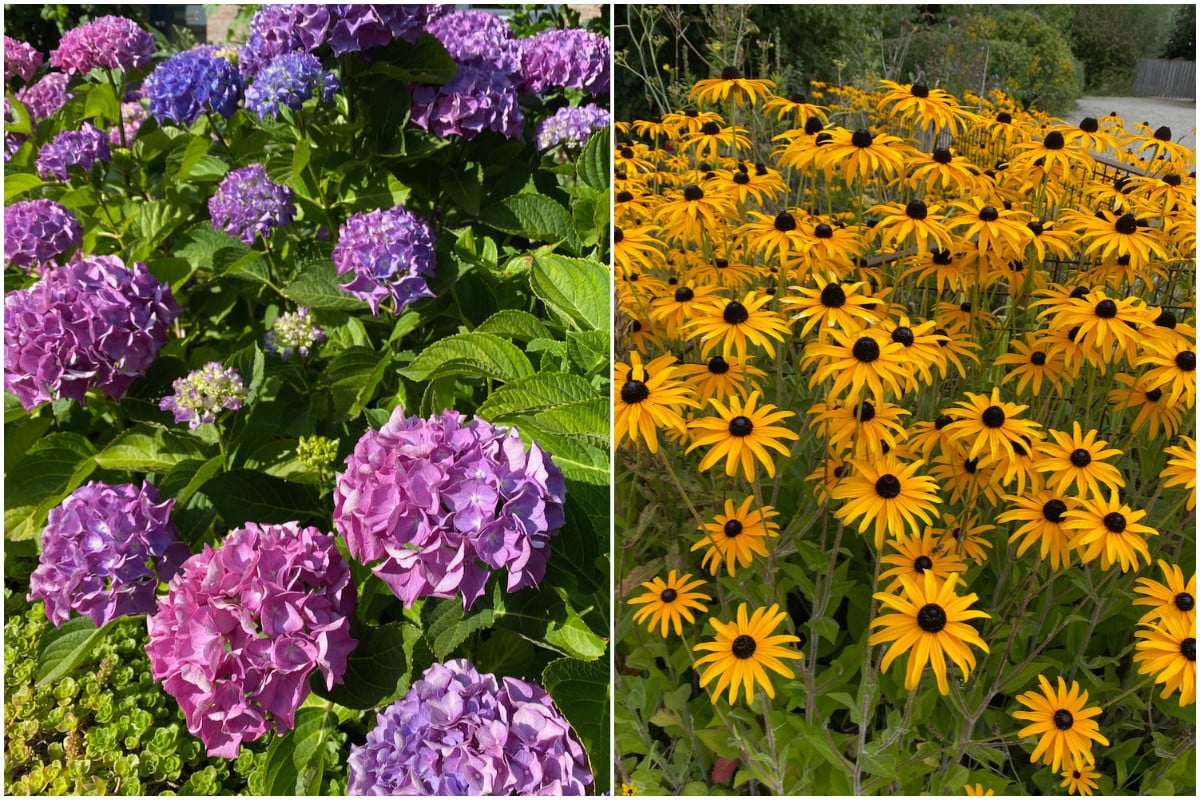
The inspiration for this article on hydrangea plant pairings came to me courtesy of golden hour. I was sitting on a bench next to a pink mountain hydrangea that looked especially gorgeous backlit by a sunset glow. Most of the glamour came from the setting sun, but some was added on by drops of sunshine in the form of black-eyed Susans, poking their cheerful smile from below the hydrangea shrub.
I have to tell someone about this, I thought! Everyone needs to plant these two ornamentals together and have this magical experience when plant pairings just “click.”
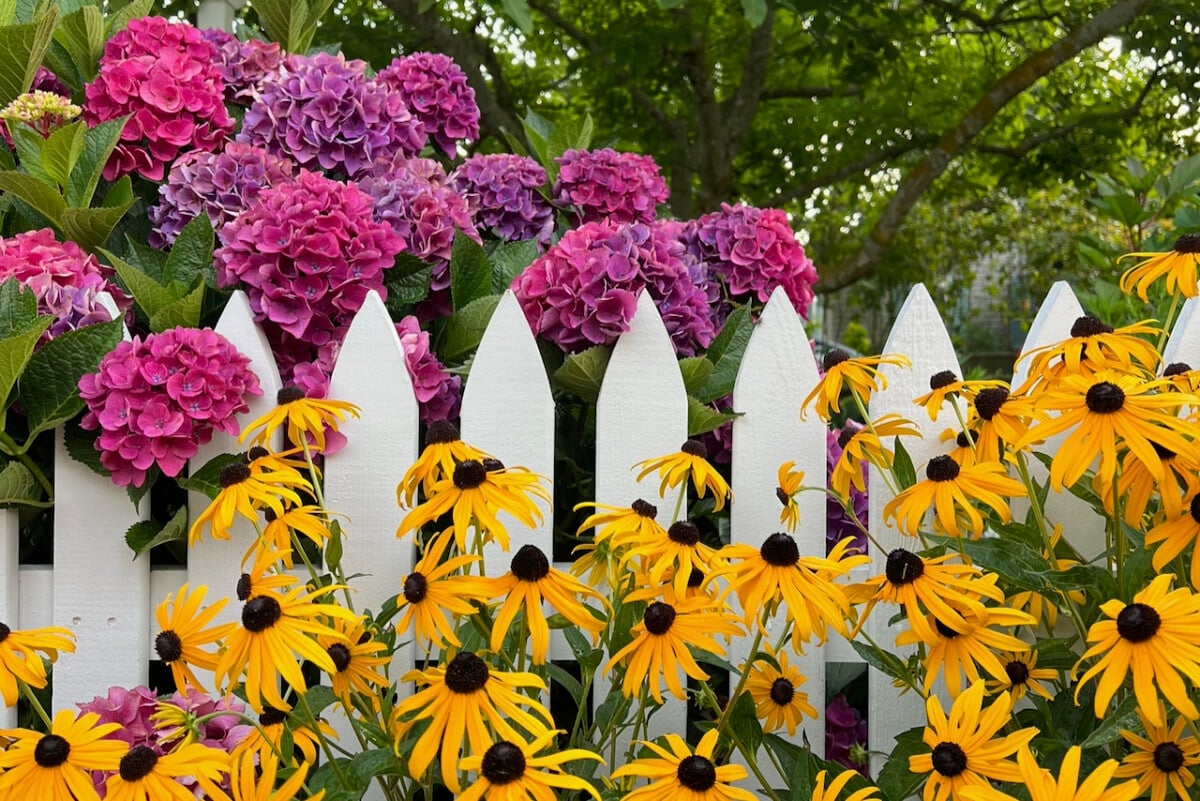
So I researched and put together a list of hydrangea companion plants. Being the practical gardener that I am, I’ve also taken practical factors into consideration. Sure, looking good is important, but health and longevity are even more so.
Where hydrangeas grow best
I’ll start with a disclaimer. There are many different types of hydrangeas and many ways to site them (east-facing, north-facing, west-facing). I have a mature hydrangea shrub in my garden that’s thriving in a north-north-west orientation, granted with some help from the heat coming off the façade of my house.
Hydrangea can grow in warm zones or colder zones. On the coast or hundreds of miles inland. In acidic or alkaline soil (a detail which will influence the color of the blooms, but only for some types of hydrangeas).
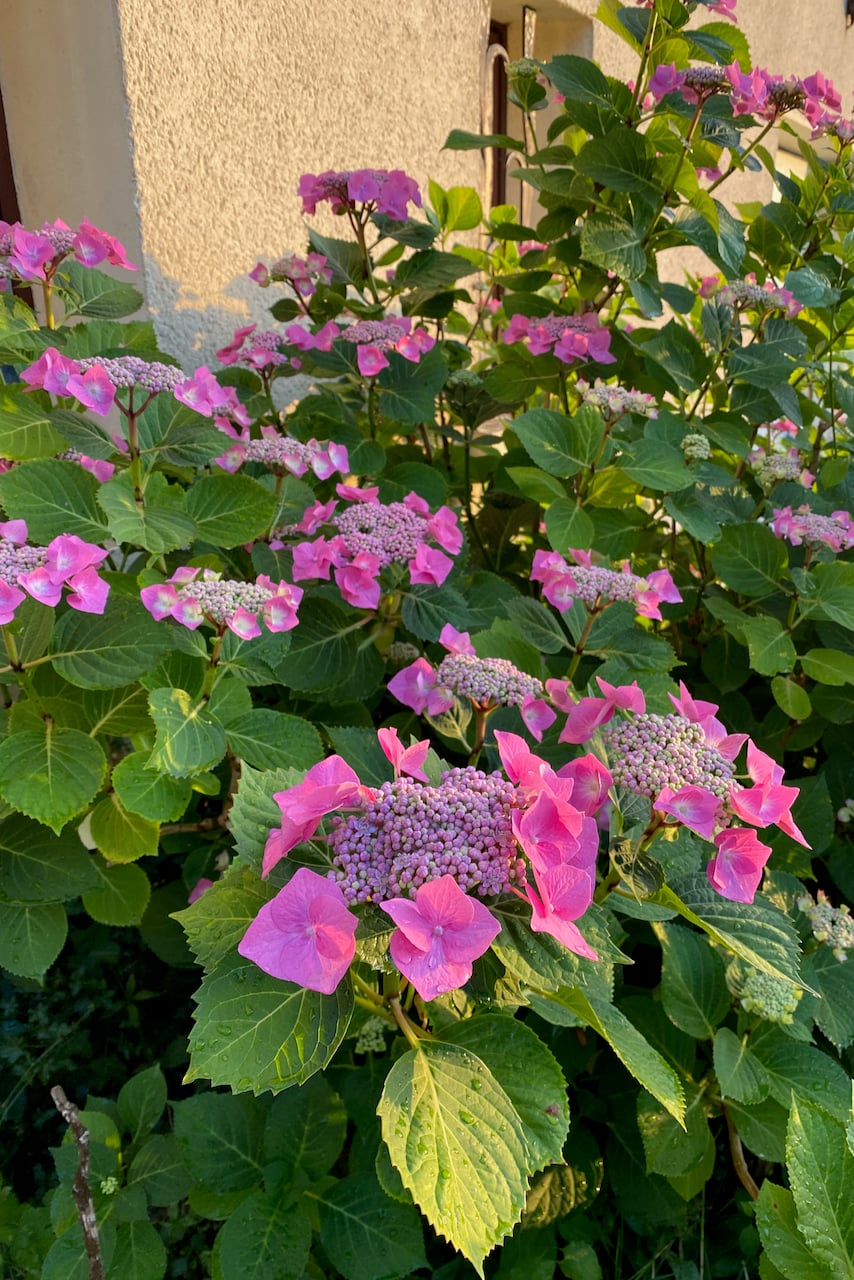
But these two details are essential:
Hydrangeas grow best in soil that is moist and well-draining.
Hydrangeas prefer part shade. And they definitely need to be kept away from bright, direct sun. Remember that bright refers to the intensity of the sun and the duration, while direct refers to the orientation of the sun when it reaches the foliage.
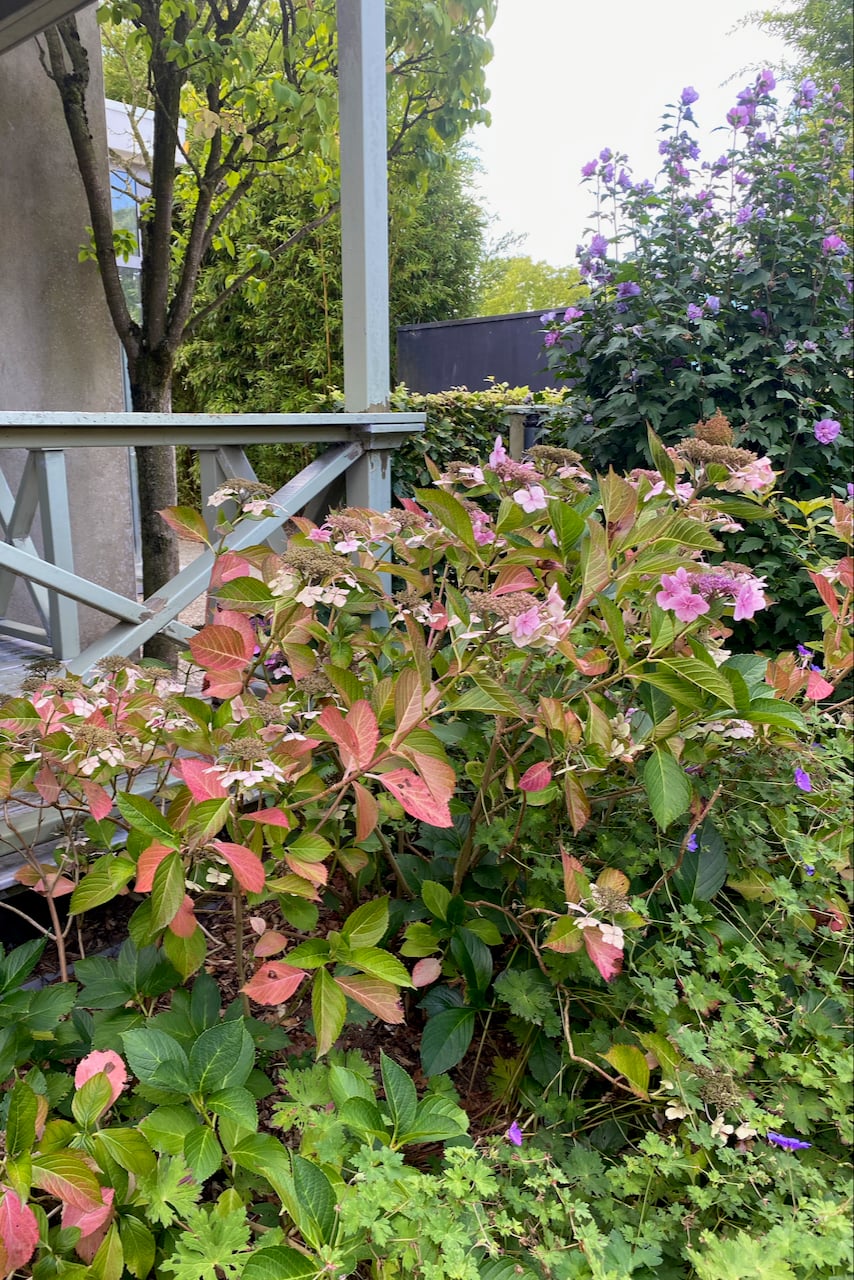
These two details are important when we choose what to plant next to a hydrangea. The companion plant needs to be able to handle part-shade and soil that stays moist.
I’ll walk you through three categories of hydrangea companions and explain the reasoning behind my choices. And you’ll see that it’s not just about choosing plants that thrive in similar conditions.
Pair hydrangeas with other shade-loving perennials.
We’re starting from the premise that you’ve planted your hydrangeas in part-shade, and the taller they get, the more shade they themselves cast upon the ground below. But that space doesn’t have to be wasted. Plant a few shade-loving perennials to accompany your hydrangeas and fill up the space around them.
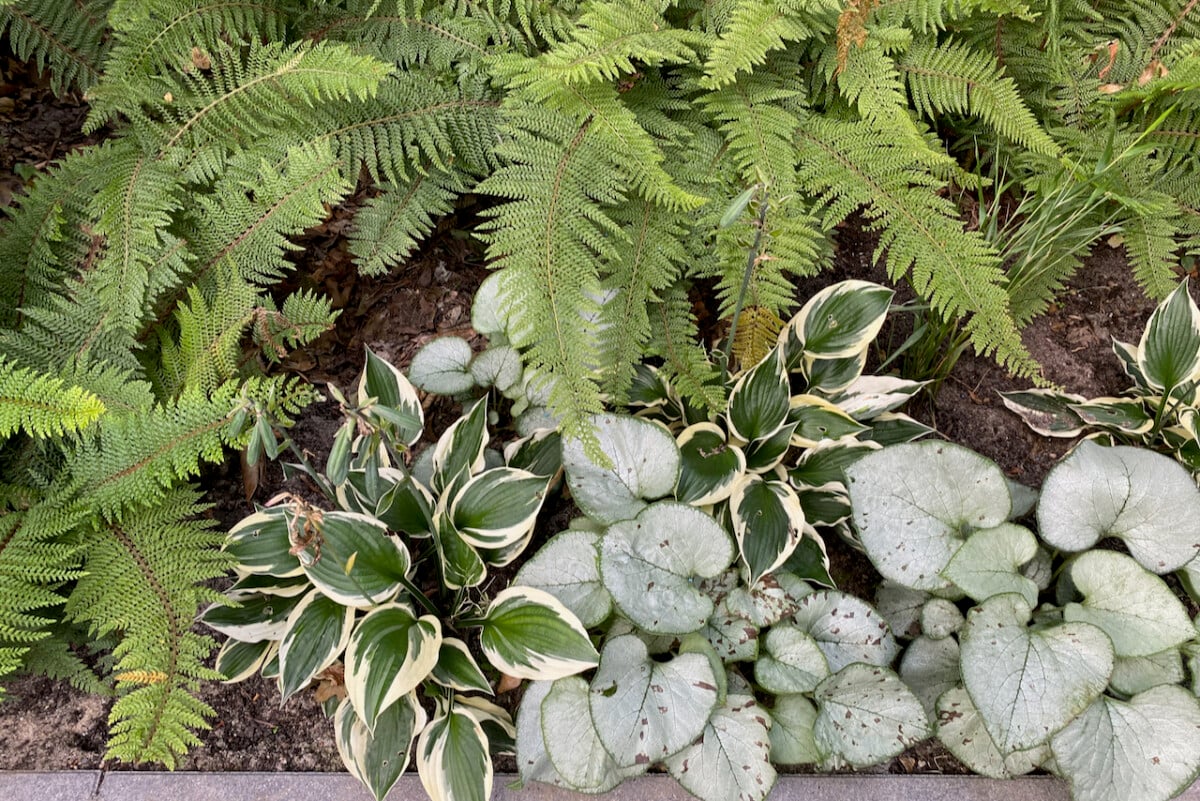
My one recommendation would be to choose hydrangea companion plants that will always stay shorter than this shrub. As always, make sure you consider the height of the plants at maturity, not just how tall they are when you’re putting them in the ground while they’re young. The height of the companion plant shouldn’t reach or overtake the height of the hydrangea shrub canopy.
3 Plants That Fit the Bill
Hostas
As far as I’m concerned, hostas and hydrangea are a match made in shade garden heaven. Hostas need the shade, and hydrangeas are happy to provide it. The thick and ribbed hosta foliage is a good indication that this beloved ornamental has the ability to retain water, so hostas won’t thirstily gulp down the water meant for hydrangea.
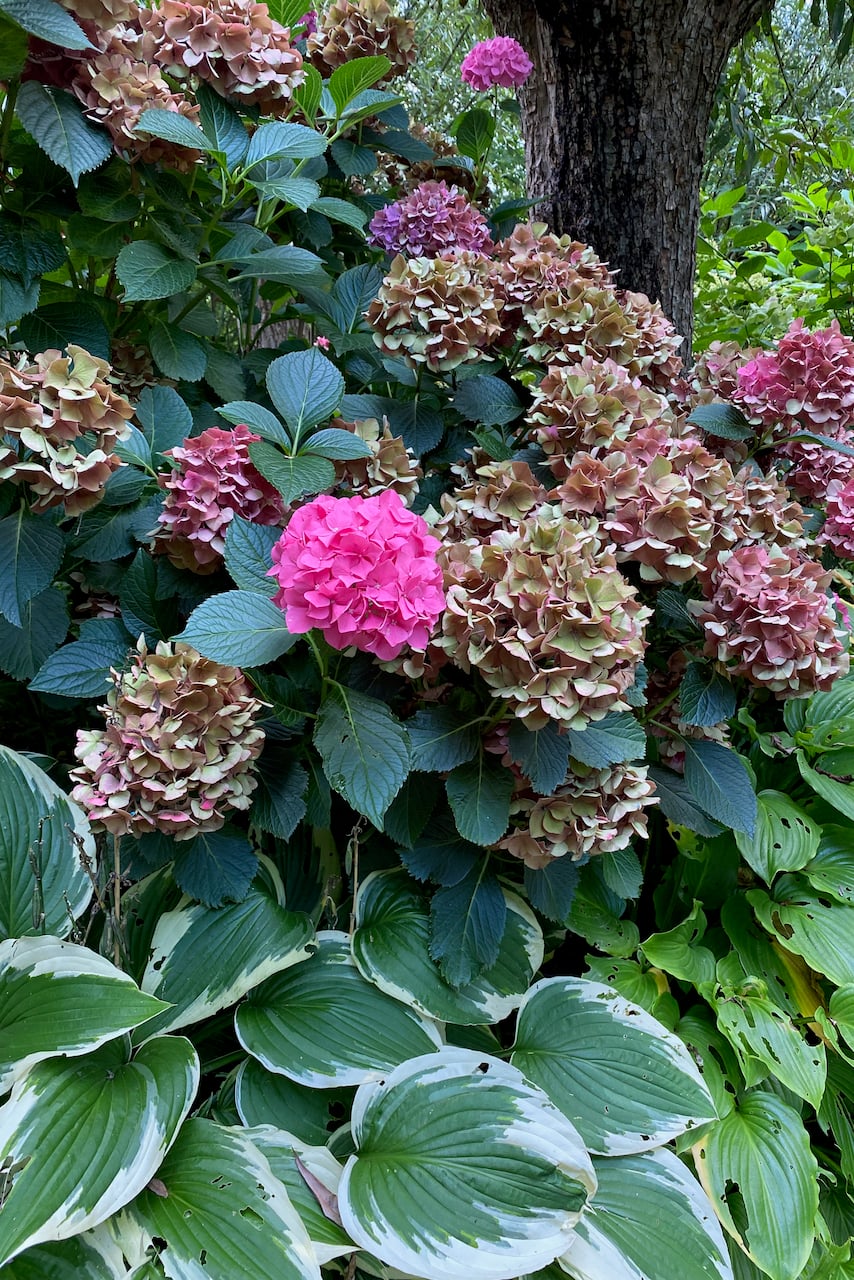
And while hydrangeas will be covered in an abundance of blooms, hostas will provide a more muted backdrop. It doesn’t mean that it has to look boring, since we have so many hosta choices nowadays: from the variegated ones with golden edges to the blue-green hostas topped with lavender bell-shaped flowers.
Perrennial Geraniums
Just like the hostas above, cranesbill geraniums (aka, the hardy ones, that grow as perennials) love growing in nutrient-rich, well-drained soil tucked away in part-shade.
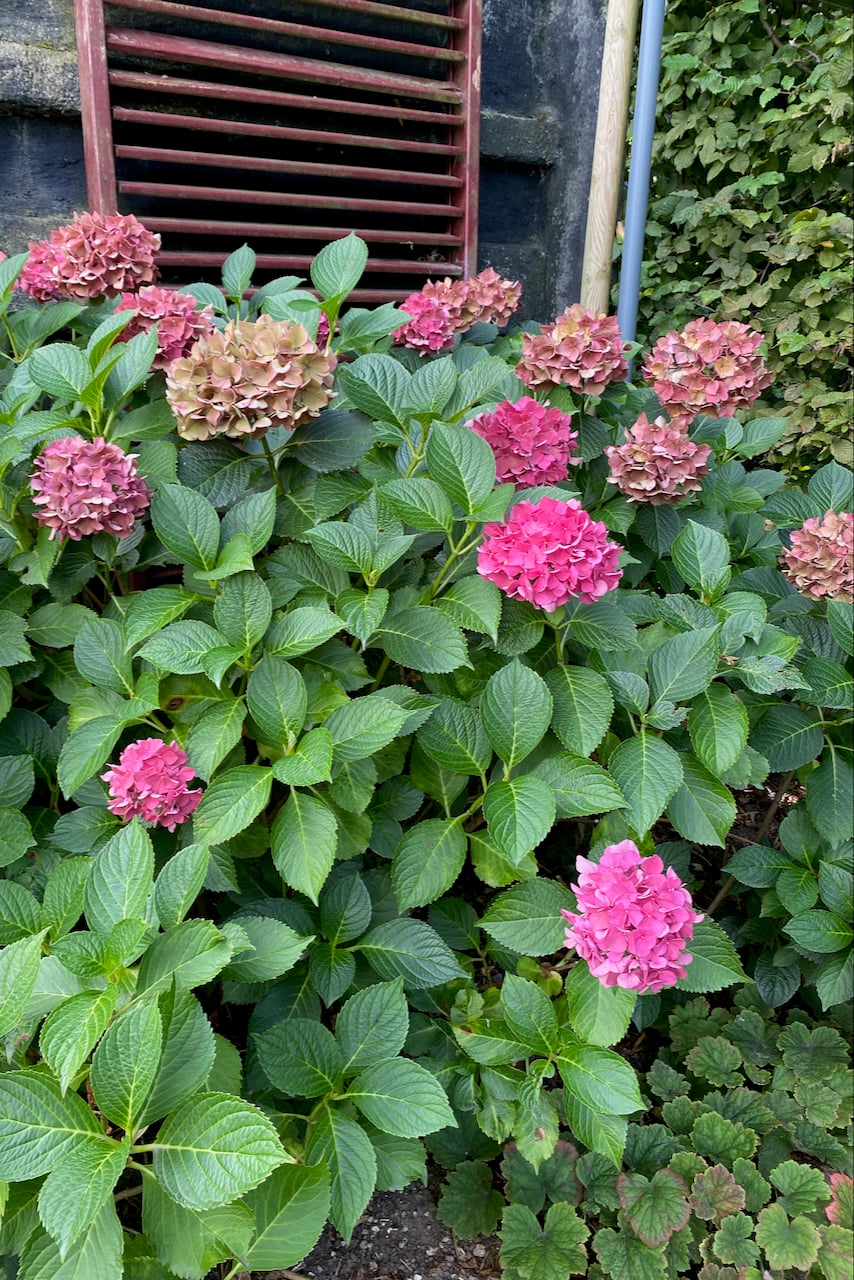
Perennial geraniums don’t require a lot of maintenance and have the added advantage that, growing so close to the ground, they can act as a living mulch to hydrangeas. This means they help lock moisture in the soil and keep the root zone cool. Their mounding growth habit and cute, dainty flowers are two more reasons why they make excellent hydrangea companion plants.
Heucheras
You may know heucheras as coral bells, a nickname it sports due to the shape of its flowers. I don’t think I’ve met anyone who planted heuchera for the flowers. I mean, look at that foliage. It’s curvy and textured and comes in so many colors. It’s a wonder anyone even noticed the flowers long enough to name them.
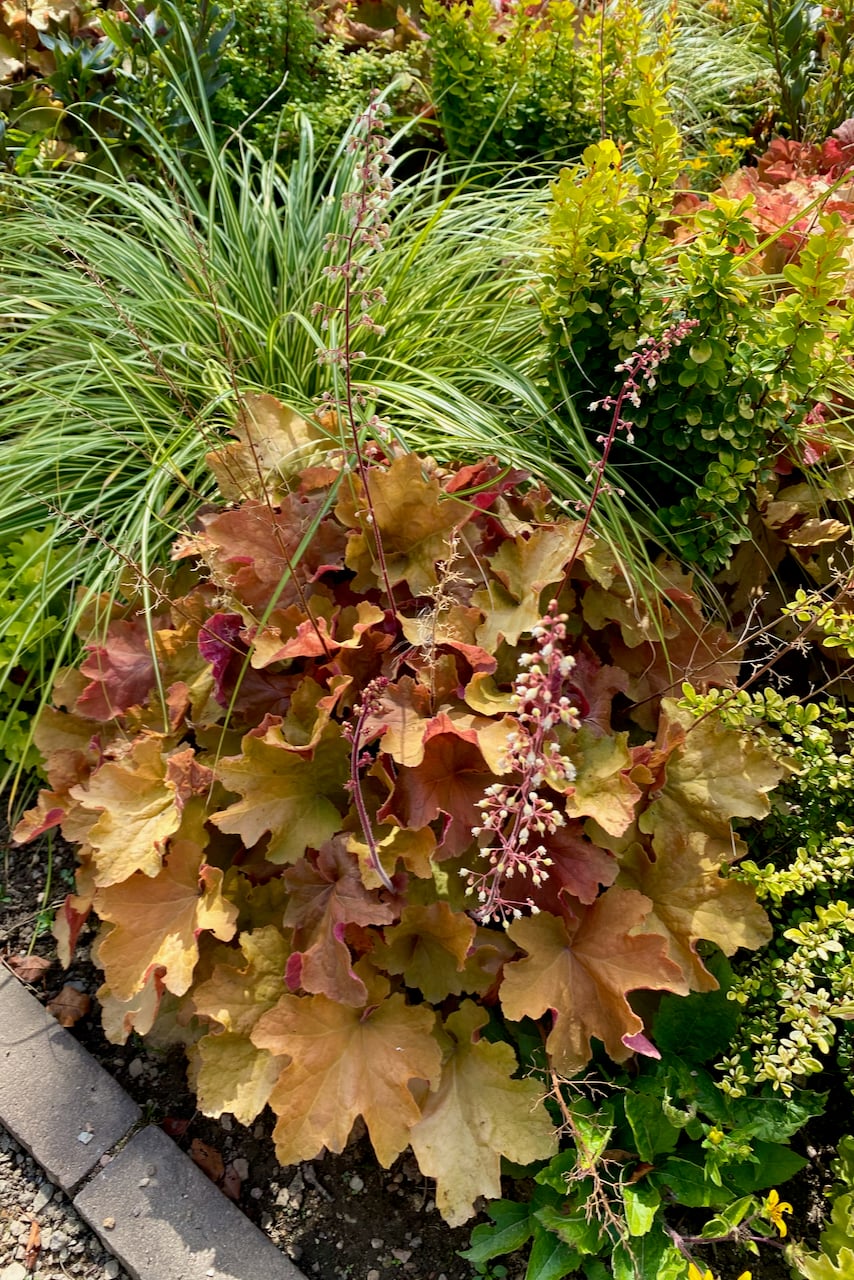
Planting them next to hydrangeas makes sense because heucheras are such hardy perennials. They tolerate all types of soil conditions, and they thrive in partial shade, just like hydrangeas. There are so many colors to choose from when you underplant hydrangeas with coral bells: from purple to orange to deep green and a myriad of variegated options. The only difficulty I have is choosing which one I like best.
Pair hydrangeas with low-water ground covers.
Here’s my reasoning: Plant a drought-resistant ground cover that doesn’t need as much water next to young hydrangeas that are still very thirsty. The hydrangeas will gobble up the moisture while the ground covers will act as a barrier against evaporation.
3 Plants That Fit the Bill
Sedum Groundcovers
My first revelation about planting a low-growing sedum as a groundcover came when I was planting this shallow garden. What started as just a pot of white stonecrop (Sedum album) quickly expanded into a whole patch.
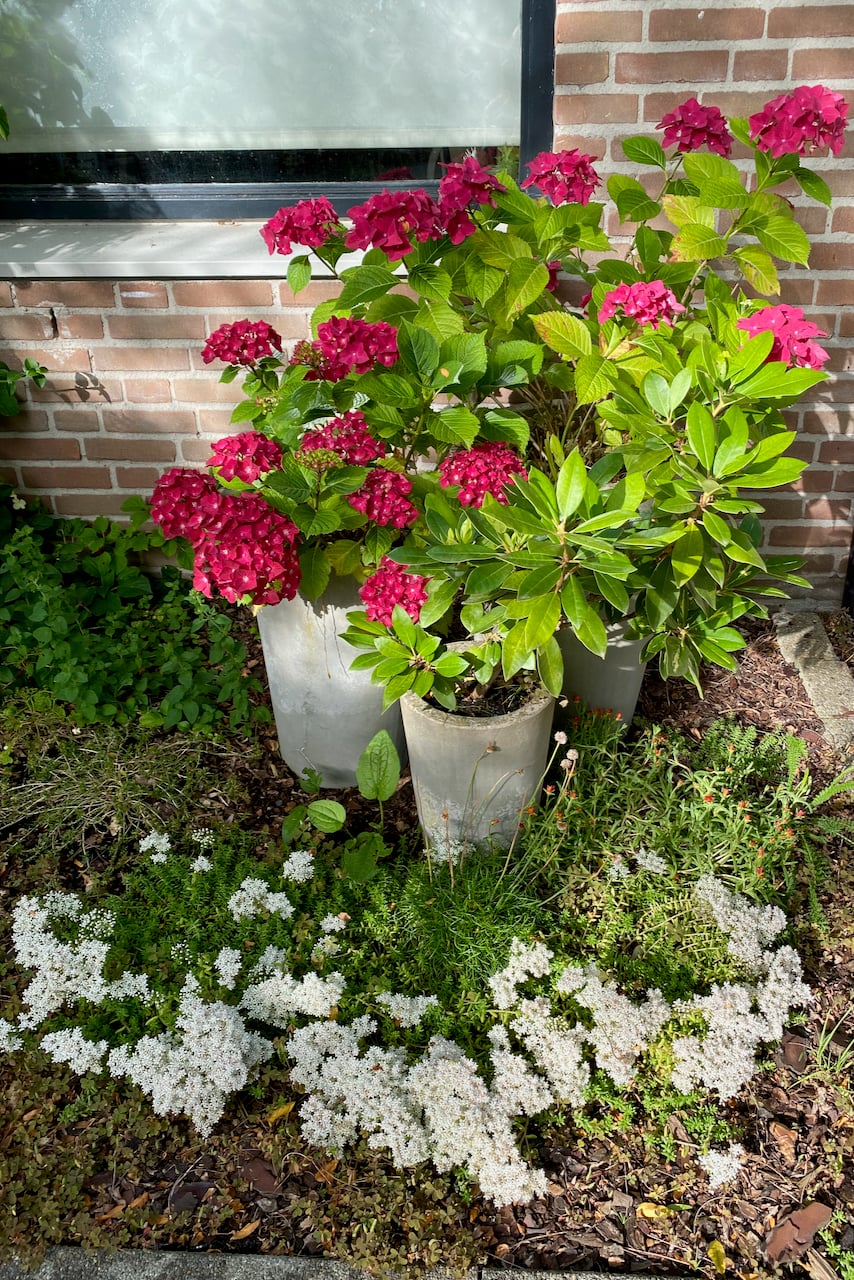
Once it bloomed into a sea of foamy white flowers, I was hooked. I’m a big fan of using planting solutions that are less obvious, so I started to use this juicy groundcover as a living mulch around some of my perennials.
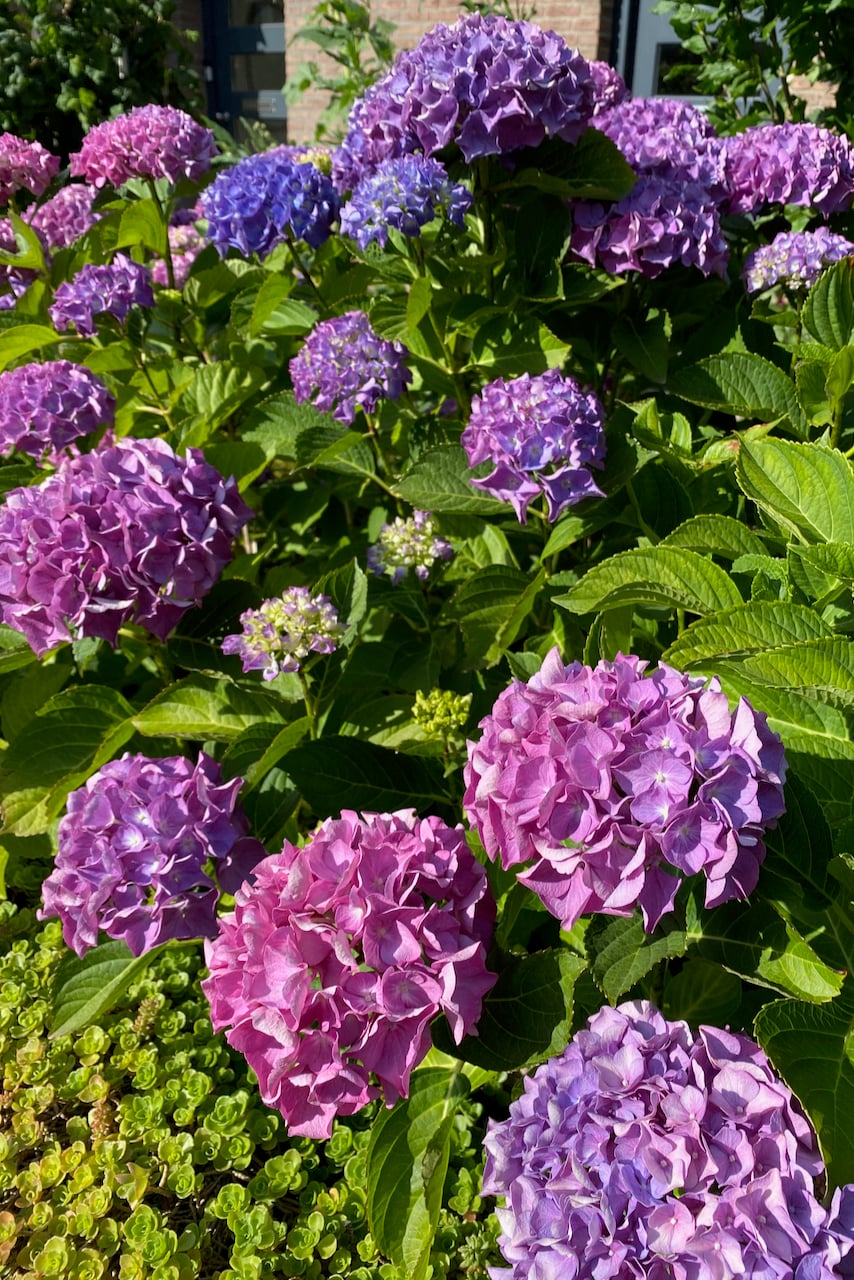
Now you may notice that it’s succulent, and you may wonder whether it won’t suffer growing at the feet of the hydrangea, where it gets pretty shaded. Nope, it won’t. Stonecrop succulents can handle part shade very well. They might get a bit stretchy in the darker months, but they will bounce back when the sun starts shining again.
Evergreen Mounding Grasses
I know we probably don’t think of ornamental grasses as groundcovers, but we should. Of course, I’m talking about the ones that stay low to the ground and have a mounding growth habit. First, I’d encourage you to see if you can find grasses native to your area that stay green over the winter (a “nice to have”, but not always feasible) and can handle part-shade (a “must-have” when joining hydrangeas).
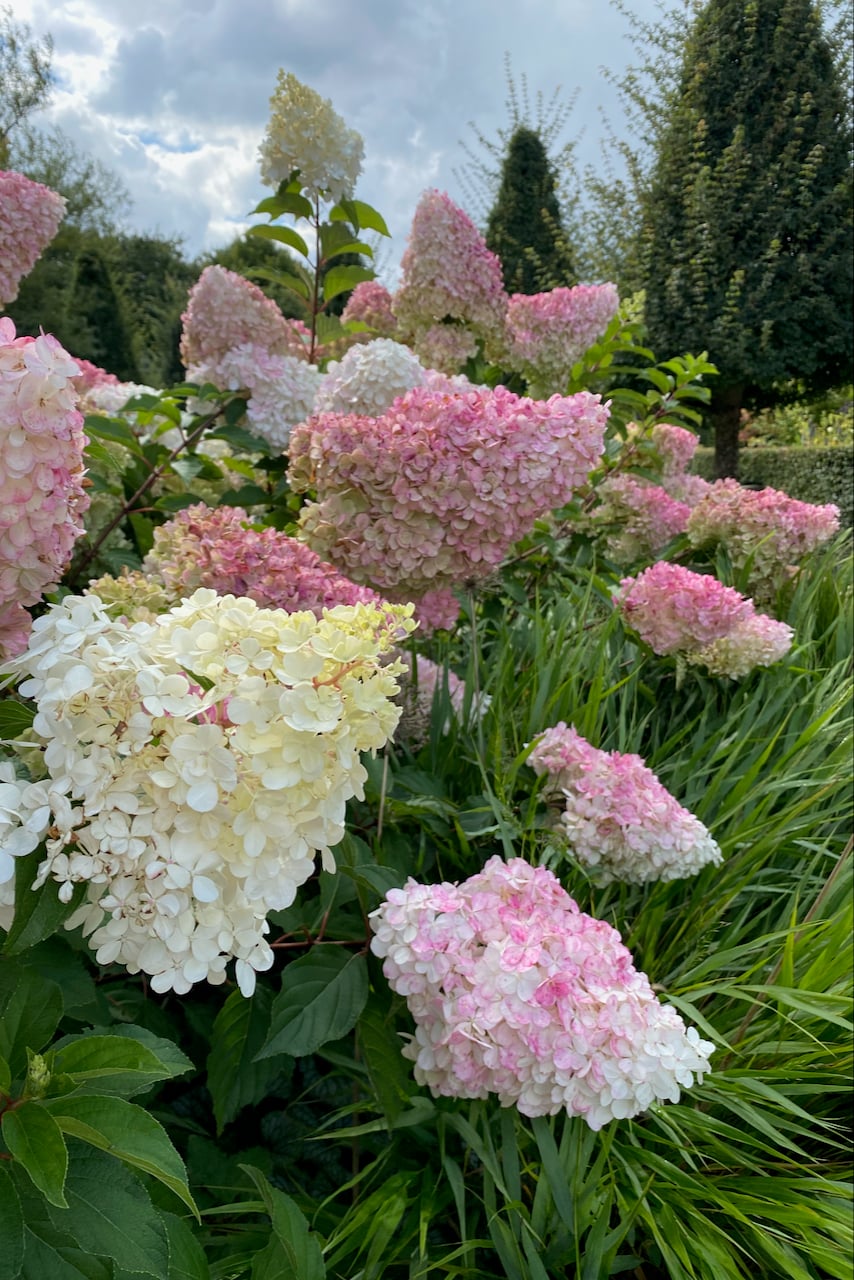
Not all evergreen grasses thrive in partial shade, but Japanese forest grass (Hakonechloa macra) does, and it maxes out at two feet tall (although having it around one foot tall is more common). It flowers in the summer, but like most grasses, the flowers are not as spectacular or rich as the foliage. And speaking of foliage, you can get it in shades of gold or a variegated pattern.
Elephant’s Ears
If you plant elephant’s ears (Bergenia) next to your pink hydrangea, don’t blame me if you keep doing double takes in early spring, thinking your hydrangea is already blooming.
Yup, that happened to me, and my heart skipped a bit when I mistook the bergenia blooms for hydrangea blooms. They are the exact same shade of hot pink. But it was early March, and my brain catastrophized about losing all the hydrangea flowers in a frost. Good thing it wasn’t hydrangea flowers.
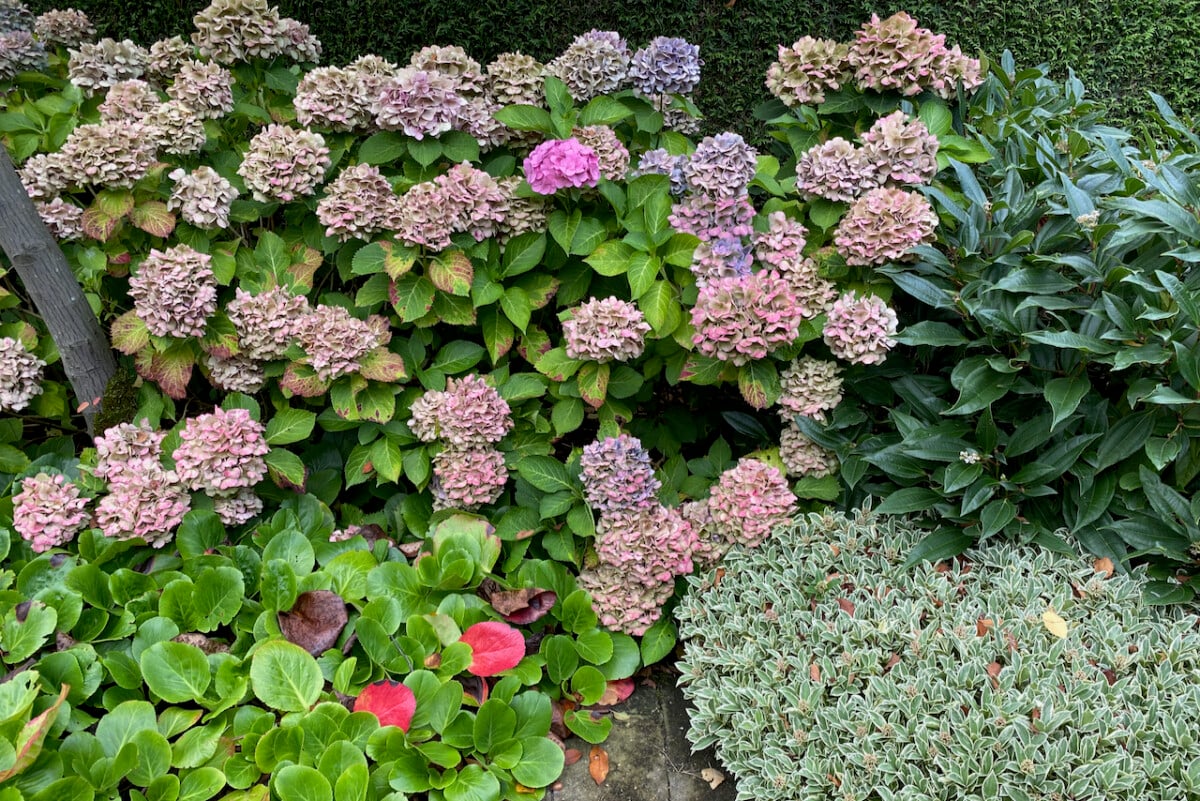
The thick, leathery leaves of Bergenia help it retain moisture for a long time, which means it won’t compete with the hydrangeas. Elephant’s ears also stay low to the ground, and in milder and temperate climates stays semi-evergreen all winter long.
Pair hydrangeas with pollinator-friendly plants.
I hate to be the bearer of bad news, but most hydrangeas are pretty useless to pollinators. Unless you’re growing Hydrangea arborescens, aka the smooth-leaf hydrangea, which is native to the United States. But even then, you’d have to be growing the wild version and not a modified cultivar such as the popular Annabel, which does not produce pollen or nectar.
Generally, hydrangeas don’t offer much to pollinators. And if we’re talking about the popular mophead hydrangeas, they don’t offer anything at all. Despite the high number of flowers contained by every inflorescence, there’s no pollen or nectar to be found.
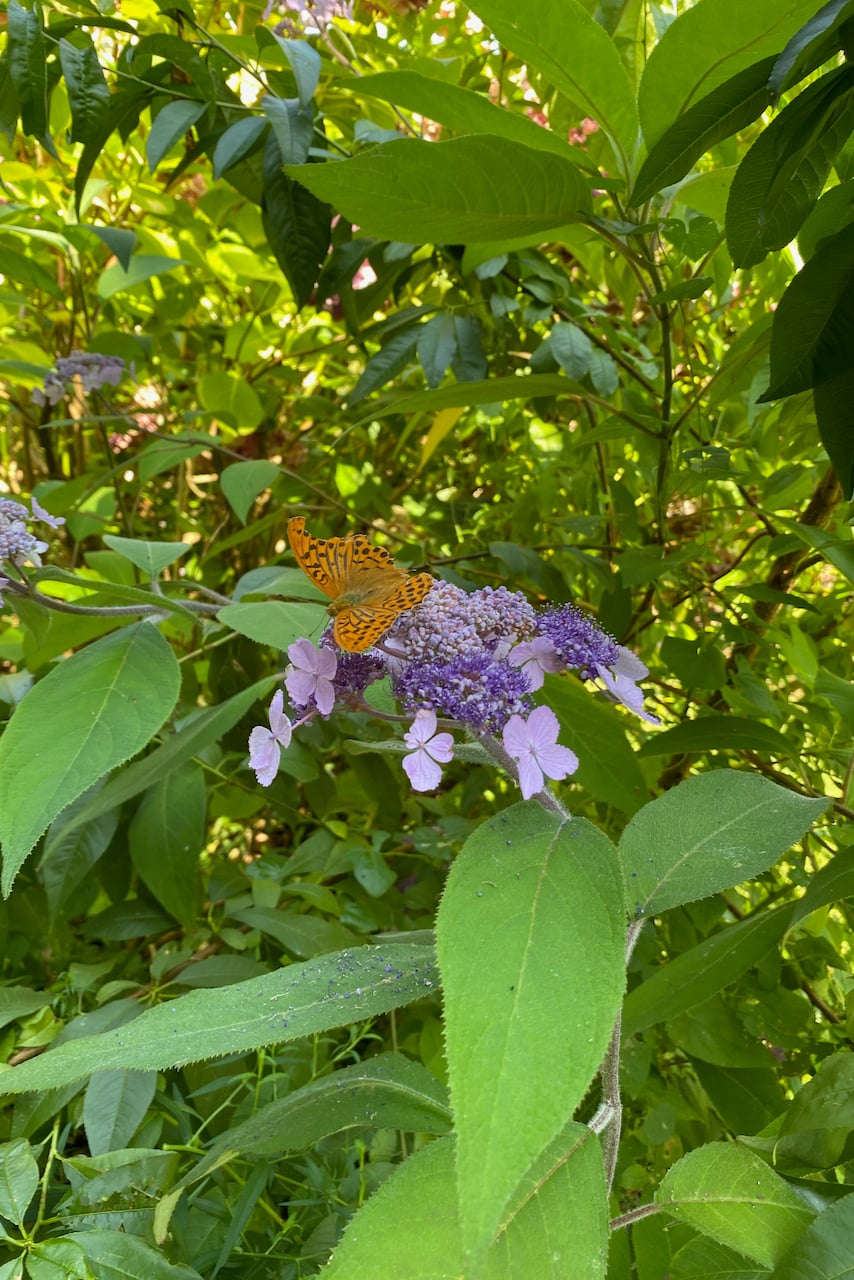
Lacecap hydrangeas do have some fertile flowers that produce pollen. It’s actually the lacey part of the lacecap, those white polka dots in the center. The pretty flowerheads around the perimeter of the bloom are sterile and only meant to trick the pollinators and attract them to the middle.
Naturally, if we want a garden that’s welcoming to pollinators, matching hydrangeas with perennials that attract them is the easy fix.
3 Plants That Fit the Bill
Rudbeckia, Black-eyed Susans
I may be a bit biased, but I think black-eyed Susans (also known as Rudbeckia) go with anything and everything. True, Rudbeckia is generally considered a sun-loving perennial, so it may not make sense to plant it in part-shade. But I treat it more as an “anywhere and everywhere” perennial myself.
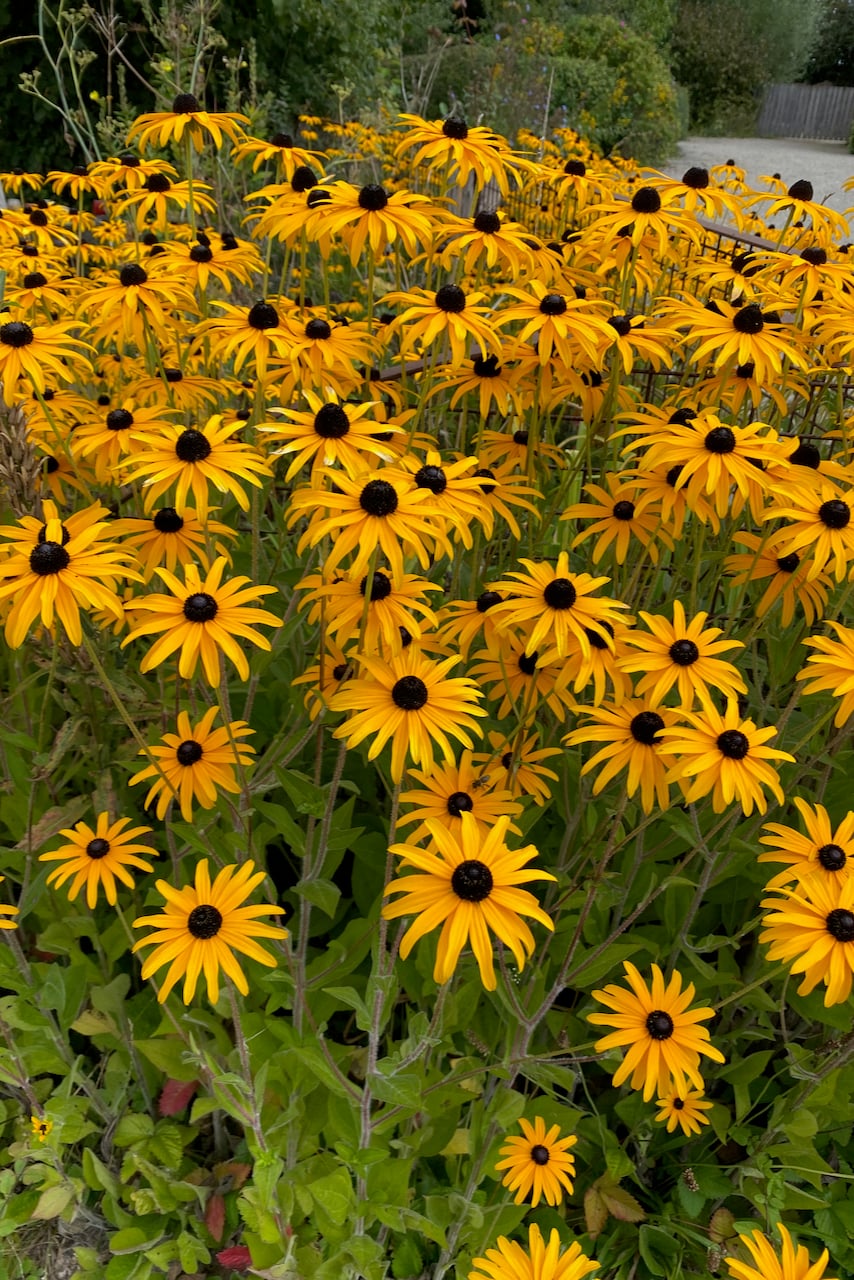
Black-eyed Susans do really well in part shade, so they are perfectly suitable as hydrangea companions. Bonus points, this perennial attracts pollinators and adds an intense burst of color to the pink/blue/white monolith that is hydrangea.
If you’re growing a smaller cultivar of hydrangea, just know that there are compact Rudbeckia cultivars, too, that won’t overwhelm it. ‘Little Goldstar’ and ‘Indian Summer’ are two of my favorites.
Echinacea
I would make the same case for cone flowers (also known as echinacea) that I made for black-eyed Susans. Even though they are happy and thriving in full sun, these sturdy perennials can also handle part shade. With a minimal decrease in blooming, I might add.
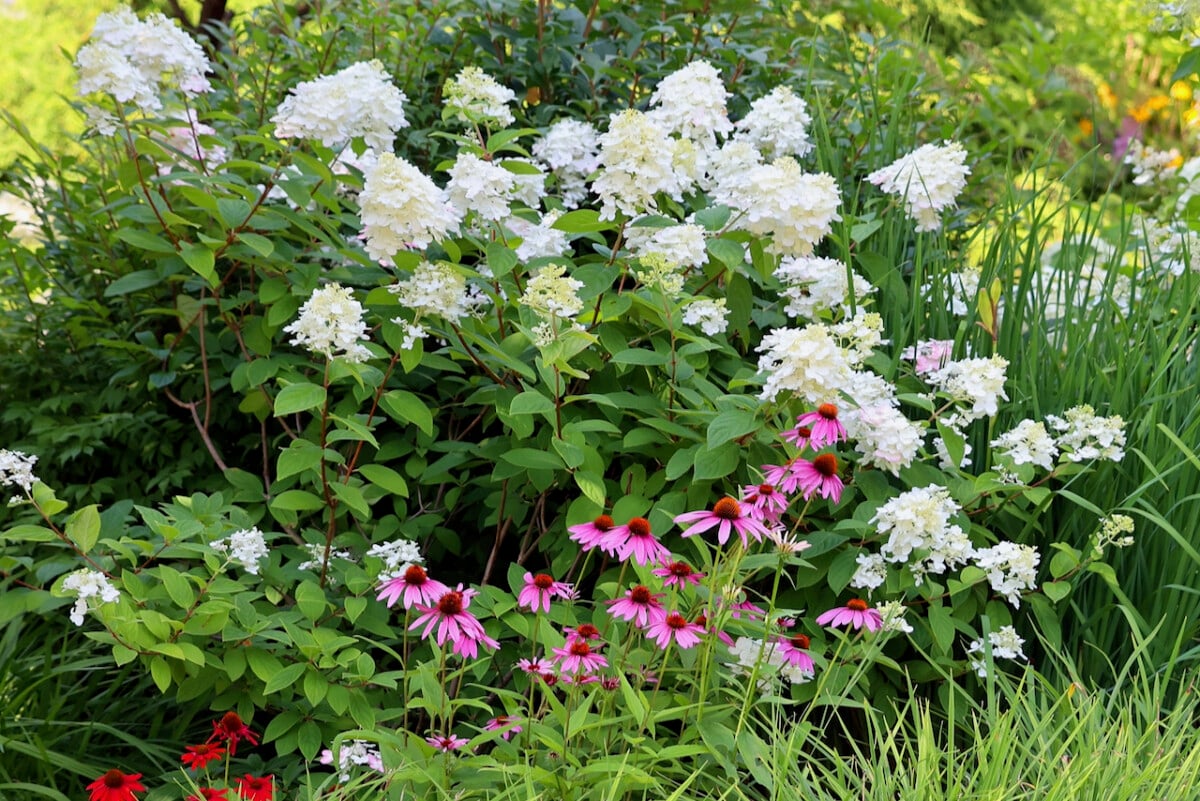
And they’ll attract pollinators like no other. Since they bloom around the same time as hydrangeas, cone flowers only add to the intensity of the color. It will be pink as far as the eye can see. Or blue, if you’re growing on acidic soil. The nice thing about coneflowers is that they do well on either side of the acidic to alkaline soil spectrum.
Echinops
I know that echinops are not as popular as rudbeckia and echinacea. But isn’t it time we changed that? The main reason is that they’re an eclectic pollinator buffet.
Echinops are just as tolerant of part-shade as they are of full sun. They can handle all manner of soil, including the acidic soil that hydrangeas tend to love.
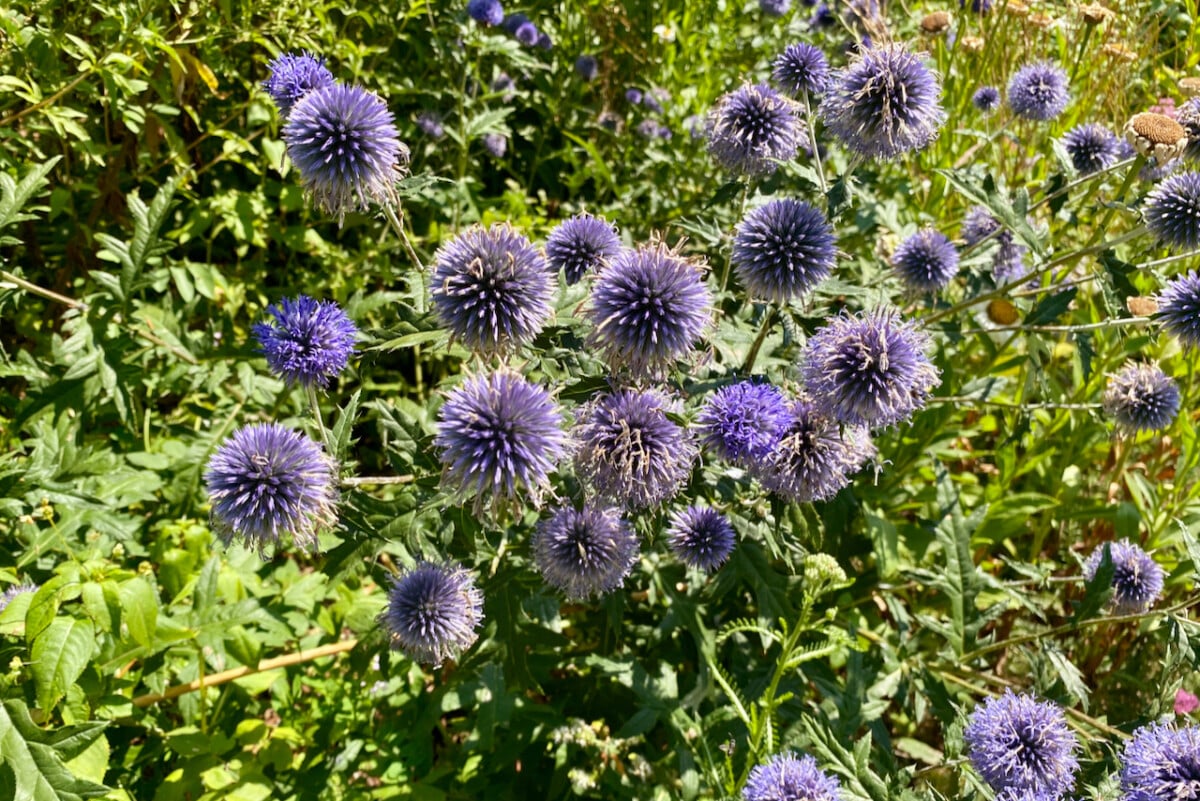
Echinops are also drought-resistant, so they shouldn’t gobble up too much of the water meant for hydrangeas. And another reason why I would pair them with this popular shrub: their electric blue color provides such a contrast, whether you’re growing pink, blue or white hydrangeas.
Don’t pair hydrangeas with sun-loving, thirsty plants
Here’s something I debated whether I should include or not. You may have noticed that so far we’ve paired hydrangeas with either:
- shade-loving perennials that love moisture just as much;
- shade-tolerant perennials that don’t need that much water;
- sun-loving groundcovers that don’t need that much water.
So there’s one category missing from our permutations. And that’s the one I would advise you to avoid.
I’m talking about sun-loving plants that need a lot of water.
Let’s take dahlias as a classic (and extremely popular) example. They are incompatible because their light needs are drastically different. Most dahlias prefer full sun, the kind of sun intensity and duration that would scorch a hydrangea. On the other hand, their water needs are very similar – both are thirsty plants. So in a period of summer drought, they may compete for this precious resource.
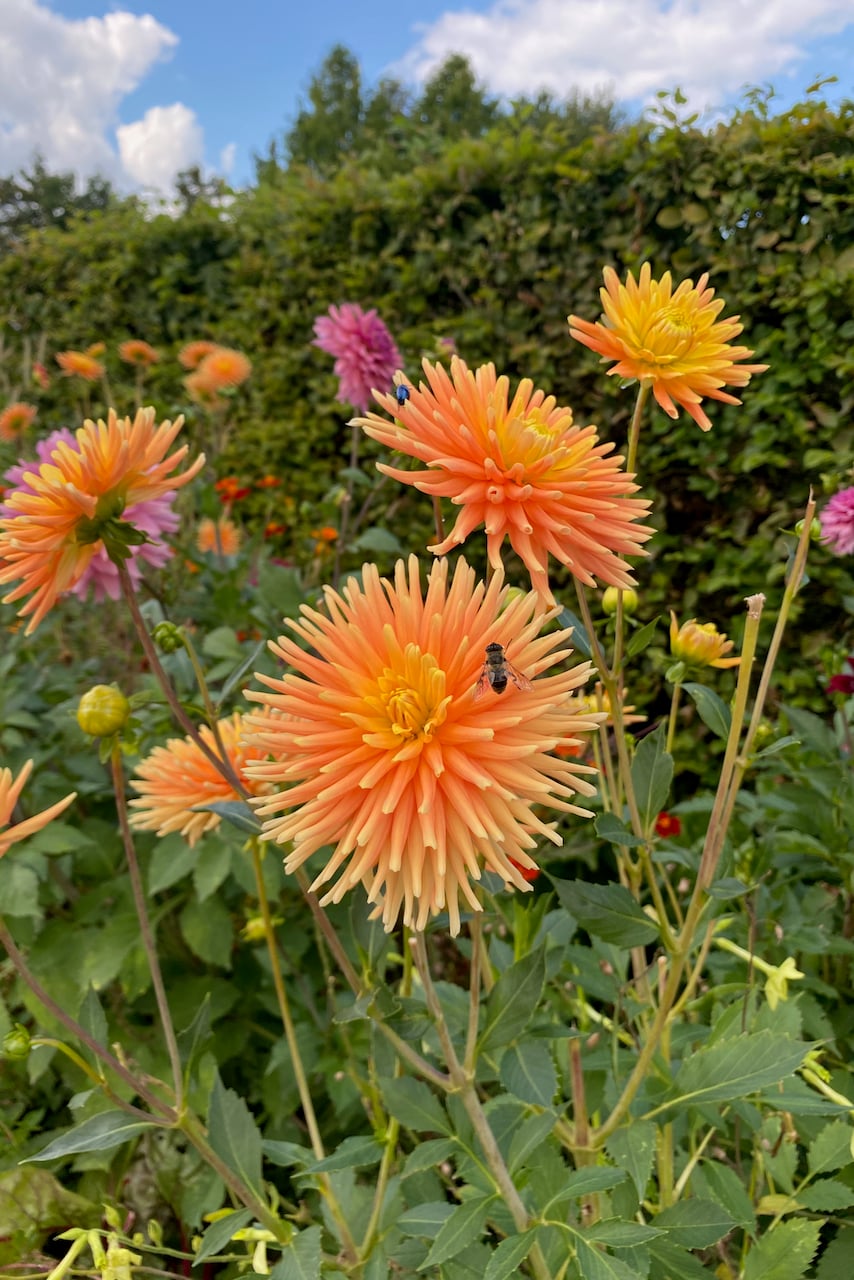
I’m not saying you shouldn’t, just that you should proceed with caution when you’re pairing two ornamentals that are known for needing a lot of water. Especially with summers getting drier and hotter.
Yes, I’m sure that we have readers out there who are ready to disagree with me on this piece of advice. If you’re a gardener who has successfully paired dahlias and hydrangeas, my hat comes off in acknowledgment of your green thumb.
But be honest and realistic here for a second. How old and established are these plants in your garden? Would you plant them again right next to each other if you were to plant them tomorrow?
Get Garden Notes From Tracey, Right to Your Inbox
Pull up a chair on the front porch. Join 54,000+ gardeners who get Tracey\'s friendly notes, seasonal to-dos, and hands-on tutorials three times a week.