

Schlumbergera – no, it’s not the name of a new Belgian craft beer brewery; rather, it’s the genus of cactus we’re going to talk about.
Most of us know it as the Christmas cactus. Or for some of us, That Plant in the Living Room That Never Blooms.
If you’ve got a Christmas cactus, and who doesn’t these days, there are some important things you need to know about it, especially if you want yours to bloom.
It seems that getting these silly things to flower and figuring out if you have a Christmas or a Thanksgiving cactus are the two things everyone wants to know about.
While both of these concerns are important (and we’ll discuss them here), there are some pretty cool things you should know about these old-fashioned plants that will make it easier to keep them thriving and maybe even producing fruit.
Yes, you read that right. Fruit.
Keep reading to learn more about this humble holiday cactus.
1. Christmas Cactuses Are the Black Sheep of the Cactaceae Family
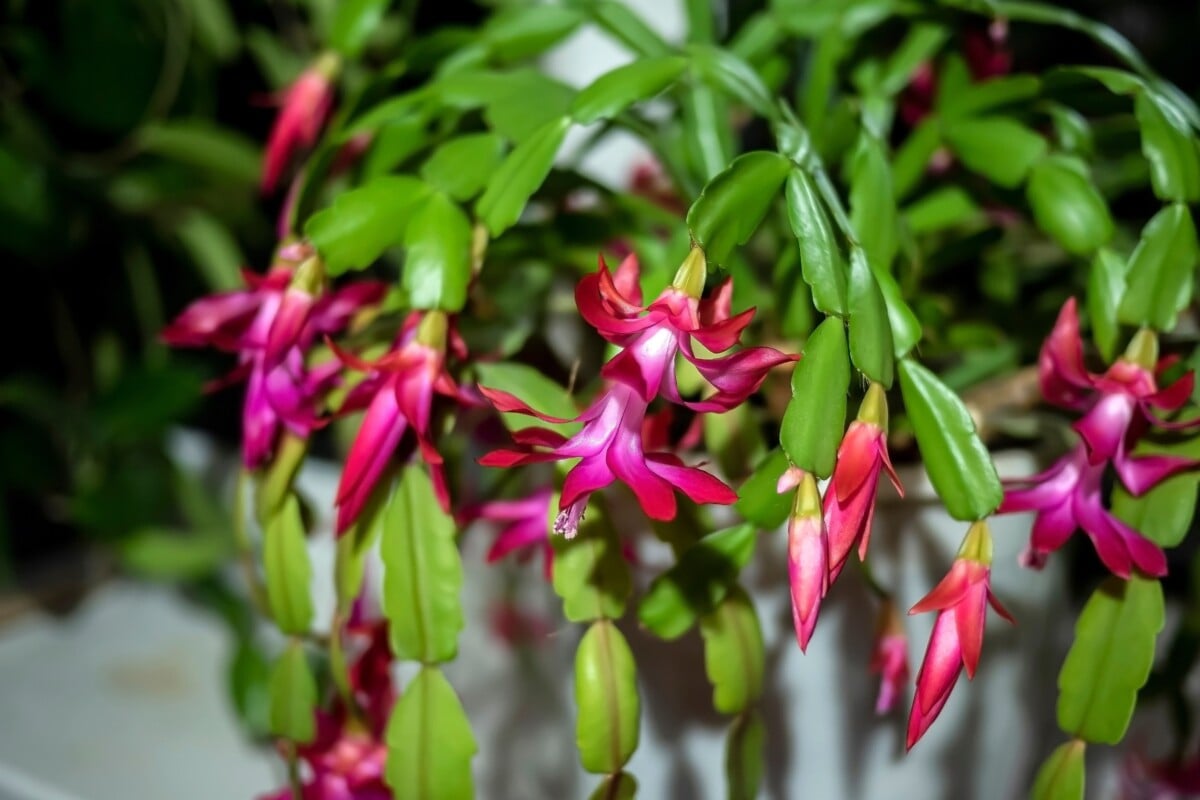
When you look at a Christmas cactus, you don’t really think ‘cactus’, do you? After all, where are the poky spines? And the shape is all wrong, too. Unlike the majority of cacti, schlumbergera are native to the coastal rainforests of Brazil, rather than deserts.
Truth be told, they look more like a succulent than a cactus. Yet, Schlumbergera are true cacti.
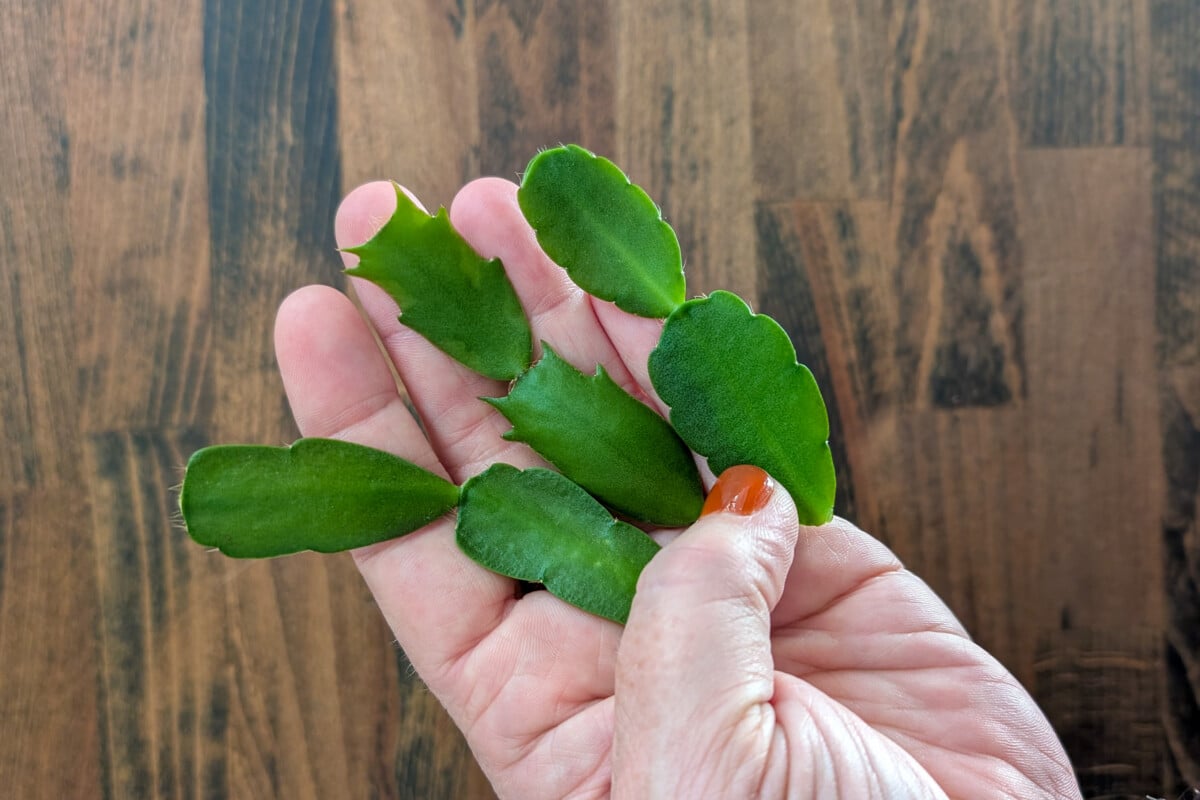
They have areoles (little bumps that produce spines), even if the spines look more like tiny hairs, and they have photosynthesizing stems instead of leaves. Those would be the individual segments, called cladodes.
These cacti grow differently from their desert-dwelling family members.
You can find them growing on rocks or trees in the coastal mountainous jungles of Brazil. Yup, rocks and trees. Plants that grow symbiotically with trees are called epiphytes. They don’t really grow in the ground. Their roots grip and grow among the crevices of trees and the organic flotsam and jetsam that naturally collect there.
That’s something to keep in mind the next time you reach for that bag of all-purpose potting soil. You’d be better off using a potting mix specifically formulated for epiphytes, such as this one.
2. Flor de Maio
The name ‘Christmas Cactus’ has done more to confuse and frustrate houseplant owners expecting blooms on December 25th than you can shake a jingle bell at! It’s all a marketing gimmick.
The Christmas cactus doesn’t even bloom in December in its native Brazil.
It blooms in April and May, which is why in the southern hemisphere, these plants are known as Flor de Maio or May Flower.
Heck, even its European moniker of ‘crab cactus’ would be less confusing. But no one wants to buy a crab cactus as a gift for someone around the holidays. Well, maybe for their mother-in-law. So, retail growers began calling them Christmas cactus, and so the confusion began. (Hopefully, it stops when you finish reading this.)
3. Chances Are You Own a Thanksgiving Cactus, Not a Christmas Cactus
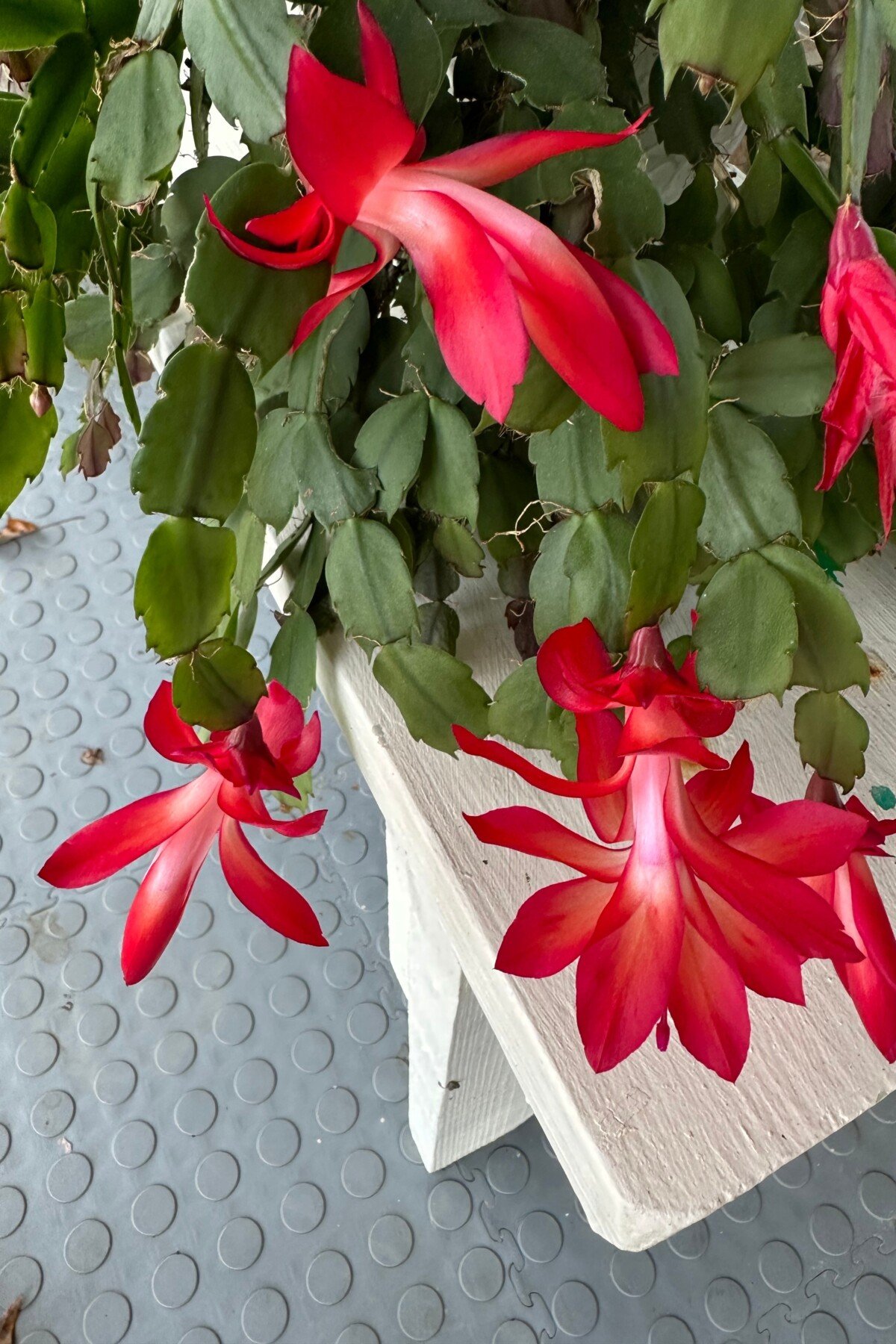
It comes as a shock to every ‘Christmas’ cactus owner when they discover their plant is actually a Thanksgiving cactus (Schlumbergera truncata) like the one above, and not a true Christmas cactus (Schlumbergera x buckleyi).
“Wait? What? What do you mean it’s not a Christmas cactus?”
The vast majority of holiday cacti for sale each year are Schlumbergera truncata, aka the Thanksgiving cactus.
I’ll tell you a little secret about the true Christmas cactus, but first, here’s how to tell them apart.
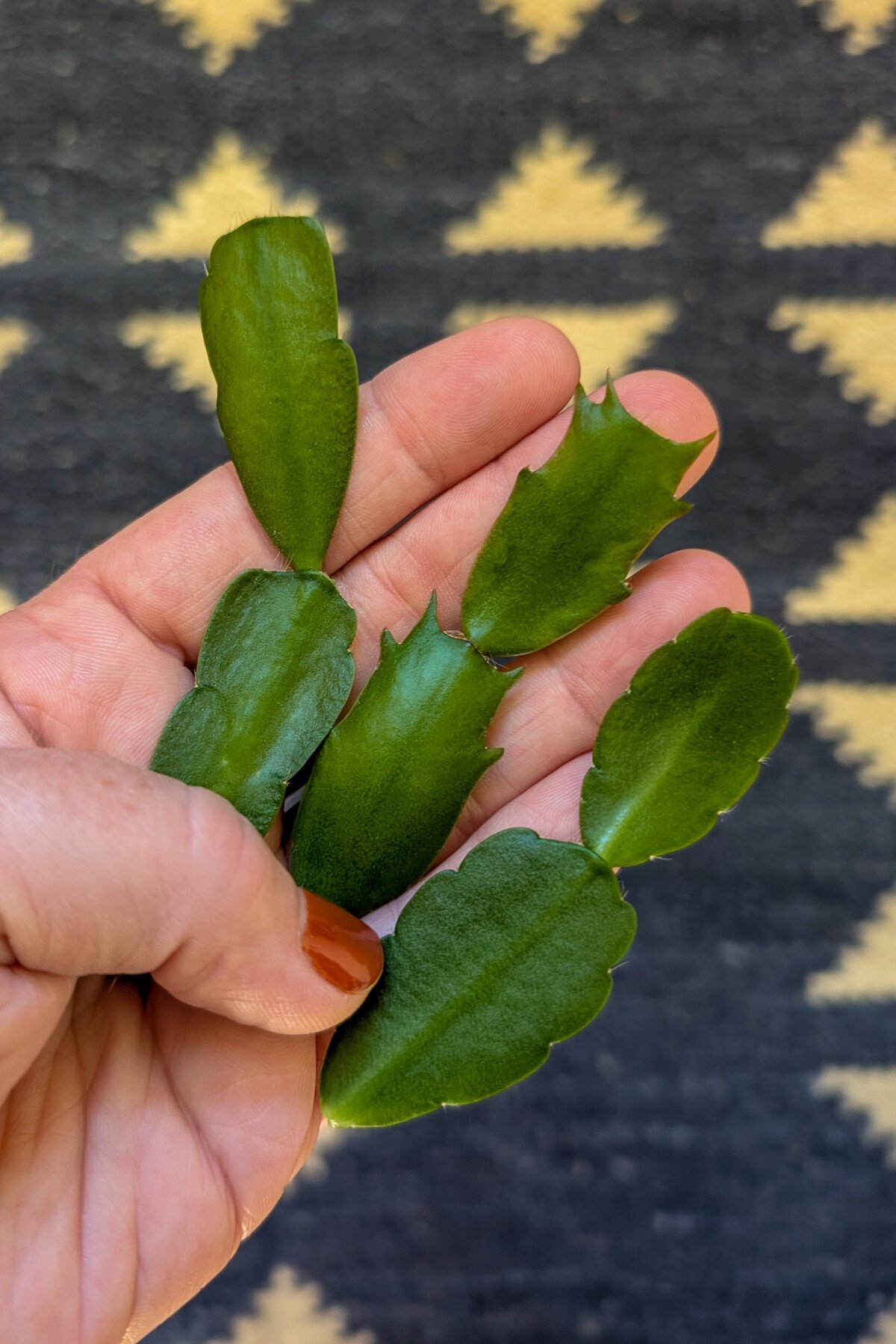
- Schlumbergera x buckleyi, the true Christmas cactus, has elongated cladodes and no spiny tips. The sides are gently scalloped, but only have two or three scallops. The flowers of the true Christmas cactus droop straight down and have pink pollen.
- S. truncata, or the Thanksgiving cactus, has cladodes that are elongated with spiny tips on either side. You’ll find tiny hairs at the tips. The flowers of the Thanksgiving cactus have yellow pollen, and they sort of look up, almost as if they’re staring at you.
- Finally, if your cactus doesn’t resemble either of these, you might have an Easter cactus. (Guess how it got its name?) This particular plant is not actually a schlumbergera. (I know, don’t look at me, I didn’t name any of these.) It has blossoms that are distinctly different from those of the other two. They are more daisy-like. The cladodes of the Rhipsalidopsis gaertneri or Easter cactus are much more rounded and deeply scalloped along the edges.
Now, about Schlumbergera x buckleyi being the true Christmas cactus.
S. truncata was crossed with Schlumbergera russulliana sometime around 1852 to create, you guessed it, Schlumbergera x buckleyi. Can it really be called the ‘true’ Christmas cactus if the Schlumbergera truncata was around before it even existed? I’ll leave that one for the taxonomists to squabble over.
Schlumbergera have been given as holiday gifts since the middle of the 19th century because in the Northern hemisphere that’s when they bloom. Both are beautiful plants. Both frustrate us when we can’t get them to bloom. Does it really matter if your schlumbergera is a truncata or a buckleyi? Nope.
This is why folks use the name Christmas cactus interchangeably and why retailers have begun referring to them as ‘holiday’ cactus. As my grandmother would say, “It’s clear as mud.”
4. Schlumbergera Can Bear Fruit
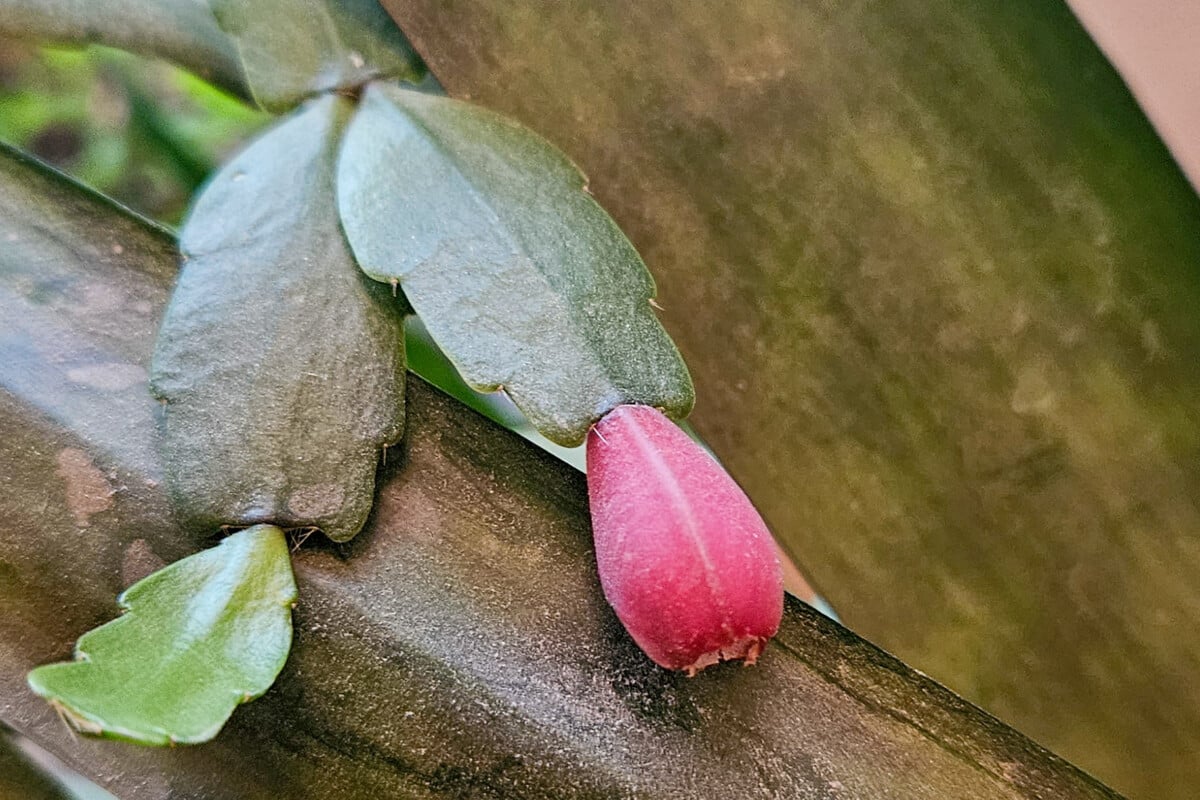
Okay, this one really knocked me for a loop. I’ve been growing schlumbergera for decades, and I didn’t know this until recently. (A special thanks to one of our regular readers, John Stroh, for the photos.) Christmas cactus can bear fruit. (You can join John and the other fabulous readers who get our Rural Sprout newsletter here.)
It seems so obvious when you consider how plants reproduce, especially cacti, but because it happens so rarely with houseplants, it’s not well known.
However, under the right circumstances, a Christmas cactus will bear fruit.
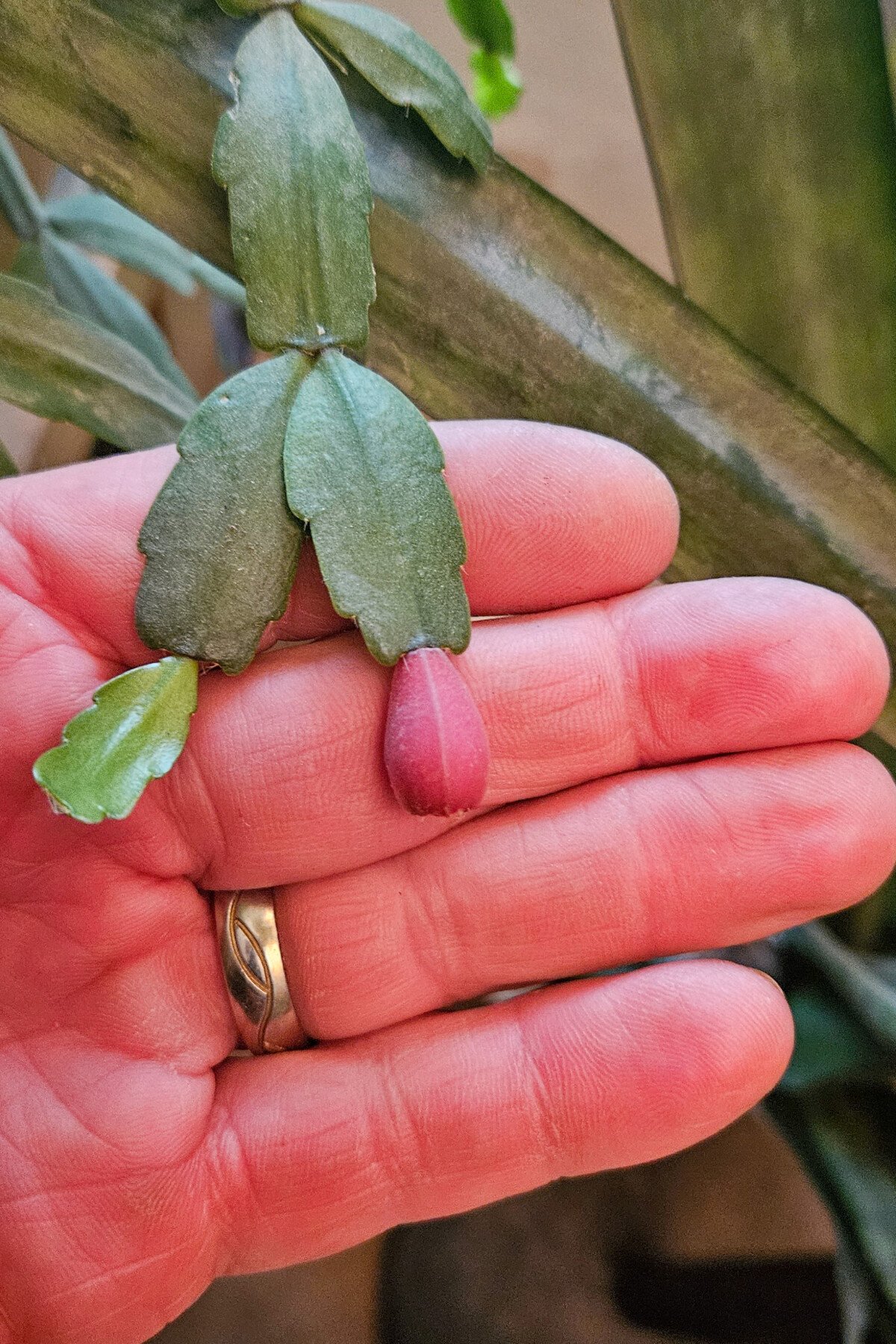
Small grape-like fruits form at the end of the flower (the ovary). Colors depend on the parent, but are usually bright fuchsia, pink or purple. And yes, you can plant the seeds and grow a new plant from them. However, like all hybrids, they won’t be the same as the parent plant, but that’s half the fun.
Yup! Crazy, I know. Most of us will never see one, though, because many things need to happen for fruiting to occur in our homes.
Christmas cactuses are self-sterile, which means they can’t be pollinated with pollen from their own flowers or the flowers of a clone. They have to be pollinated by another schlumbergera. Either a plant of the same species but a different parent, or a Thanksgiving cactus (S. truncata) or S. russelliana.
Next, you have to have blooms from these separate plants available at the same time. If you’re trying to do this with a Thanksgiving cactus and a Christmas cactus, it can be tricky.
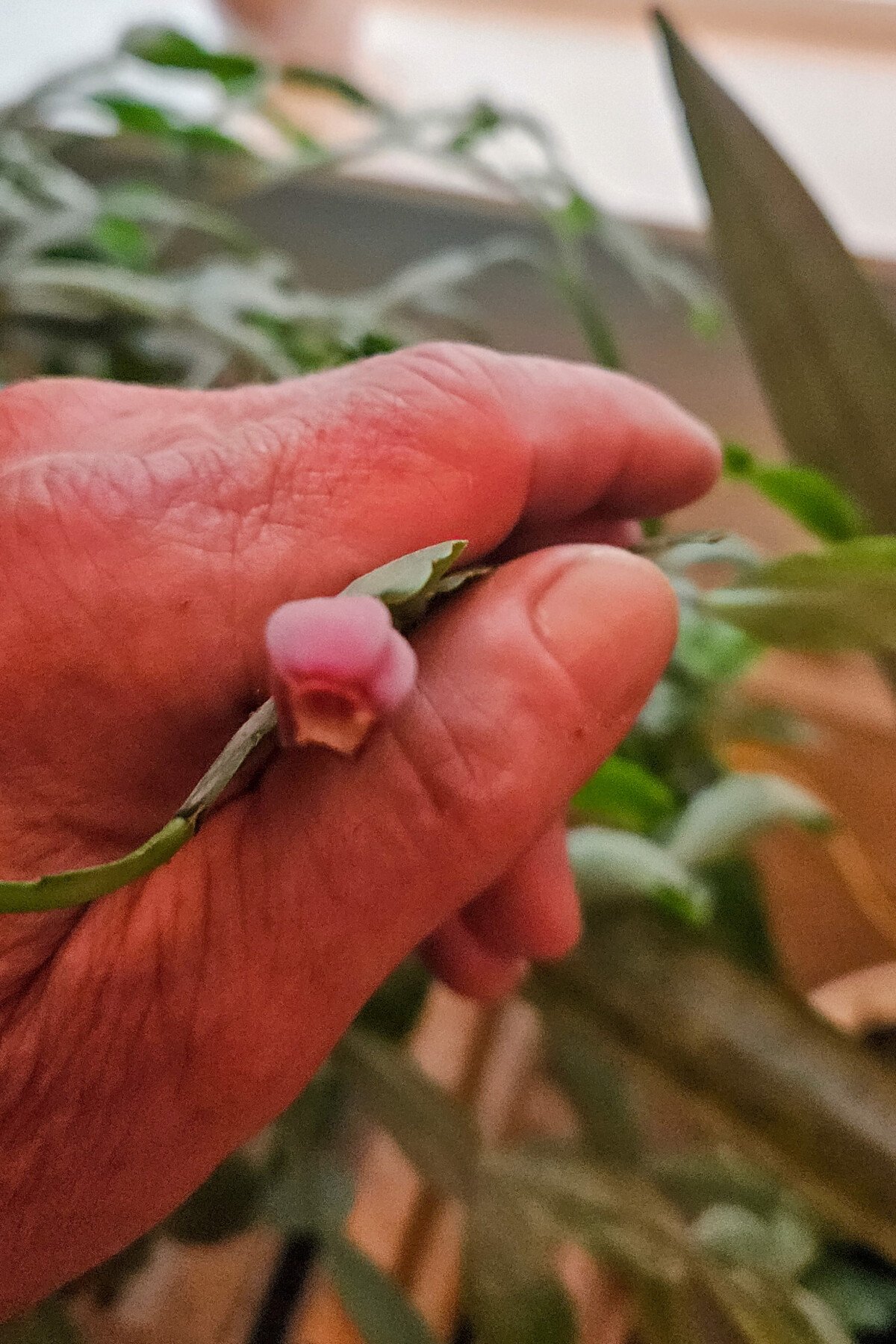
Finally, because the plants are in our homes, there’s no wind or pollinators to transfer pollen from one plant to another, so we need to self-pollinate the plants. You can do this with a small, soft-bristled paintbrush or a Q-Tip. But you need to do it when the flowers are fully open and before they begin to wilt. Each flower is only viable for a few days.
Now you know why so few people know that Christmas cacti can bear fruit.
But guess what I’ll be attempting this holiday season? I’m going to try to knit seven new Christmas stockings for the family before Christmas Eve. Oh, and I’m going to try to get one of my Schlumbergera to produce fruit.
And because I know someone will email me and ask, yes, the fruit is edible, but from reports from the few people who have eaten them, they’re “meh” in flavor. Just as with foraging, edible doesn’t always mean worth eating, which leads me into our next segment.
5. The Holiday Plant Preferred by Pet Owners

Unlike holly and mistletoe and amaryllis and paperwhites and wintergreen and poinsettias and what seems like all the other fun holiday plants, all Schlumbergera are pet-friendly and non-toxic for dogs and cats. Humans, too, should your Christmas with the family become so stressful that you find yourself chewing on your Christmas cactus.
6. Your Christmas Cactus Deserves a Summer Vacation
Okay, you’ve done everything you’re supposed to, and you still can’t get your Christmas cactus to bloom. You’ve given it plenty of light and fertilizer during the growing season. You put it in a dark, cool place in the evenings in the fall…and nothing.
Next year, try sending your schlumbergera on a summer vacation.
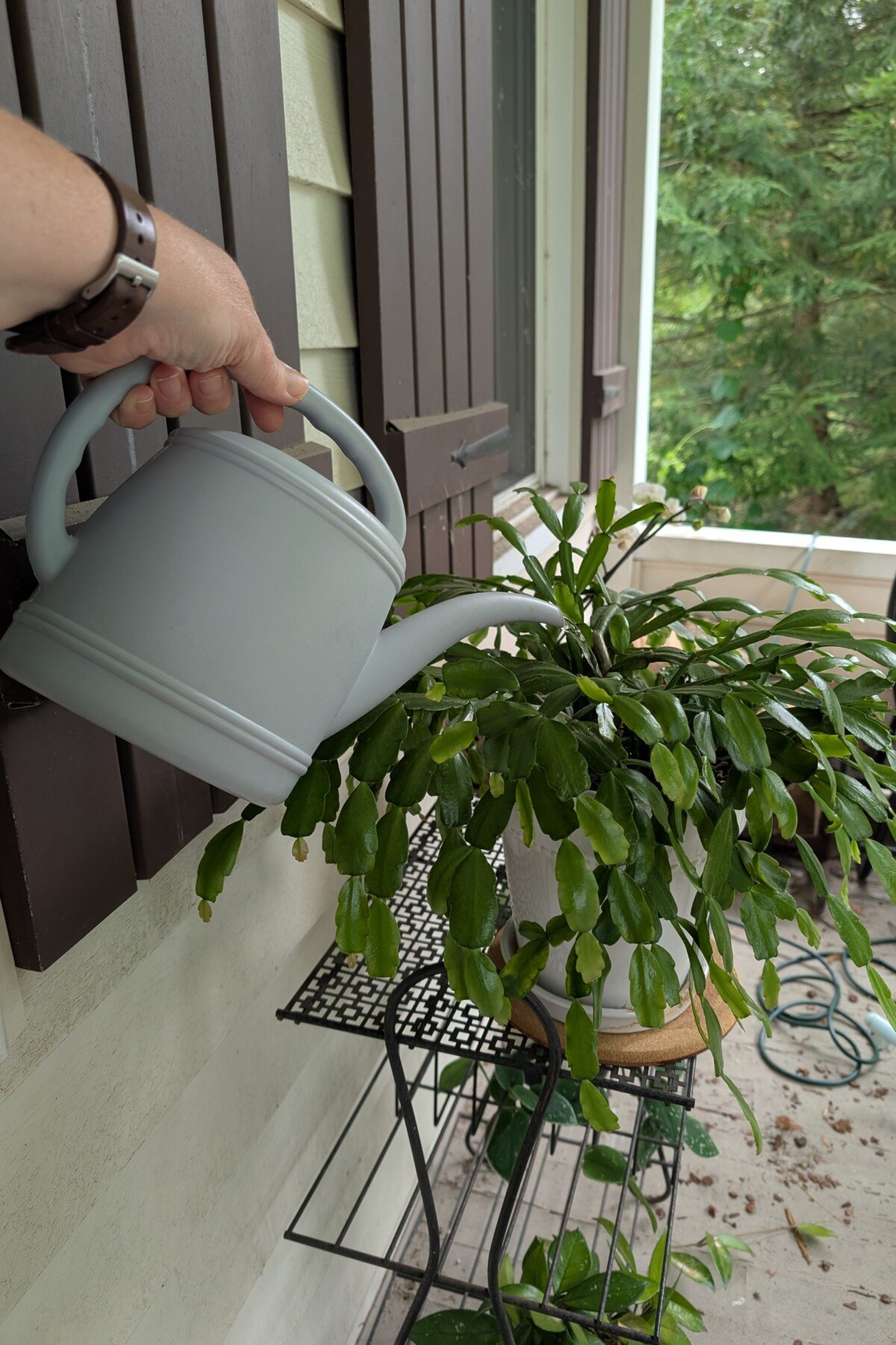
One of the easiest ways to ensure your plant is loaded with blooms for the holidays is to set it up outside during the warmer months of the year. These plants sunburn easily, so you need to be careful, but I’ve spelled out how to transition your holiday cactus to living outdoors for the summer here.
Your plant will spend the summer storing all that energy from the sun, and then later in the fall, it will explode with buds. This is one of the easiest things you can do to ensure your plant blooms each year.
7. Your Living Room Is Probably the Worst Place for a Christmas Cactus
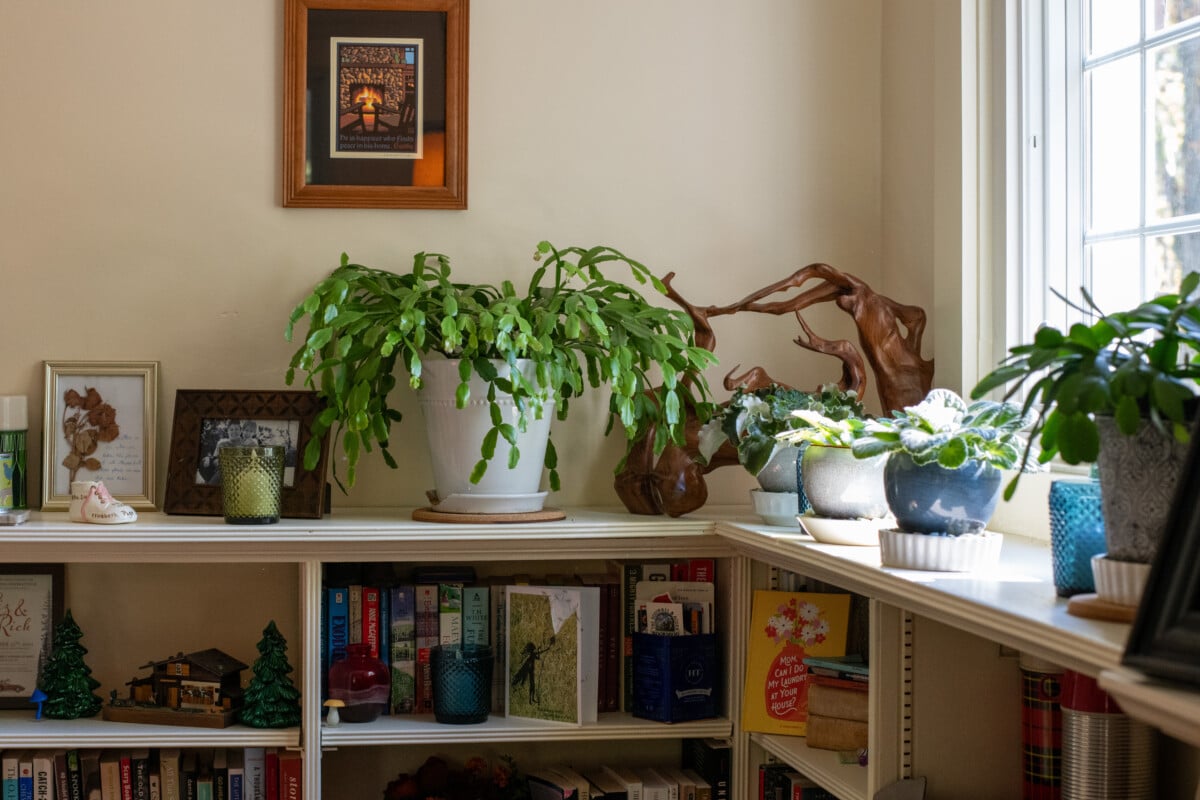
If you’ve read my comprehensive guide on caring for Christmas cactus, then you know that schlumbergera are short-day bloomers. This means that the shortening days and longer, cooler nights that occur in the fall are what trigger schlumbergera to set buds.
These plants require nighttime temperatures of around 50-60 degrees F, total darkness for 12 hours or more per night, and a humid environment to set buds.
I don’t know about you, but that does not describe my living room in the fall. In the weeks leading up to the holidays, my living room is 68 degrees until I go to bed around 10:00 pm. I’m usually watching TV or reading, which means the lights are on, and since the furnace is running, the air is quite dry.
None of this is an ideal environment if you want a blooming schlumbergera.
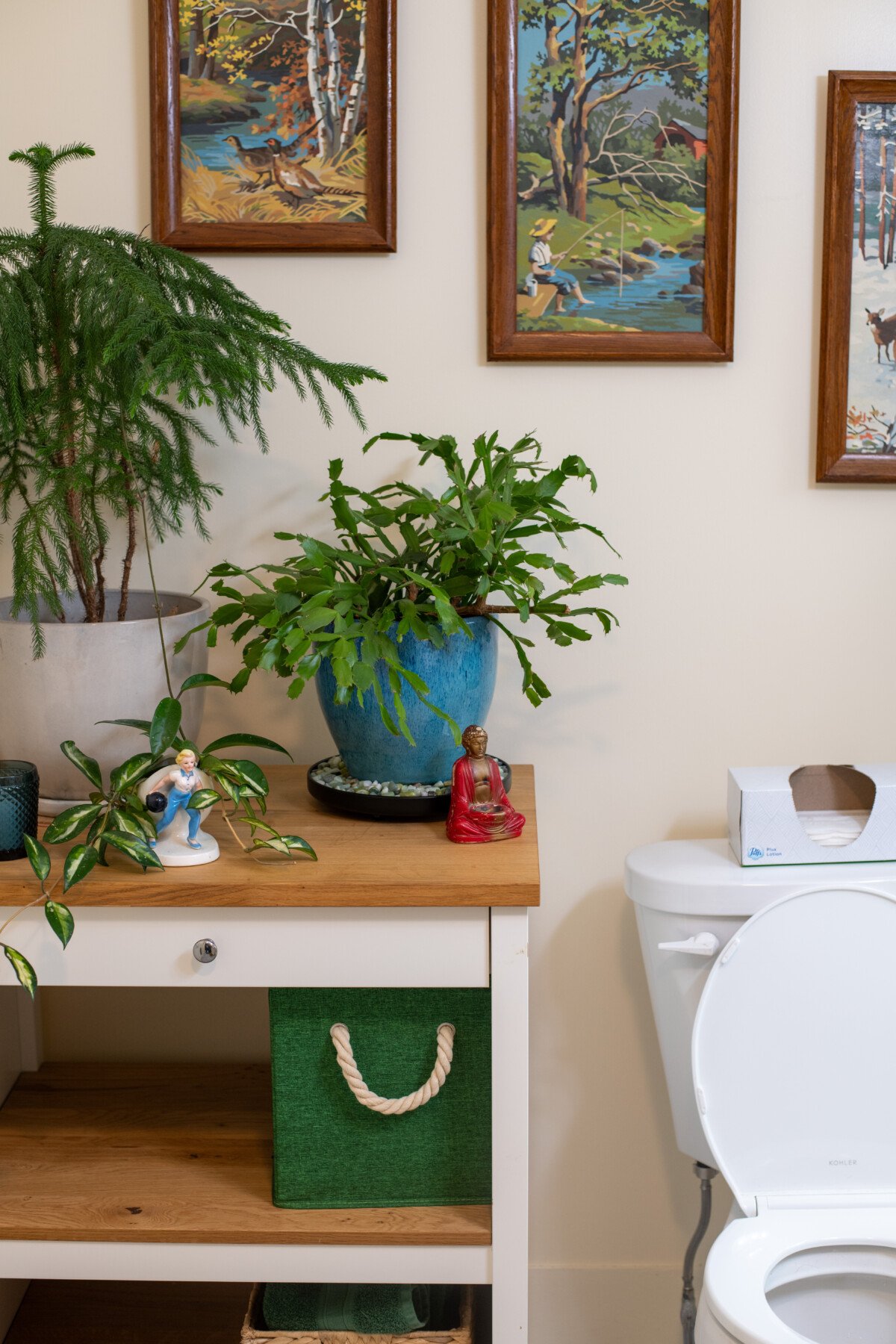
Instead, put your plant in a bathroom or the kitchen. Both rooms have better humidity. If you can’t move your plant, set it up on a pebble tray with water to provide humidity. Cover your plant with dark-colored pillowcases at night to block out light.
8. You Can Get Your Christmas Cactus to Bloom More Than Once a Year
Look, no one likes a show off, but once you’ve figured out how to get your Christmas cactus to bloom reliably every holiday season, you might want to check this out. I walk you through how to reset your plant to bloom again in late winter/early spring. It’s a nice late-winter burst of color.
9. For Tons of Blooms, Stop Fertilizing, Don’t Stop Watering
Like all plants, your holiday cactus needs nutrients to grow and produce blooms. But it needs them during its active growing cycle.
In late winter, as the days begin to lengthen and we’re all starting to climb the walls with cabin fever, your plant will break dormancy and start to grow again. You’ll notice teensy-weensy (yes, that’s the scientific term) cladodes beginning to grow. This is the time to begin fertilizing your plant again.
In the spring and summer, these plants need a balanced fertilizer or one that’s higher in nitrogen.
Throughout the warmer months, your plant will be growing and storing nutrients to produce blooms during the cooler months of the year. In mid-summer, switch to a fertilizer specifically formulated for blooming plants (one that’s higher in phosphorus and potassium and low in nitrogen). I’ve had great luck with Schultz African violet plus plant food.
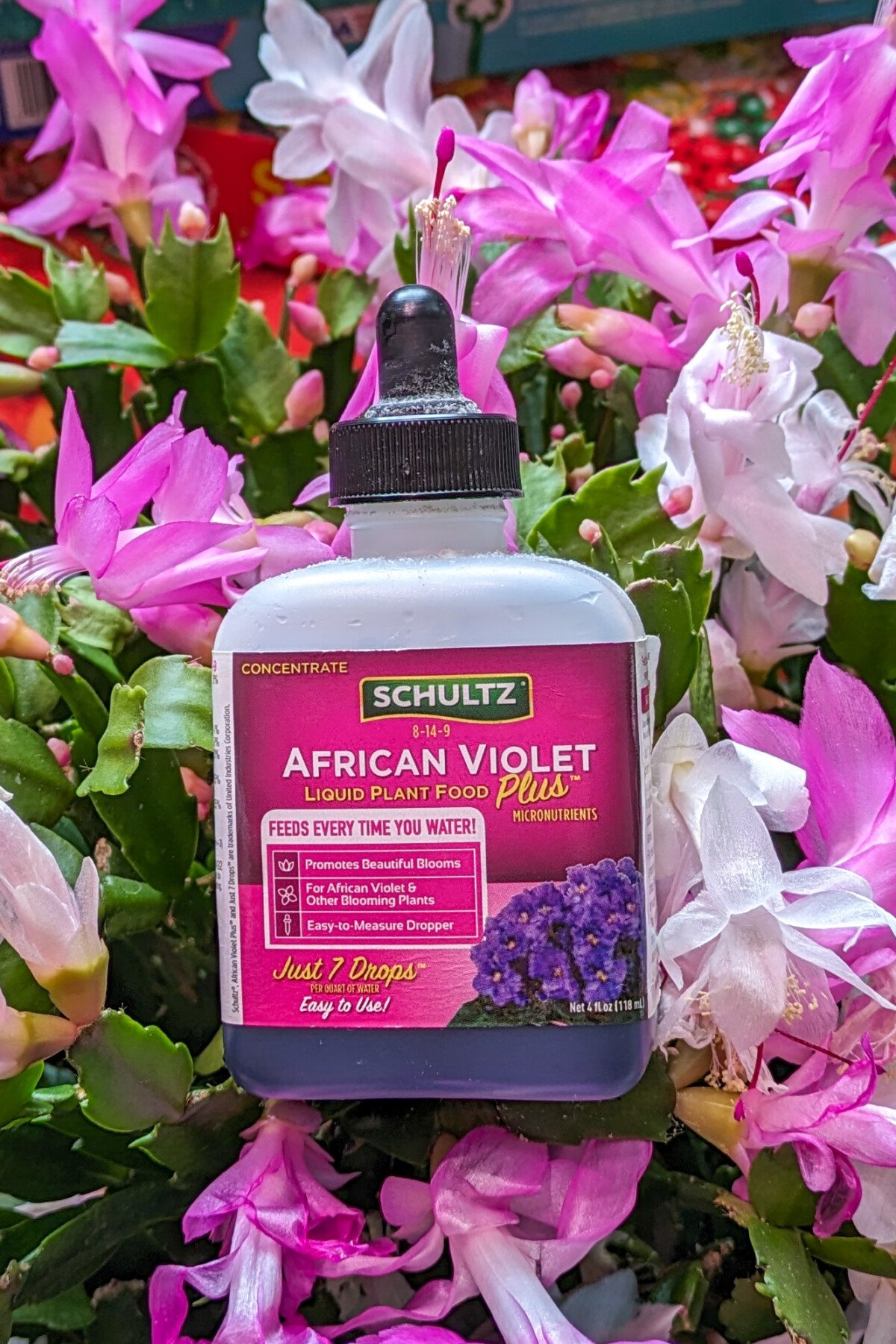
When September rolls around, stop fertilizing altogether, but don’t stop watering.
There used to be a popular notion that you needed to dry the plants out leading up to bud set, but that’s counterintuitive to what the plant needs.
As the plant stops its normal growth cycle, it naturally uses less water; however, you still need to water it so it can produce buds for the holidays. Keep the soil moist but not soggy.
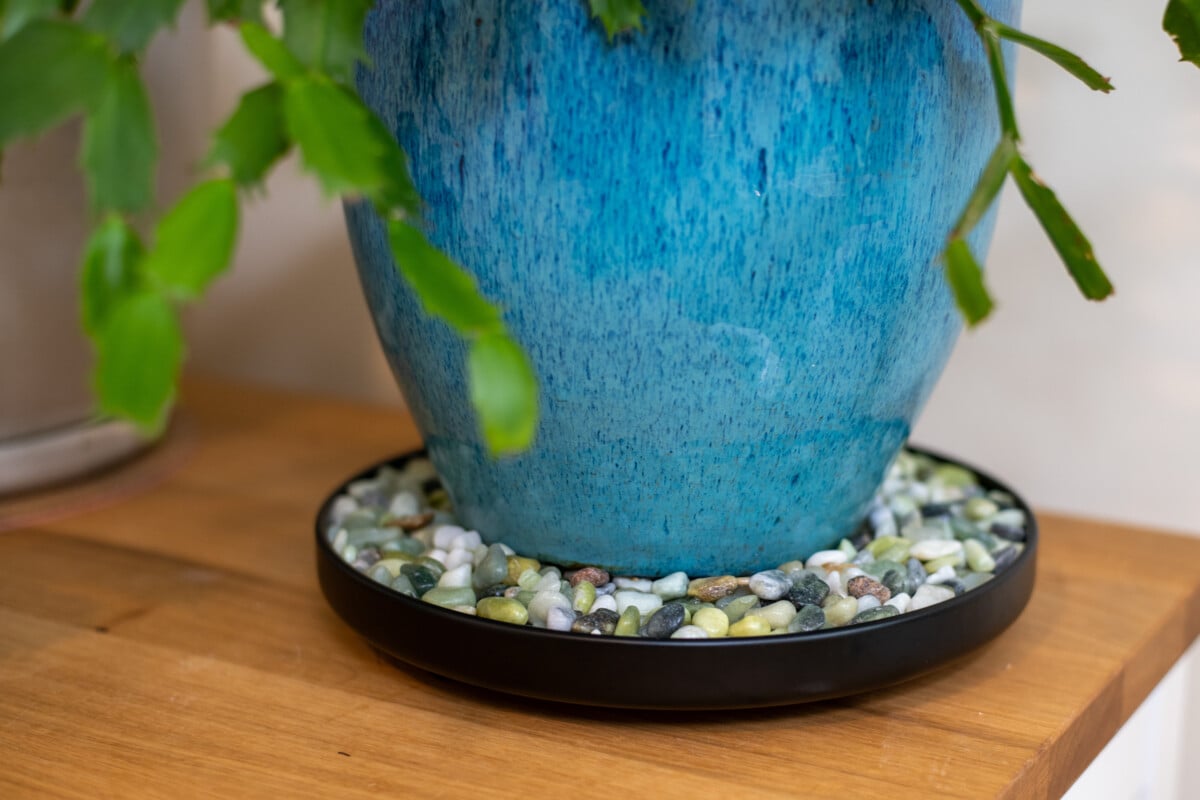
I also set my schlumbergeras on a tray of pebbles. (I love these. They’re a soft green and look lovely.) Excess water drains out of the soil without the plant sitting in a puddle of water on a saucer. I add water to the pebbles to provide the humidity these plants need in our dry homes during the heating months.
So, now that you’ve read up on these plants, you’re going to try to get one to fruit this winter, aren’t you? Yeah, me too.
Get the famous Rural Sprout newsletter delivered to your inbox.
Join the 50,000+ gardeners who get timely gardening tutorials, tips and tasks delivered direct to their inbox.